
Most advice on blogging in 2026 is stuck in the wrong debate. People keep asking whether blogging is dead. Small business owners should ask a harder question instead. Does blogging deserve budget inside a modern marketing mix where you also need reach, speed, and measurable demand?
The answer isn't a clean yes or no. Blogging still works, but it works differently now, and it shouldn't be treated as your entire acquisition strategy. For some businesses, a blog is the right foundation. For others, it's the slower, lower-risk layer beneath channels that can create demand faster.
The 2026 Reality for Small Business Marketing
The scale of the opportunity is easy to miss when marketing advice gets abstract. In the United States, 36,207,130 small businesses make up 99.9% of all businesses, and a 2026 outlook found that 87.8% reported stable or increasing revenue, according to the U.S. Small Business Administration's 2026 small business data. That means millions of owners aren't trying to survive month to month. They're trying to grow, and they need channels that match their cash flow, sales cycle, and local market reality.

That changes how you should think about the question behind "Blogging for Small Business: Is It Still Worth It in 2026?" Blogging isn't just a content tactic. It's an owned media asset. But owned assets usually build more slowly than paid distribution, which is why smart budgeting now looks more like portfolio design than channel loyalty.
Why the old debate misses the real budgeting issue
A local service business, a dentist, a brokerage, and an e-commerce brand don't all need the same mix. Some need booked calls next month. Some need broader awareness in a new region. Some need educational content that lowers friction before a lead ever talks to sales.
Three realities matter:
Small businesses need scalable channels: Growth-oriented firms need marketing they can keep building, not one-off campaigns alone.
Search behavior has shifted: A blog can still create demand capture, but it no longer guarantees attention just because a post exists.
Owned and paid media work differently: A blog compounds. Distribution channels accelerate exposure.
If you're reviewing budget for 2026, don't ask whether blogging still "works." Ask whether it should function as your library, your trust layer, your lead capture engine, or one part of a broader system that also includes channels discussed in social media trends for small business in 2026.
Blogging is still relevant. Treating it as a complete substitute for reach is where small businesses go wrong.
Winning the New Game of SEO and Search
The old blogging playbook was simple. Publish posts, target keywords, wait for traffic. That model is weaker now because search demand is fragmented across AI summaries, zero-click results, local intent, and direct platform discovery. The result is that more content doesn't automatically mean more business.
Recent small-business SEO guidance points to the practical shift: the most useful blog formats are the ones tied to measurable actions, with local relevance, Google Business Profile signals, and tracking for calls and directions alongside clicks, as outlined in this small business SEO guide for 2026.
What kind of blog content still matters
A small business blog now performs best when it supports buying intent instead of chasing broad informational curiosity. That's especially true in local markets.
Useful formats include:
Problem and solution posts: Explain a local customer problem in plain English, then connect that problem to a service page or booking action.
FAQ articles: Answer questions your staff already hears on calls, in emails, or at the counter.
Expectation-setting content: Clarify process, timing, service fit, or what happens next.
Decision support posts: Compare options, explain tradeoffs, and reduce uncertainty before contact.
These formats do two jobs at once. They help search visibility, and they help conversion once someone lands.
Why traffic quality matters more than traffic volume
A lot of small businesses still overvalue pageviews. That's a mistake in a fragmented search environment. If a post attracts people who will never buy locally, the traffic may look healthy while the business gets no closer to revenue.
A better standard is whether the post helps a visitor take an action that matters. For local firms, that often means:
Calling the business
Requesting directions
Booking an appointment
Submitting a lead form
Clicking into a service page
Practical rule: Write blog posts that make your service pages easier to trust, not blog posts that compete with your service pages for attention.
That approach also aligns with local SEO execution. If your team is still thinking about blogging separately from location pages, reviews, maps visibility, and business profile signals, your content strategy is too isolated. For a practical companion to that work, review this guide to local SEO for small business and the map pack.
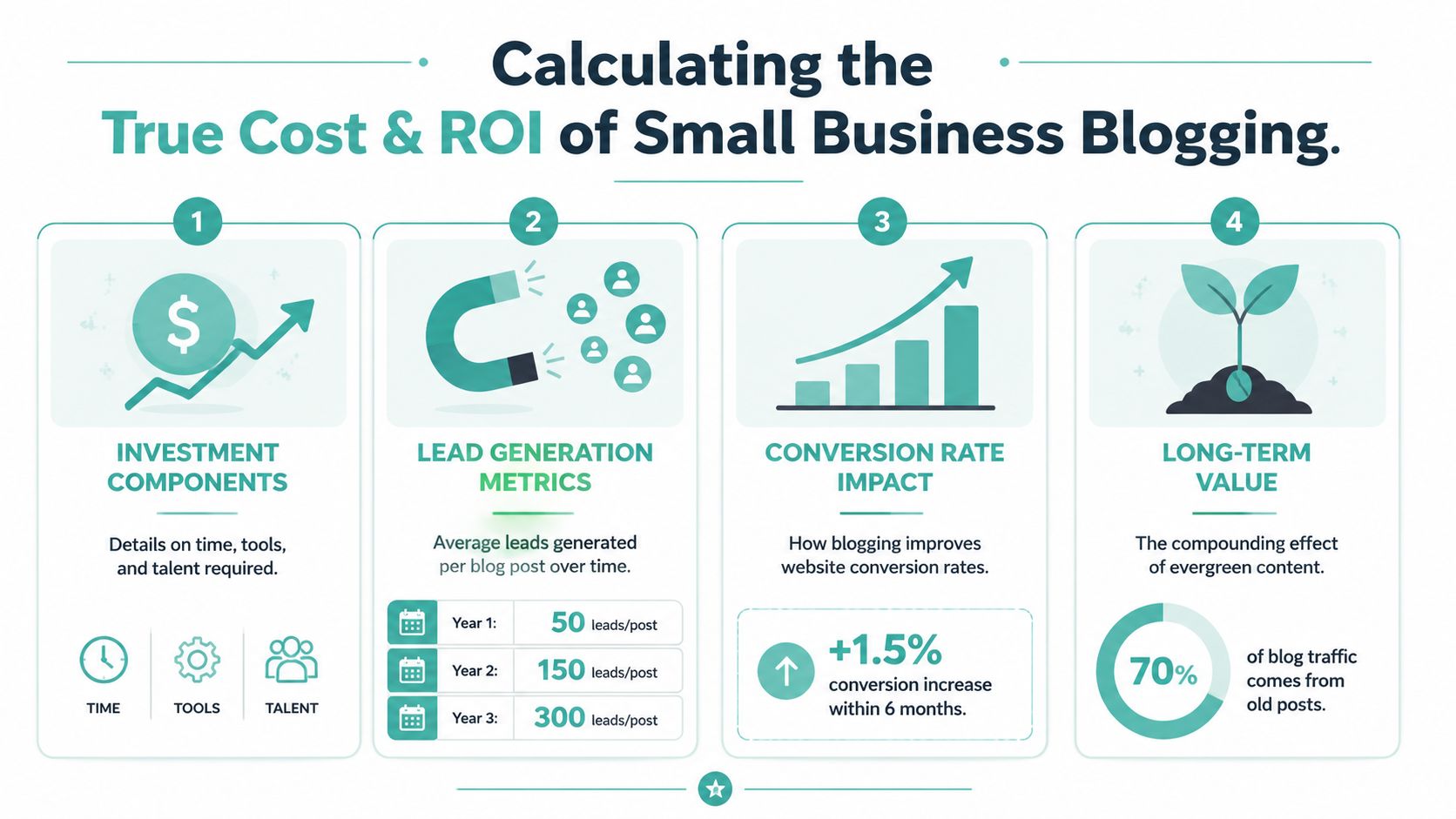
Calculating the True Cost and ROI of Blogging
A blog usually fails on a small business P&L for one reason. Owners price the article, but not the asset.
That accounting mistake matters in 2026 because blogging now sits in a tighter budget mix. Search is less predictable, paid channels are more expensive, and newer reach channels such as programmatic TV can build awareness faster than content ever will. Blogging still earns budget, but only if you evaluate it against the right job: capturing existing demand, improving conversion efficiency, and creating reusable sales assets over time.
HubSpot's marketing research reports strong returns for some website, blog, and SEO programs. Results depend on the topics, audience, and connection to the products or services being sold. (HubSpot's State of Marketing reporting and statistics library)
Blogging is an asset class inside your marketing mix
A post has more in common with a service page enhancement than with a one-time social post. Once published, it can keep attracting qualified searches, answer objections during the sales process, support retargeting audiences, and give your team material for email and follow-up.
That changes the budgeting model.
A useful blog asset usually does four things at once:
It addresses a real buying question.
It moves readers toward a commercial page or conversion action.
It stays relevant long enough to justify refreshes.
It can be reused in other channels, including email, sales collateral, short video, and ad creative.
Small businesses often miss the fourth point. Repurposing is where content economics improve. If one article informs a sales script, a nurture email, and a paid landing page test, the effective production cost drops.
ROI comes from cumulative contribution, not post-level wins
The strongest business case for blogging is durability. Orbit Media's long-running blogger survey documents how blogs are often updated, republished, and improved over time rather than treated as disposable content, which supports the case for measuring return across a content library instead of judging each post in isolation, as detailed in Orbit Media's annual blogging statistics and trends research.
That has a practical implication for budget allocation. A business with 40 underperforming articles may get a better return from pruning, consolidating, and refreshing than from publishing 20 new ones. In other words, content maintenance is often a higher ROI line item than net-new output.
The real cost question
A fair ROI model for blogging has to include more than writing fees. It should include subject matter interviews, editing, optimization, internal linking, design support, refresh cycles, and the opportunity cost of waiting for results. It should also credit the content for assisted conversions, not only last-click leads.
Track blogging spend against these factors:
Production cost: Writing, editing, expert input, upload, and optimization
Distribution value: Use in email, social posts, sales follow-up, and remarketing
Assisted conversion impact: Calls, form fills, bookings, and service-page visits influenced by the content
Refresh efficiency: Whether an existing post can regain usefulness with updates instead of a full rewrite
For a cleaner framework, use a marketing ROI measurement approach tied to business outcomes rather than counting traffic or published posts.
Blogging takes time to attract readers. If few local buyers know your business, compare the cost of more articles with paid social or TV campaigns that introduce it to a wider audience.
Comparing Blogging to Paid Social and TV Advertising
Blogging earns its place through durability. Paid social and TV earn theirs through speed and reach. The mistake is treating them as substitutes when they solve different timing problems.
A small business that needs faster local awareness may not want to wait on search momentum. A business with long sales cycles or education-heavy offers may benefit more from a strong content base. The right budget mix depends on the gap you're trying to close first.
Side by side channel tradeoffs
Blogging and paid social are familiar. Programmatic TV is still overlooked by many SMBs because owners assume TV belongs to national brands with large production budgets. That assumption is outdated.
Where programmatic TV changes the equation
Programmatic TV matters when the business problem is awareness, not just demand capture. If prospects don't know your name yet, a blog won't fix that quickly on its own. TV-style creative can increase familiarity before search even happens.
One platform that fits this shift is Adwave, an AI-powered TV advertising platform that lets small businesses generate a broadcast-ready ad from a website URL, launch across premium channels, set budget limits, and track performance in a single workflow. In practice, that makes TV more usable for local and regional businesses that want broader visibility without a traditional production process.
Blogging helps when buyers are searching. TV helps when you need more buyers to recognize your name before they search.
How to choose between them
Use blogging first when:
Your sales process depends on education
Your category has recurring questions
Your service pages need trust support
You're willing to invest for compounding returns
Use paid social first when:
You need quick testing around offers or audiences
Your creative changes often
Retargeting is central to conversion
Use programmatic TV first when:
You need local brand lift
You want broader exposure in a market
Your business benefits from visual credibility
You need faster awareness than a blog can create alone
If you're weighing these tradeoffs directly, this breakdown of Google Ads vs Facebook Ads vs TV is a helpful comparison point because it frames channels by business objective instead of platform habit.
A Modern Content Strategy That Gets Results
The most efficient small-business content strategy in 2026 doesn't start with publishing frequency. It starts with reuse. If one piece of content can support search, sales, email, and creative development for another channel, the economics improve fast.
Recent guidance has moved toward topic clusters and ongoing refreshes, which shifts the budgeting question from ranking alone to how efficiently one asset can support multiple channels, as discussed in this article on the benefits of blogging for business.
Build around clusters, not isolated posts
A cluster model is simpler than it sounds. Pick a commercial theme that matters to your revenue, then create supporting articles around it.
A local home services company might build around:
Service explanation
Common repair questions
What affects timing
What affects pricing
Maintenance advice
Neighborhood-specific concerns
That structure gives your site internal logic. It also gives your sales team cleaner assets to send after calls.
Working principle: Every article should either attract the right visitor, qualify that visitor, or move that visitor closer to a commercial page.
Turn one article into multiple assets
A single strong post can become far more than a blog entry. That's where the budget argument gets stronger.
For example:
Write a clear article answering a buyer question.
Pull key claims into an email follow-up.
Rework the strongest paragraph into social copy.
Turn the core customer problem into a short video script.
Use the same message as the basis for ad creative.
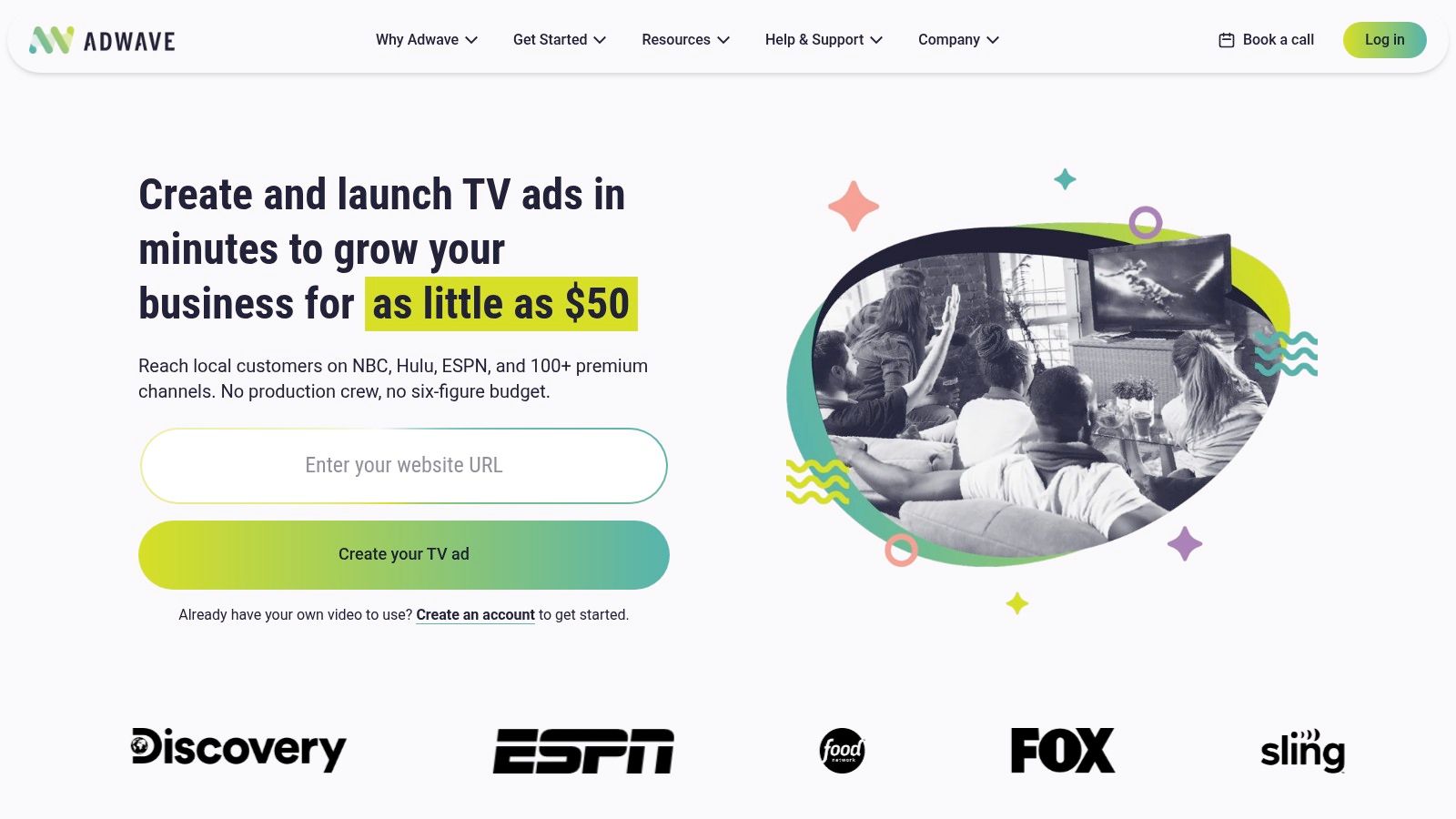
A blog stops being "content marketing" in the narrow sense and starts acting as raw material for the rest of your media mix. A customer case study, local FAQ, or service explainer can become the creative brief for an AI-generated TV ad just as easily as it can become a search asset.
A practical workflow for a small team
If you don't have a dedicated content department, use a repeatable system:
Choose revenue-linked themes: Start with services, product categories, or recurring customer objections.
Map questions by intent: Separate early education from decision-stage concerns.
Create one strong core asset: Make it specific, readable, and linked to an action.
Refresh on a schedule: Update facts, examples, and internal links instead of always starting from zero.
Repurpose before publishing net-new work: Extract more value from what already exists.
If you need a planning tool before building that system, the business strategy content canvas from The Business Model Analyst is a useful framework for matching content themes to business goals, audience needs, and channel use.
Measuring KPIs That Drive Business Growth
The easiest way to overvalue a blog is to measure what it makes visible instead of what it makes possible.
Traffic, impressions, and time on page can help diagnose content performance, but they are weak budget metrics on their own. A small business deciding between another article, more paid social spend, or a local programmatic TV test needs evidence that content is influencing revenue, not just attracting attention.
Blogging often works through assisted behavior. Someone reads a service explainer, leaves, sees your brand later in a paid social ad or an Adwave TV campaign, searches your company name, then books from a commercial page. If your reporting only credits the last click, the blog looks less useful than it is. If your reporting stops at pageviews, it can look more useful than it is. Both errors lead to bad budget decisions.
The KPIs that matter more than raw traffic
Track outcomes that connect content to pipeline and sales activity:
Qualified form submissions: Which posts attract prospects in your service area or target customer profile?
Phone calls from content pathways: Which articles lead readers into call actions, even if the call happens on a later visit?
Appointment or consultation bookings: Which topics reduce enough friction to trigger outreach?
Branded search lift: Are more people searching for your business after awareness campaigns run?
Service page assists: Which posts regularly send visitors into high-intent pages?
One pattern matters more than viral reach. Content should move readers toward a commercial step.
How to connect content to business outcomes
Use a measurement model that is simple enough to maintain every month:
Tag commercial clicks: Track movement from blog posts to service pages, booking pages, forms, and click-to-call buttons.
Review lead quality by landing page: Some posts bring students, competitors, or out-of-market readers. Others bring buyers.
Track assisted conversions: Give credit to articles that start or support the journey, not just the final converting page.
Compare topics by revenue influence: A content theme can outperform a single high-traffic post if it consistently supports deals.
A post with modest traffic and frequent bookings deserves more budget than a post with heavy traffic and no sales impact.
This measurement discipline also clarifies channel roles. Blogging usually captures and nurtures intent. Paid social can retarget that interest. Programmatic TV can increase direct traffic, branded search, and name recognition before a prospect ever visits the site. Once you see those interactions in reporting, the budget question changes. It stops being "is blogging working?" and becomes "which mix of content and distribution produces the lowest cost to generate qualified demand?"
The Final Verdict For Your Small Business
Yes, blogging is still worth it in 2026. But the reasons often cited are incomplete.
It's worth it when you treat it as an owned, compounding asset. It's worth it when you write for local intent, measurable actions, and commercial relevance. It's worth it when your content library supports service pages, trust, lead capture, and follow-up across channels.
It's less compelling when you expect it to replace demand creation on its own. A blog can capture and nurture interest. It usually won't build broad awareness quickly, especially in competitive local markets where buyers choose familiar names.
The budget decision most owners should make
If your business needs long-term efficiency, trust-building, and searchable expertise, keep blogging in the mix. If your business also needs faster recognition, broader local reach, or visual brand exposure, pair that content foundation with a channel built for awareness.
Blogging can answer questions people search for. TV can introduce the business to people who have yet to search for it.
The strongest 2026 plan for many SMBs isn't blog or TV. It's blog plus distribution, with each channel doing the job it's naturally suited to do.
If you want faster local awareness to complement your content strategy, Adwave gives small businesses a way to create, launch, and measure TV advertising from a simplified platform without relying on a traditional production process.


