-
19.9%
Broadcast TV's share of U.S. TV viewing (April 2026, first sub-20% reading)
-
41.5%
Broadcast and cable combined, now below streaming (April 2026)
-
$50
Minimum to start advertising on connected TV with Adwave
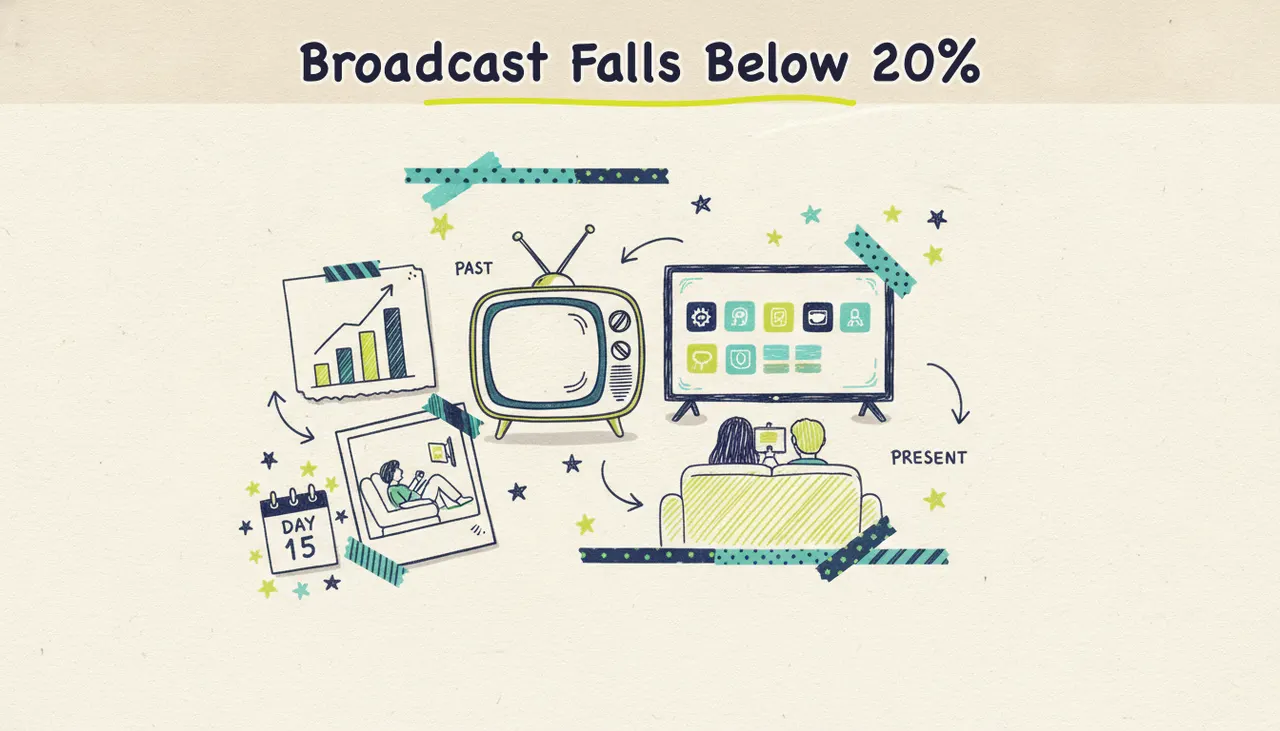
Broadcast television, the free over-the-air networks like CBS, NBC, ABC, and Fox, accounted for just 19.9% of U.S. TV viewing in April 2026, according to Nielsen's The Gauge. That's the first time broadcast has fallen below 20%, and it makes broadcast the smallest of the three traditional viewing categories, now behind cable and far behind streaming.
For a local business, this is a quiet but important milestone. Broadcast was where local advertising lived for generations: the evening news, the local affiliate, the community reach. That audience is still there, but it's shrinking, and it's moving to the same connected TVs where advertising is now open to any budget. Let's break down broadcast's Q2 2026 share, what still holds it up, and what the decline means for where local ad dollars work hardest.
What the data shows
Nielsen's The Gauge measures how Americans split their television time across broadcast, cable, streaming, and other uses. In the April 2026 report, released June 25, 2026, broadcast came in at 19.9%, the first sub-20% reading trade outlets have recorded in the Gauge's history.
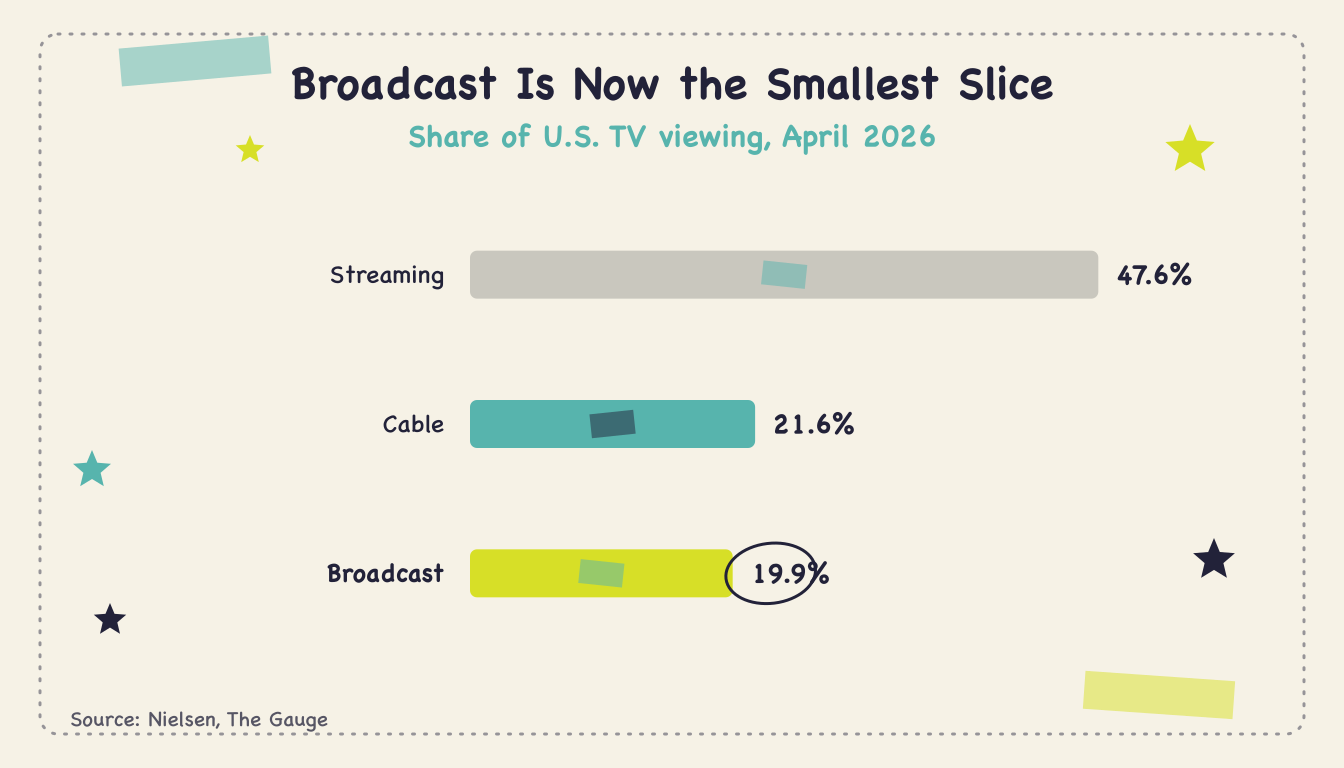
Here's how U.S. TV viewing split in April 2026:
Streaming: 47.6% (a record high)
Cable: 21.6%
Broadcast: 19.9% (below 20% for the first time)
Other (gaming, physical media, unmeasured tuning): 10.9%
The ordering itself tells a story. For most of TV history, broadcast networks were the giants and everything else orbited them. Now broadcast sits at the bottom of the three main categories, smaller than cable and less than half the size of streaming. Broadcast and cable combined, the whole of traditional linear television, add up to 41.5%, which is less than streaming pulls on its own. The cable versus streaming split tells the same story from the cable side.
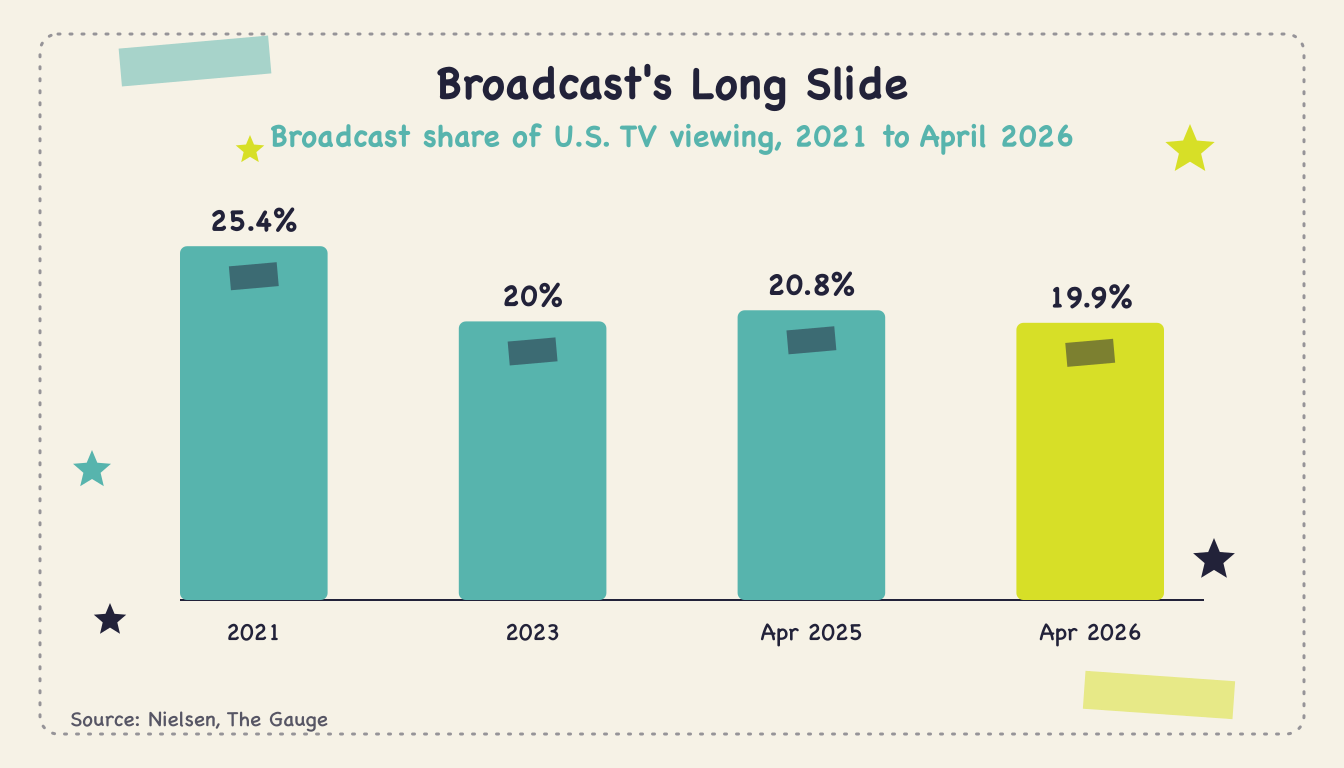
One thing worth stating clearly: broadcast's decline is real but gradual, and it's held up better than cable. Broadcast has shed roughly five and a half points since Nielsen started The Gauge in 2021, when it sat above 25%. Cable lost more than twice that over a comparable stretch. Live sports and local news have kept broadcast more durable than the cable bundle, even as the long-term direction points down.
A timing note: April is the last month Nielsen has fully reported as of late July 2026. Nielsen delayed its March Gauge amid a dispute over new measurement methodology, and the recalibrated version isn't expected until the fall. that recalibration is expected to nudge broadcast and cable shares up slightly, so 19.9% may be revised upward once the new methodology lands. Every figure here reflects data through April 2026.
How Nielsen measures this, and why April is the latest number
Broadcast's 19.9% comes from Nielsen's national panel, the same measurement behind its TV ratings, which tracks actual viewing on television sets across a representative sample of U.S. households. The Gauge divides that total into broadcast, cable, streaming, and other, measured the same way each month, so changes reflect real shifts in viewing rather than changes in method.
This year the reporting calendar got complicated, and it matters for how you read the broadcast number:
April 2026 is the latest confirmed month. Treat 19.9% as broadcast's current reading, not a stand-in for May or June, which Nielsen hasn't published.
A methodology reset is coming in the fall. Nielsen delayed its March Gauge and is moving to recalibrated universe estimates expected around the start of the fall season. That change is projected to lift broadcast and cable and trim streaming, so broadcast's reported share could tick up when the new numbers arrive, even without a real change in viewing.
Seasonality is built in. Broadcast swings with the sports calendar. It peaked near 21.7% in February on the Super Bowl and Winter Olympics, then fell to 19.9% by April once the NFL season ended. Read the trend across the year, not any single month.
The headline still holds: broadcast is the smallest of the three traditional categories, and its long-term direction is down, even if a fall methodology change softens the exact figure.
Breaking down the numbers
Broadcast's share isn't a steady line, it's a seasonal wave, and understanding the wave explains both the April low and why broadcast isn't going away quietly.
Here's how broadcast tracked across the reported months of 2026:
January 2026: 21.5%, with NFL football driving about 30% of all broadcast viewing
February 2026: 21.7%, lifted by Super Bowl LX and the Winter Olympics
April 2026: 19.9%, after the NFL season ended and sports fell to about 12% of broadcast
That swing tells you exactly what props broadcast up. When the NFL is on, broadcast surges. When football ends, it sinks. In April, with no NFL, dramas carried the category, shows like Tracker and Marshals on CBS and High Potential on ABC, and the Masters final round on CBS was the single most-watched broadcast telecast. Live sports and live events are broadcast's anchor, which is why our live sports share of TV viewing breakdown matters for understanding linear TV's staying power.
Year over year, broadcast slipped from 20.8% in April 2025 to 19.9% in April 2026, a decline of about 0.9 points. That's a gentler fall than cable's 2.9-point drop over the same year, but it's part of a longer slide: broadcast has moved from above 25% in 2021 to under 20% now. The audience that remains is real and valuable, especially for live sports and local news, but it's a smaller slice of a TV day that streaming increasingly owns.
It's worth putting the pace in context. Broadcast crossing below 20% isn't a sudden collapse, it's the latest step in a decline that has been steady and predictable for years. Each fall, the NFL and new season premieres lift broadcast back up; each spring and summer, it settles lower than the year before. Layer those annual waves on top of one another and the trend is unmistakable: the peaks are getting lower and the troughs are getting deeper. April's 19.9% is simply a trough that finally dipped under a round number, and the fall recovery will very likely start from a lower base than last year's.
The question for a local business isn't whether broadcast still has viewers. It does. The question is whether broadcast advertising is still the best way to reach them, and that answer has changed.
Why it matters for your business
Broadcast was the original home of local advertising. The local affiliate, the evening news, the community reach that a small business could tap without going national. That model isn't dead, but it's shrinking, and the economics have shifted decisively toward connected TV.
Here's what broadcast's decline means practically for a local advertiser:
The reach is fragmenting. Broadcast still delivers a real audience, especially for live news and sports, but at under 20% of viewing and falling, it reaches a smaller share of your local market than it used to. Reaching the rest means following viewers to streaming.
The economics favor connected TV. Local broadcast ad buys come with rate cards, sales reps, and limited targeting. Connected TV advertising is self-serve, targetable by geography and household, and open at budgets broadcast never accommodated.
Measurement is a different world. A broadcast spot is hard to tie to results. Connected TV campaigns connect to website visits, branded search, and foot traffic, which matters when every dollar has to prove itself.
None of this means broadcast is worthless for advertisers. If your customers are devoted local-news viewers or live-sports fans, broadcast still reaches them. But for most local businesses deciding where new dollars go, the combination of a shrinking broadcast audience and a growing, more affordable, more measurable streaming option points in one direction. The difference between CTV and linear TV is ultimately about who can afford to advertise and how well they can measure it.
How to take advantage
Broadcast's decline is really an opportunity in disguise: the audience is moving to a screen where advertising is cheaper, more targeted, and open to any budget. Here's how a small business acts on the shift.
Follow the viewers to streaming. If you've run local broadcast spots, the same audience is increasingly reachable on connected TV, at lower cost and with sharper targeting.
Target your service area. Set a geographic radius, usually 15 to 25 miles, so every impression lands on a potential customer instead of a wider media market you're paying to reach.
Budget for frequency. Plan enough spend to reach the same households several times over two to three weeks. On connected TV, meaningful frequency costs hundreds of dollars, not the thousands broadcast buys often required.
Let AI handle the creative. You don't need a production crew or an agency. AI tools turn your existing website into a broadcast-quality 30-second ad in about two minutes.
Measure brand lift. Track branded search, direct traffic, and calls during and after a campaign rather than chasing clicks, since TV builds demand you capture elsewhere.
The mechanics are simple. With Adwave, ad creation is free, a campaign starts at a $50 minimum, and you can be live across 100+ premium streaming channels in under 10 minutes. You point it at your website, it builds the spot, and you're reaching the audience that used to be broadcast's on the screen that's replacing it. For how streaming ad costs compare to a local TV ad cost, our breakdown lays out the numbers.
The bigger picture
Broadcast's dip below 20% is one marker in a long migration, and the ad-dollar side of that story is moving in the same direction as the viewing.
A few forces give the April 2026 number its weight:
Linear ad spend is following linear viewing down. National linear TV ad spending is projected to fall by double digits in 2026, while connected TV keeps growing at double-digit rates, per eMarketer forecasts. Advertisers are moving their money because the audience already moved.
Local CTV is the growth segment. Even in local advertising, broadcast's home turf, connected TV is the part that's expanding, growing roughly 9% in 2026 while local broadcast spend edges down. The connected TV advertising market is where the local ad growth now lives.
Streaming owns the TV day. Broadcast's 19.9% sits inside a picture where streaming took a record 47.6% of viewing and traditional linear, broadcast plus cable, fell to 41.5% combined. The cord-cutting trend that hollowed out cable is now reshaping broadcast's place too.
For small businesses, the throughline is that the accessible advertising screen and the popular screen have converged on streaming. Broadcast gave local businesses their first taste of TV advertising decades ago. Connected TV is finishing the job broadcast started, reaching a local audience on the biggest screen in the house, at a price a corner shop can afford.
Where broadcast still wins
It would be a mistake to write broadcast off entirely. It's declining, but it holds real strengths that keep it relevant for specific audiences, and a smart advertiser knows where those pockets are.
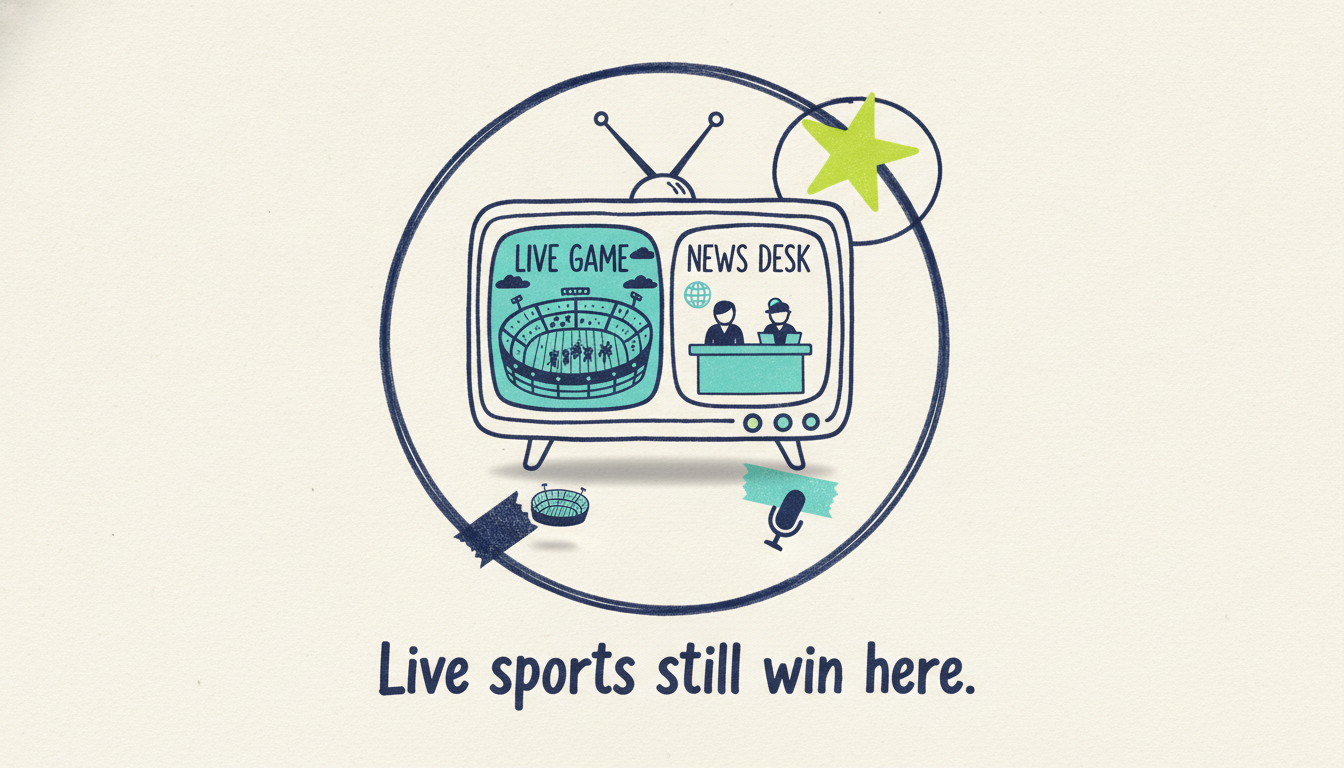
Live sports. This is broadcast's fortress. NFL football alone drove roughly 30% of broadcast viewing in January 2026, and no other format reliably pulls audiences that size at once. If your customers are avid sports fans, broadcast still reaches them in the moment.
Local and national news. Live news remains a broadcast strength, especially among older viewers and during major events. Local affiliates still command loyal news audiences that streaming hasn't fully replicated.
Big cultural events. The Super Bowl, the Olympics, awards shows, and season finales create broadcast surges that streaming can't match on a single night. February 2026's jump to 21.7% came from exactly these events.
Simplicity and free access. Broadcast is free over the air and requires no subscription or connected device, which keeps it accessible to households that haven't gone all-in on streaming.
Here's the balanced read: broadcast is a shrinking but not vanishing channel, strongest in live sports, news, and marquee events. For most local businesses, that means the bulk of a TV budget belongs on connected TV, where the audience is larger and the targeting is sharper, with broadcast worth considering only if your specific customers cluster around live sports or local news. The 19.9% share tells you where the weight has shifted, and for the average small business, it has shifted decisively toward streaming.
What experts are saying
Nielsen's framing has been measured: broadcast is declining but resilient, propped up by the live sports and events that streaming still struggles to fully replace. The company's monthly Gauge commentary consistently ties broadcast's swings to the sports calendar, and April's drop to 19.9% came precisely because the NFL season had ended and dramas, not sports, carried the category.
Analysts covering the ad market read the broadcast decline through the money. eMarketer has documented linear TV ad spending falling as viewer attention shifts, with the majority of marketers planning to increase connected TV budgets. The consensus isn't that broadcast disappears, live sports and local news will keep it relevant for years, but that its share of both viewing and ad dollars keeps eroding while CTV captures the growth. For local advertisers specifically, the takeaway is that broadcast still reaches a real audience, but connected TV reaches more of it, more affordably, and with better proof of results. That's the calculation more small businesses are making every quarter.
What the numbers don't tell you
Broadcast's sub-20% headline is striking, but a few caveats keep it in perspective.
Broadcast still owns live moments. The NFL, big events, and breaking news pull broadcast audiences that streaming can't reliably match. In fall and winter, broadcast's share climbs. Read 19.9% as a spring low, not a permanent ceiling.
The fall recalibration may raise the number. Nielsen's coming methodology change is expected to lift broadcast and cable. So 19.9% could be revised upward later in 2026, which wouldn't reverse the trend but would soften the figure.
Local broadcast still matters for local news. If your customers are loyal local-news viewers, broadcast reaches them in a way few channels do. The decline is real, but broadcast isn't irrelevant for every audience.
Share isn't your customer. Broadcast's percentage is a national average. Your specific audience might over-index or under-index on it, which is exactly why targeted connected TV, aimed at your service area, tends to work better than a broad broadcast buy.
Read the 19.9% as a direction: broadcast is shrinking, its audience is migrating to streaming, and the advertising economics have followed. That's what should shape where your budget points.
Common questions answered
What percentage of TV is broadcast in 2026? Broadcast television held 19.9% of U.S. TV viewing in April 2026, per Nielsen's The Gauge, the first time it has fallen below 20%. That makes broadcast the smallest of the three traditional categories, behind cable at 21.6% and far behind streaming at 47.6%.
Why is broadcast TV declining? Viewers are shifting to streaming, which took a record 47.6% of TV viewing in April 2026. Broadcast has slid from above 25% in 2021 to under 20% now. It still holds up better than cable, thanks to live sports and local news, but the long-term direction is down as audiences move to on-demand streaming.
Is broadcast TV still worth advertising on? It can be, for the right audience. Broadcast still reaches live-sports fans and local-news viewers effectively. But for most local businesses, connected TV now reaches more of the audience at lower cost, with sharper targeting and better measurement. The economics increasingly favor streaming for small-business budgets.
What keeps broadcast TV viewership up? Live sports, especially the NFL, and live news and events. In January 2026, NFL games drove about 30% of broadcast viewing. When football ends, as it had by April, broadcast's share drops and scripted dramas carry the category. Big events like the Super Bowl and Olympics create temporary broadcast surges.
How much does it cost to advertise on streaming versus broadcast? Streaming is generally more accessible for small budgets. The average CTV CPM runs roughly $15 to $35, and with Adwave a campaign starts at a $50 minimum with free ad creation, reaching premium living-room audiences without the rate cards and minimums that came with broadcast buys.
The numbers at a glance
Key figures behind broadcast's Q2 2026 standing, with sources:
19.9%: Broadcast's share of U.S. TV viewing, April 2026, a first-ever sub-20% reading (Nielsen, The Gauge)
21.6%: Cable's share, now ahead of broadcast (Nielsen, The Gauge)
47.6%: Streaming's share, a record (Nielsen, The Gauge)
41.5%: Broadcast and cable combined, below streaming (Nielsen, The Gauge)
-0.9 pts: Broadcast's year-over-year change, April 2025 to April 2026 (Nielsen)
~25.4% to 19.9%: Broadcast's decline from the Gauge's 2021 debut to April 2026 (Nielsen)
~30% vs 12%: Sports share of broadcast viewing in January vs April 2026 (Nielsen)
Down double digits: Projected 2026 national linear TV ad spend decline (eMarketer forecast)
Reach the audience broadcast is losing, from $50
Broadcast fell below 20% of U.S. TV viewing for the first time in April 2026, its audience steadily migrating to streaming. The good news for small businesses is that the screen that's winning is also the one that's finally affordable and targetable.
You don't need a broadcast budget to reach TV viewers anymore. See how Adwave works to turn your website into a broadcast-quality 30-second ad in minutes, or check pricing to launch a connected TV campaign from a $50 minimum. The audience moved. It's a good time to move your budget with it.