-
80.7M
U.S. non-pay-TV households in 2026, now outnumbering pay-TV homes (eMarketer)
-
~42%
Share of U.S. households still on traditional pay-TV, down from ~88% in 2010 (eMarketer)
-
$50
Minimum to start advertising on connected TV with Adwave
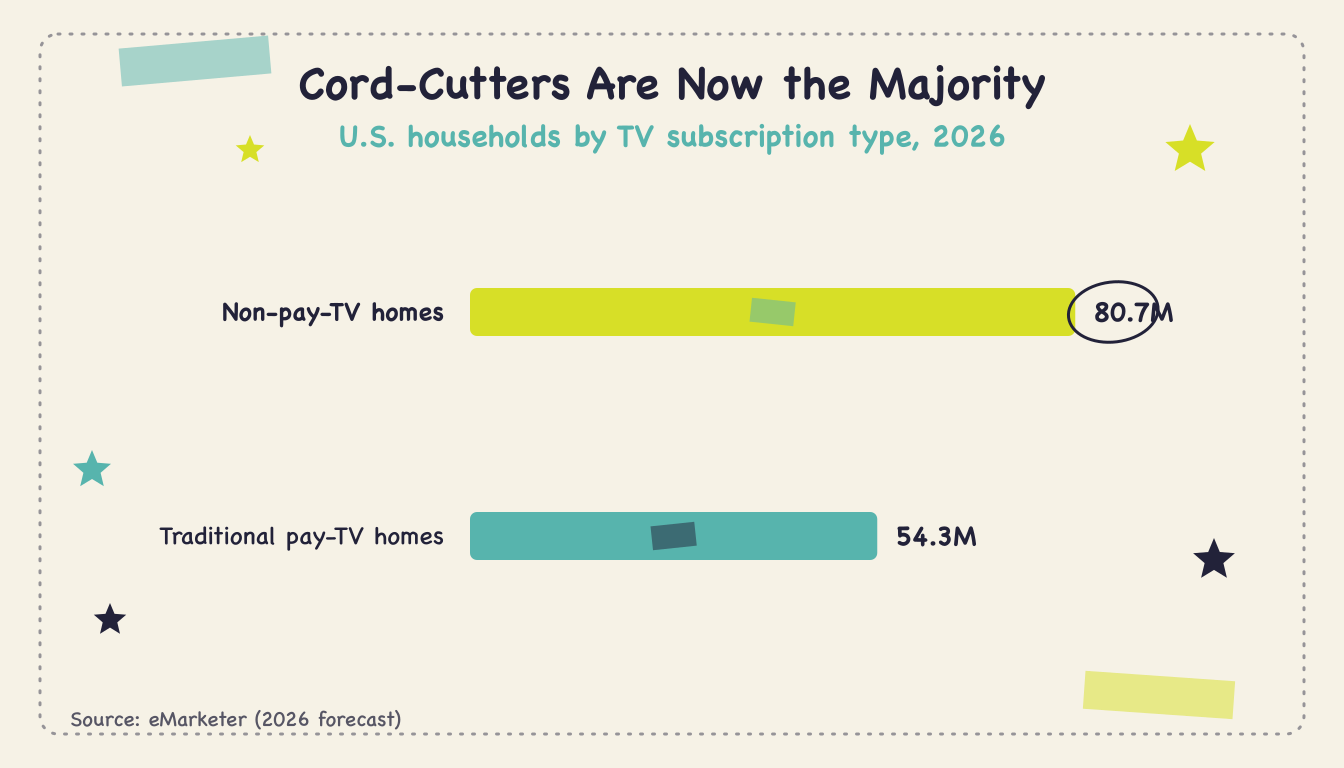
More U.S. households now live without traditional pay-TV than with it. In 2026, an estimated 80.7 million American households have cut the cord or never had cable, outnumbering the households that still pay for it by more than 25 million, according to eMarketer. Traditional pay-TV penetration has fallen to around 42% of households, down from about 88% in 2010.
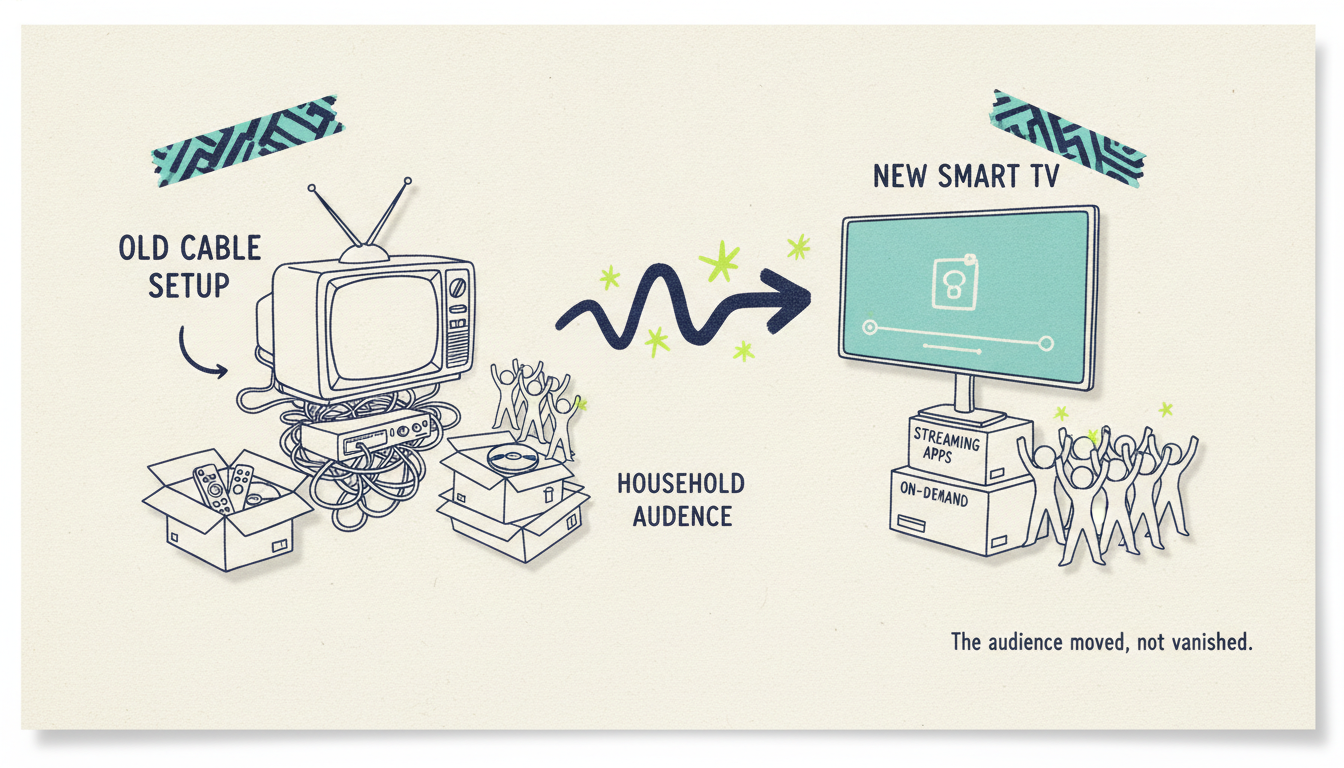
For a small business, cord-cutting isn't just a media-industry trend, it's a map of where your customers went. The audience didn't stop watching television. It moved to streaming, onto the same connected TVs where advertising is now open to any budget. The cable subscribers local advertisers used to reach are still watching, just on a different kind of TV. Let's break down the Q2 2026 cord-cutting numbers, where those viewers went, and what it means for reaching them.
What the data shows
Cord-cutting describes households dropping traditional pay-TV, meaning cable, satellite, and telco TV subscriptions, usually in favor of streaming. After more than a decade of steady decline, 2026 marks the point where cord-cutters and cord-nevers are firmly the majority.
Here are the headline cord-cutting figures for 2026:
80.7 million: U.S. households without traditional pay-TV, per eMarketer
~42%: share of households still subscribing to traditional pay-TV, down from about 88% in 2010
~48 million: households still on traditional pay-TV, per Leichtman Research Group's tracked providers
25 million+: the margin by which non-pay-TV households now exceed pay-TV households
A quick note on the numbers, because you'll see different pay-TV counts cited. Leichtman Research Group tracks subscribers at major providers and lands around 48 million traditional pay-TV households. eMarketer estimates total households a bit differently and projects traditional pay-TV falling toward 54 million by the end of 2026. The exact count depends on methodology, but every measure points the same way: traditional pay-TV keeps shrinking, and the households leaving it aren't coming back.
That decline is the flip side of a shift we track across our stat snapshots, where streaming took a record 47.6% of U.S. TV viewing in April 2026. Cord-cutting is what turns a viewing trend into a permanent one: when people cancel cable, the change sticks.
Breaking down the numbers
The pace of cord-cutting is easy to underestimate because it happens one household at a time. Zoom out, and the decline is dramatic. Pay-TV penetration has fallen from near-universal to a minority of homes in about fifteen years.
Here's the trajectory of traditional pay-TV penetration:
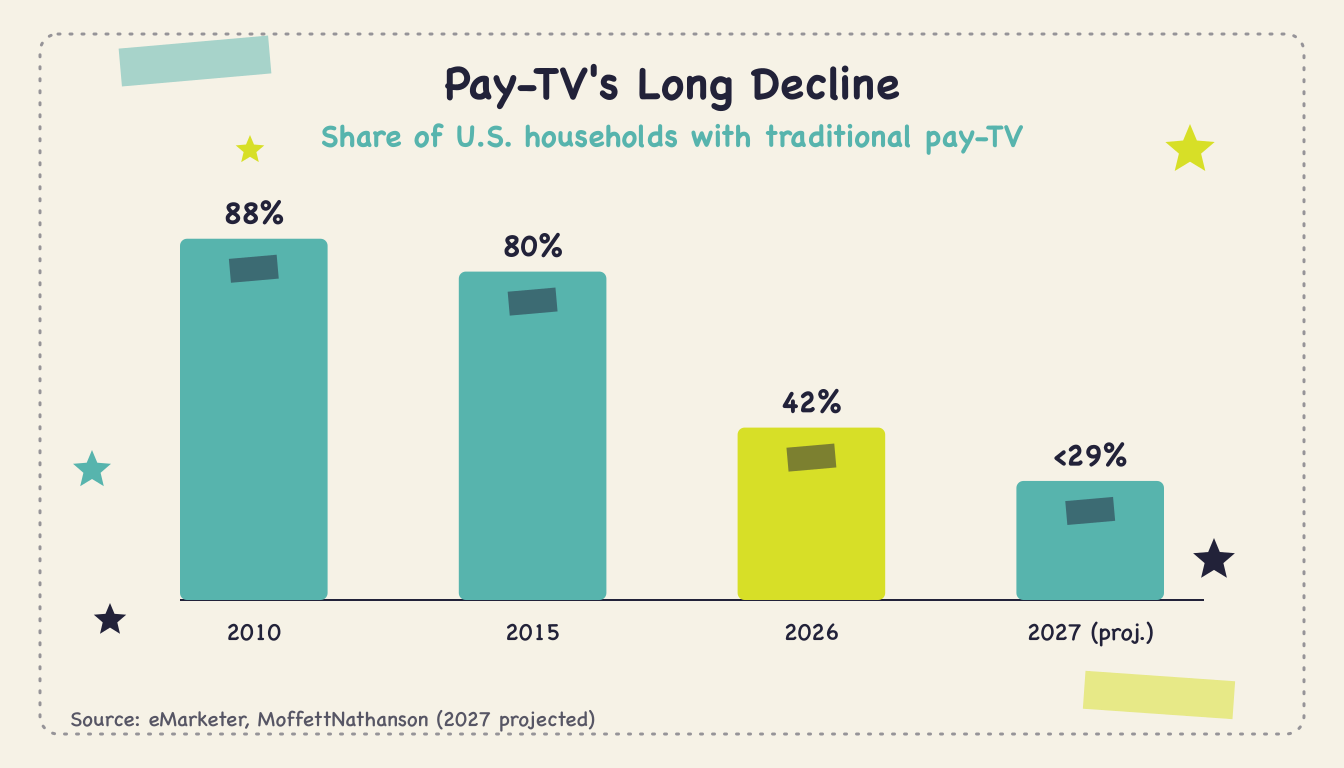
2010: about 88% of U.S. households
2026: about 42% of U.S. households
2027 (projected): below 30% of households, per eMarketer and MoffettNathanson forecasts
The losses are still mounting. U.S. pay-TV providers shed roughly 2 million subscribers in the first quarter of 2026 alone, according to MoffettNathanson, continuing a slide that has run about 5 million subscribers a year in recent years. Our cord-cutting trend breakdown tracks the momentum in detail.
There was one notable blip worth understanding. In the third quarter of 2025, U.S. pay-TV added about 303,000 subscribers, its first quarterly gain in eight years. But the gain wasn't a cable comeback. It came entirely from virtual providers like YouTube TV, which stream live TV over the internet, offsetting continued losses at traditional cable and satellite. In other words, even the rare growth in pay-TV is really the audience moving to streaming, just a live-TV flavor of it. The cable versus streaming split shows the same migration from the viewing side.
What makes these numbers so striking is how quickly the crossover happened. For most of television history, having pay-TV was simply what a household did, as routine as having a phone line. As recently as 2015, roughly 80% of homes still paid for cable or satellite. In about a decade, that near-universal norm flipped into a minority behavior, with non-pay-TV homes now the majority and the gap widening every quarter. Few consumer shifts of this scale move this fast, and it's worth sitting with the pace, because it explains why advertising strategies built on cable's old reach no longer hold up. The ground moved, and it moved quickly.
The story underneath the numbers is simple: the audience is leaving traditional TV, and it's landing on connected TVs.
Where the cord-cutters went
Cord-cutters didn't stop watching television. They swapped the delivery method. Understanding where they went is the whole point for an advertiser, because that's where you now have to be.
The cord-cutting audience splits across a few destinations:
Ad-supported streaming. Netflix, Amazon Prime Video, Disney+, Hulu, Peacock, Tubi, Roku Channel, and Pluto are all ad-supported or offer ad tiers, and they've absorbed most of the cord-cutting audience.
Free streaming (FAST). Free ad-supported services like Tubi and the Roku Channel have surged, giving cost-conscious cord-cutters a no-subscription option that's entirely ad-supported.
Virtual live TV. Services like YouTube TV recreate the cable bundle over the internet. YouTube TV has crossed 10 million subscribers and is on track to become the largest single U.S. pay-TV provider, which tells you the live-TV audience is migrating too.
What ties these together is the device. More than 90% of U.S. households now use a connected TV device, whether a smart TV, a streaming stick, or a game console. The cord-cutters are all watching on internet-connected televisions, which is exactly the inventory connected TV advertising reaches. The audience consolidated onto a screen that any advertiser can now buy into.
The virtual-TV wildcard
The most interesting twist in the 2026 cord-cutting story is that not everyone who leaves cable leaves the bundle entirely. A growing group is switching to virtual pay-TV, live-TV services delivered over the internet, and it's reshaping what "pay-TV" even means.
YouTube TV is the clearest example. It has crossed 10 million subscribers and is on track to become the largest single pay-TV provider in the country, ahead of the legacy cable giants. Along with Hulu + Live TV and Sling, these virtual services are the only growing segment of pay-TV, and they're the reason the industry posted that rare net gain in late 2025. Here's why that matters for advertisers:
Even the live-TV holdouts are online now. The households that still want live sports and news are increasingly getting them over the internet, on connected TVs, not through a coaxial cable. That's still connected TV inventory.
The bundle didn't die, it moved. Virtual providers recreate the cable experience on streaming devices, which means the audience is reachable through the same connected TV ecosystem as pure streamers.
Pay-TV rankings are being rewritten. When an internet-delivered service becomes the biggest "pay-TV" provider, the line between cable and streaming has effectively dissolved. It's all connected TV now.
The takeaway is that cord-cutting isn't just people trading cable for Netflix. It's the entire television system, live TV included, migrating onto internet-connected screens. For a local advertiser, that consolidation is good news: nearly the whole TV audience, cord-cutters and virtual-TV subscribers alike, now sits on connected TVs you can reach with one campaign.
Why it matters for your business
If your advertising instincts were shaped by the cable era, cord-cutting has quietly moved your audience out from under you. The customers you used to reach on local cable are increasingly on streaming, and a broadcast or cable buy simply reaches fewer of them every year.
Here's what cord-cutting means practically for a local advertiser:
Your audience is on connected TV now. With non-pay-TV households the majority, reaching your local market increasingly means reaching people on streaming, not cable. Following the audience isn't optional anymore.
The reachable inventory grew as cable shrank. Every cord-cutter who moved to ad-supported streaming became addressable connected TV inventory. The audience didn't just leave cable, it landed somewhere you can buy.
The economics improved in your favor. Connected TV is self-serve, targetable by geography and household, and open at budgets cable never accommodated. The shrinking side of the market was the expensive, hard-to-target side.
There's a simple reframing here. Cord-cutting sounds like a threat to TV advertising, but for a small business it's the opposite. It moved the TV audience onto a screen that's finally affordable and measurable. The customers are still watching television. They're just watching it somewhere a corner shop can now advertise. Our connected TV household penetration page shows just how universal that screen has become.
How to take advantage
Cord-cutting created an opportunity: the TV audience moved to a screen that's cheaper and more targeted than cable ever was. Here's how a small business acts on it.
Follow the audience to streaming. If you've run cable or broadcast spots, the same viewers are increasingly reachable on connected TV, at lower cost and with sharper targeting.
Target your service area. Set a geographic radius, usually 15 to 25 miles, so every impression reaches a potential customer rather than a distant viewer.
Budget for frequency. Plan enough spend to reach the same households several times over two to three weeks. On connected TV, meaningful frequency costs hundreds of dollars, not the thousands cable buys required.
Let AI handle the creative. You don't need a production crew. AI tools turn your existing website into a broadcast-quality 30-second ad in about two minutes.
Measure brand lift. Track branded search, direct traffic, and calls during and after a campaign rather than chasing clicks, since TV builds demand you capture elsewhere.
The mechanics are simple. With Adwave, ad creation is free, a campaign starts at a $50 minimum, and you can be live across 100+ premium streaming channels in under 10 minutes. You point it at your website, it builds the spot, and you're reaching the cord-cutters on the connected TVs where they now watch. For how streaming costs compare to a local TV ad cost, our breakdown lays out the numbers.
Why people cut the cord
Understanding why households cut the cord explains why they don't come back, and it points to where the audience is most reachable. The reasons are consistent, and cost tops the list.
Industry surveys and consumer research consistently point to a few drivers:
Cost. The average traditional cable bill runs well over $100 a month by industry estimates, before equipment fees and sports surcharges, while a typical streaming setup costs a fraction of that. Price is the single most cited reason households cut the cord.
Streaming alternatives. With the most-watched content now available on streaming, the value of a full cable bundle has eroded. Most subscribers watched only a fraction of the channels they paid for.
Rising sports costs. Sports-rights inflation is a major driver of cable-bill increases, and as marquee sports move to streaming, one of cable's last exclusive holds is loosening.
These figures on cable bills and consumer behavior come largely from consumer-guide and comparison research rather than tier-one measurement firms, so treat the specific dollar amounts as directional industry estimates. The direction, though, is not in doubt: households leave for cost and convenience, they save money by switching, and having switched, they stay switched. That permanence is what makes cord-cutting a structural shift rather than a passing trend, and it's why advertisers can count on the streaming audience continuing to grow.
The bigger picture
Cord-cutting in 2026 is less a single event than the culmination of a long migration, and the ad-dollar side is following the audience with a short lag.
A few forces give the 2026 numbers their weight:
The crossover is done. Non-pay-TV households now outnumber pay-TV households, and the gap widens every quarter. This isn't a future prediction, it's the current state, with penetration projected to fall below 30% as soon as 2027.
Even live TV is going virtual. YouTube TV's climb toward the top of the pay-TV rankings shows that even the live-sports-and-news audience, cable's last stronghold, is moving to internet delivery. The whole category is migrating.
Ad budgets are following. U.S. connected TV ad spending is on track for roughly $38 billion in 2026, growing double digits while traditional TV ad spend shrinks. The connected TV advertising market is expanding precisely because the audience cord-cut its way onto streaming.
For a small business, the throughline is that cord-cutting relocated the TV audience to a screen you can finally afford. The households that dropped cable didn't drop television, they upgraded to a connected TV that any advertiser can reach. The audience that was once locked behind cable rate cards is now an open, addressable market.
What experts are saying
Analysts have stopped debating whether cord-cutting will happen and started measuring how far it goes. MoffettNathanson, which tracks the industry closely, has described traditional pay-TV as being in a structural decline, noting that even the rare quarterly gain in late 2025 came entirely from virtual providers rather than any cable recovery. The firm projects pay-TV penetration falling below 30% in a couple of years.
EMarketer frames the same shift from the household side, marking 2026 as the point where non-pay-TV homes decisively outnumber pay-TV homes. The consensus across research firms is that the migration is one-directional and accelerating, and that the audience isn't disappearing, it's consolidating onto connected TV. For advertisers, especially local ones, the expert takeaway is consistent: the customers who left cable are reachable on streaming, and the businesses that follow them there reach an audience their competitors relying on shrinking cable buys increasingly miss. Cord-cutting didn't shrink the TV audience. It moved it somewhere more accessible.
What the numbers don't tell you
The cord-cutting headlines are striking, but read them with a few caveats.
Pay-TV counts vary by method. Leichtman's roughly 48 million and eMarketer's household estimates differ because they measure different things. Check which definition a figure uses before comparing it to another.
Cost figures are estimates. The average-cable-bill numbers come largely from consumer-guide research, not measurement firms. They're directionally right but not precise, so treat them as ballpark.
The audience didn't vanish. Cord-cutting reduces cable subscribers, not TV viewers. The same people are watching, often more than before, just on streaming. Read the decline as a move, not a loss of audience.
Live sports still slows some churn. Sports remains a reason some households keep cable, though that hold is loosening as sports move to streaming. It's a factor, not a reversal.
Read the cord-cutting data as a relocation notice: your TV audience changed addresses, from cable to connected TV, and that's where your advertising should follow.
Common questions answered
How many Americans have cut the cord in 2026? An estimated 80.7 million U.S. households now live without traditional pay-TV, outnumbering pay-TV households by more than 25 million, per eMarketer. Traditional pay-TV penetration has fallen to around 42% of households, down from about 88% in 2010. Non-pay-TV homes are now the clear majority.
How many households still have cable or pay-TV? Around 48 million U.S. households still subscribe to traditional pay-TV per Leichtman Research Group's tracked providers, with eMarketer projecting a somewhat higher household figure falling toward 54 million by the end of 2026. The count depends on methodology, but every measure shows a steady, continuing decline.
Is cord-cutting slowing down? No. Pay-TV providers lost about 2 million subscribers in the first quarter of 2026 alone. A small net gain in late 2025 came entirely from virtual live-TV services like YouTube TV, not a cable recovery. Penetration is projected to fall below 30% by 2027.
Where did all the cord-cutters go? To streaming, watched on connected TVs. Most moved to ad-supported services like Netflix, Prime Video, Tubi, and Roku Channel, while others adopted virtual live-TV bundles like YouTube TV. More than 90% of U.S. households now use a connected TV device, which is exactly the inventory connected TV advertising reaches.
What does cord-cutting mean for advertisers? It means your audience moved from cable to streaming. Reaching them now requires connected TV, not cable buys. The upside for small businesses is that CTV is more affordable and targetable than cable ever was. With Adwave, you can reach cord-cutters across 100+ premium streaming channels from a $50 minimum.
The numbers at a glance
Key cord-cutting figures for Q2 2026, with sources:
80.7 million: U.S. non-pay-TV households in 2026, now the majority (eMarketer)
~42%: traditional pay-TV penetration, down from ~88% in 2010 (eMarketer)
~48 million: households still on traditional pay-TV (Leichtman Research Group)
25 million+: margin by which non-pay-TV homes exceed pay-TV homes (eMarketer)
~2 million: pay-TV subscribers lost in Q1 2026 alone (MoffettNathanson)
+303,000: rare Q3 2025 net gain, driven entirely by virtual providers (MoffettNathanson)
10 million+: YouTube TV subscribers, on track to be the largest U.S. pay-TV provider (Cord Cutters News, Omdia)
90%+: U.S. households using a connected TV device (industry estimates)
Reach the cord-cutters, starting at $50
Cord-cutting crossed a milestone in 2026: non-pay-TV households became the majority, and traditional pay-TV fell to around 42% of homes. The audience didn't leave television, it moved to connected TV, and that screen is finally open to advertisers of every size.
You don't need a cable budget to reach TV viewers anymore. See how Adwave works to turn your website into a broadcast-quality 30-second ad in minutes, or check pricing to launch a connected TV campaign from a $50 minimum. The audience cut the cord. It's a good time to meet them where they landed.