
You're probably in one of two places right now. Either every meaningful deal still runs through you, or you've started handing sales to someone else and the results got shaky fast. One week the pipeline looks healthy. The next week follow-ups are late, proposals sit untouched, and nobody can tell you why one rep closes while another stalls on the same kind of prospect.
That's the point where small businesses stop needing “more hustle” and start needing a system. Creating a repeatable sales process for your small business isn't about turning your team into robots. It's about getting the same good outcome without requiring the founder to rescue every deal.
Most guides stop at naming pipeline stages. That helps, but it doesn't fix the part that usually breaks. The main leak is follow-up. Warm leads don't vanish because your offer suddenly got worse. They go cold because nobody owns the next touch, the timing, or the message.
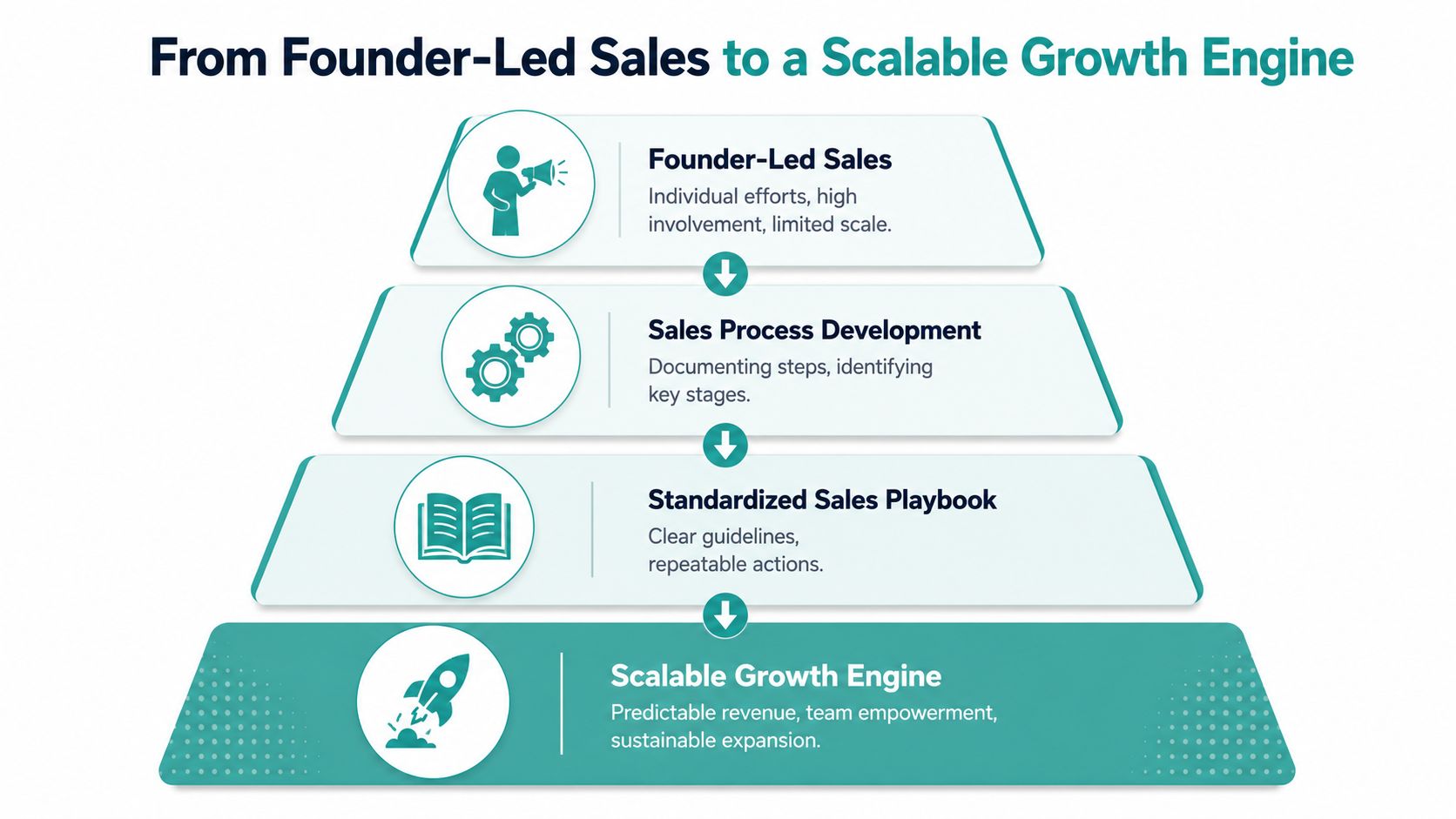
From Founder-Led Sales to a Scalable Growth Engine
Founder-led sales works well early because the founder knows the product, hears objections in real time, and improvises well enough to keep deals moving. The problem starts when the company grows and that instinct stays trapped in one person's head. Then the business has “a process” only in the loose sense that someone usually knows what to do next.
A repeatable process is different. It produces reliable movement from first conversation to closed deal because the steps are documented, coached, and measured. It doesn't depend on charisma, memory, or one closer having a good week.
Know when intuition has stopped scaling
There's a practical point where founder intuition stops being enough. A repeatable sales process becomes critical once a small business reaches $500,000 in ARR, and useful benchmarks include a 25-30% close rate and new reps reaching full productivity in less than 60 days according to M Accelerator's breakdown of repeatable sales process benchmarks.
Those numbers matter because they tell you whether the method transfers. If a founder can close but a new rep can't ramp, the company doesn't have a system. It has a heroic workaround.
Practical rule: If the founder still rewrites proposals, jumps into late-stage calls, and remembers follow-ups from memory, sales is operating on personal effort, not process.
Define what repeatable looks like in practice
For a small business, repeatable sales usually has four traits:
Clear stage exits: A deal doesn't move because someone feels optimistic. It moves because the buyer gave a specific signal or completed a specific action.
Shared language: Reps use the same qualification questions, the same proposal framing, and the same objection-handling logic.
Visible next steps: Every active deal has an owner, a next action, and a due date.
Transferable execution: A new person can follow the playbook and become productive without shadowing the founder for months.
That last point is where many businesses struggle. They document stages such as “Discovery” and “Proposal,” but they don't document how a rep should run a discovery call, when to send the second follow-up, or what to say when a buyer asks to “circle back next quarter.”
A scalable engine needs those details. This is similar to moving from a chef who cooks from feel to a kitchen that can serve the same dish every night. The goal isn't less skill. The goal is consistent output.
Start with the buyer, not your org chart
If your current sales process mirrors internal handoffs more than buyer behavior, it will feel clunky to customers and impossible to coach. A better approach is to map the buyer's path first, then define the seller actions that support that path. That's where consistency comes from.
A useful companion to that exercise is Adwave's guide on how to market my small business, especially for founders trying to connect top-of-funnel activity with a more disciplined sales workflow.
Designing Your Sales Playbook and Cadence
Most small businesses don't lose deals because the offer is terrible. They lose them in the messy middle. A prospect replies once, asks for pricing, says timing is bad, or goes quiet after a good call. Then the rep waits too long, sends a weak “just checking in,” or forgets entirely.
That's the follow-up gap, and it's bigger than most owners think.
Build fewer stages and better rules
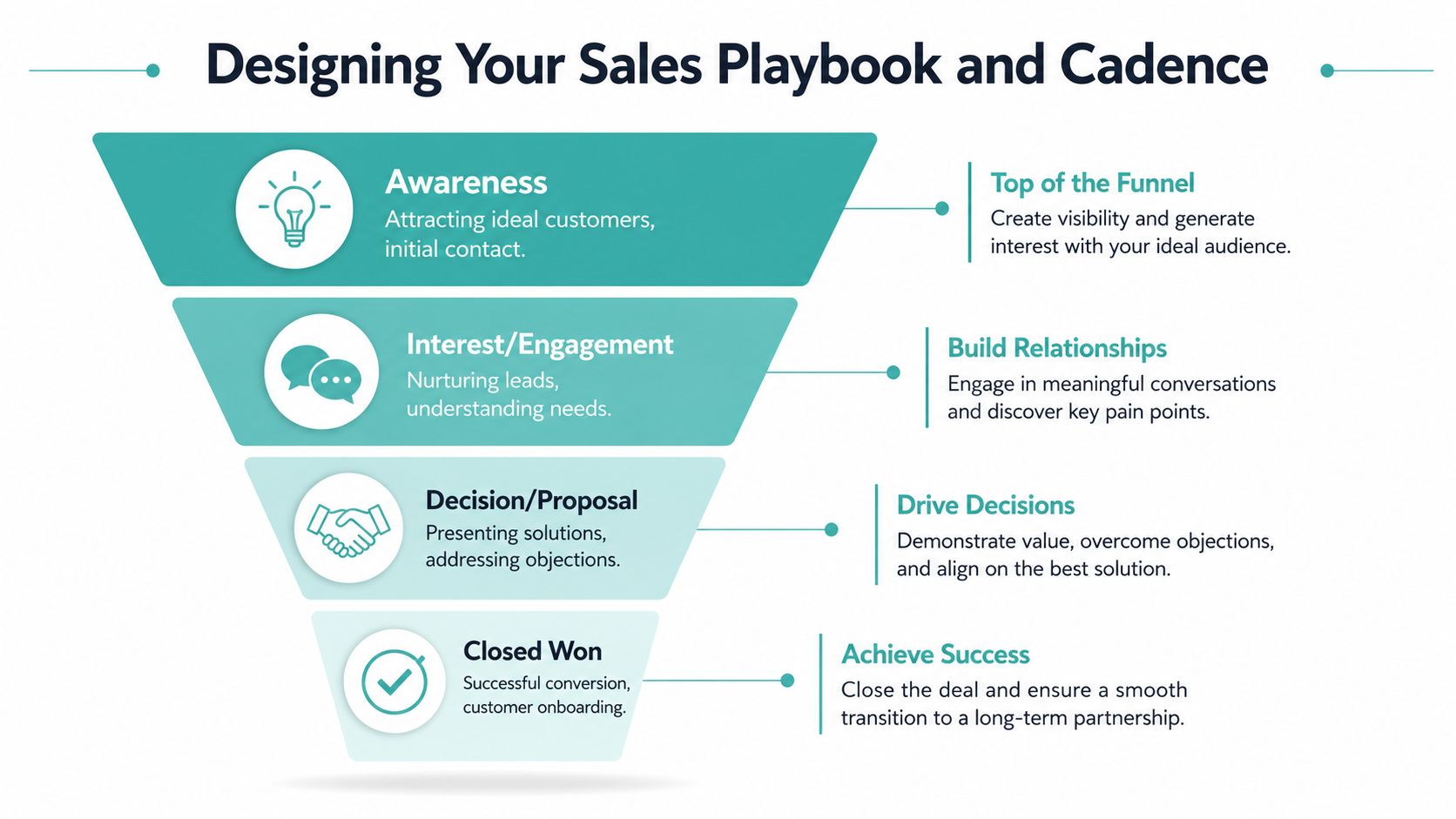
Keep your process simple enough that your team uses it. For most small businesses, 4 to 6 stages is usually enough as a design principle, but the quality of your stage definitions matters more than the count. I prefer something close to this:
The common mistake is using vague exits like “interested” or “qualified enough.” That invites opinion. Your playbook should answer a harder question: what evidence must the rep collect before the deal can advance?
Write the playbook like a field manual
A sales playbook shouldn't read like company values. It should read like operating instructions. Include the actual words your team can use, then leave room for style around the edges.
Your playbook needs these pieces at minimum:
Qualification questions: What problem triggered the search, what's happening if nothing changes, and who's involved in the decision.
Stage-specific talk tracks: A first-call opener, a discovery transition, a proposal setup, and a clean close plan.
Objection handling: Short responses to “send me information,” “we're already working with someone,” and “not a priority right now.”
Exit criteria: The prerequisites for moving each deal forward.
Follow-up rules: Timing, channel, ownership, and message type.
Most content on sales processes undersells follow-up. The recommended standard is 5 to 7 touches over 30 days, while most small businesses execute fewer than 3, causing 60%+ of warm leads to go cold according to Prospeo's small business sales analysis.
That single point changes how you design the whole playbook. If your team only follows up when they “have time,” your pipeline isn't a pipeline. It's a list of forgotten conversations.
Use a fixed cadence so warm leads don't drift
You don't need brilliant follow-up. You need consistent follow-up with a reason behind each touch. A simple cadence might look like this:
Touch one: Same day recap after discovery. Confirm pain point, next step, and timeline.
Touch two: Short value add. Answer a question, share a relevant example, or clarify scope.
Touch three: Decision-focused message. Ask what needs to happen for the deal to progress.
Touch four: Call or voicemail. Use voice when email starts getting ignored.
Touch five: Breakup-style note that's respectful, not dramatic. Give the buyer an easy yes, no, or later.
Some businesses spread those touches over a shorter period. Others use the full month. The exact spacing can vary. What shouldn't vary is ownership. Every open deal needs a next touch already scheduled.
For teams that need help seeing the buying path more clearly before writing scripts, this framework on customer journey mapping for small business is a useful planning reference.
Script the moments that repeat
The best scripts are for high-frequency moments, not every sentence in the conversation.
Use scripts for:
Opening a discovery call
Asking budget and decision questions without sounding stiff
Resetting a stalled deal
Handling “send me a proposal” before qualification is complete
Don't script:
Every greeting
Every transition
Every piece of rapport building
A good playbook reduces hesitation. It shouldn't make your team sound like they're reading cue cards.
Building Your Tech Stack with a Smart CRM
A repeatable process falls apart fast if reps track deals in inboxes, notebooks, and memory. The CRM isn't optional because it stores contacts. It matters because it enforces behavior. If your process lives in a slide deck and your team sells somewhere else, you don't have one operating system. You have two competing realities.
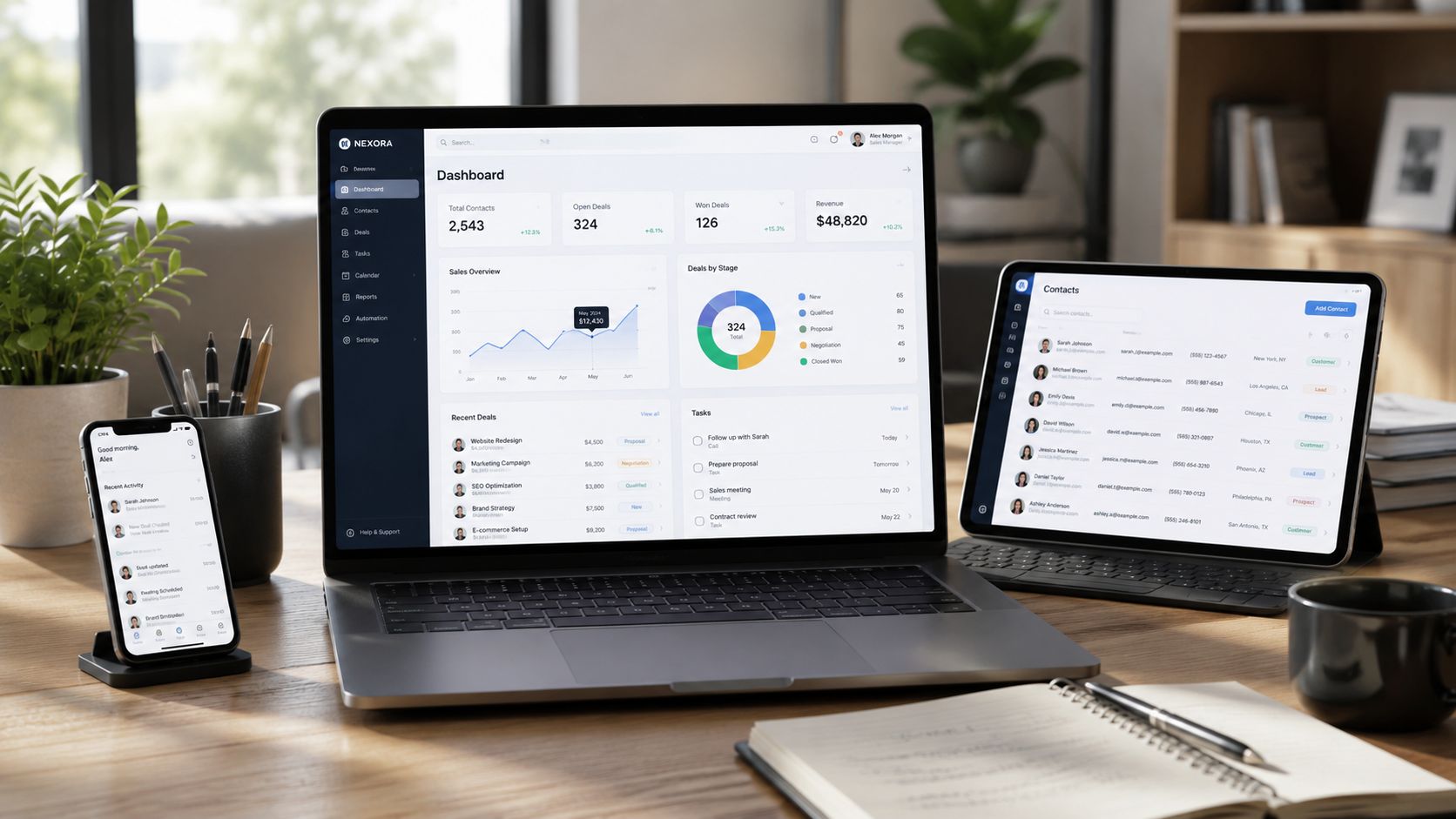
Configure the CRM to match the way you sell
The best small business CRM setup is boring in the right way. It mirrors your pipeline exactly, asks for only the data you'll use, and makes the next action obvious.
That means:
One pipeline with clean stages: Your CRM stage names should match your playbook stage names.
Required fields that matter: Capture qualification notes, next step, owner, and close reason. Skip vanity fields nobody reads.
Task automation: When a deal moves, the next follow-up task should appear without the rep creating it manually.
Activity logging: Calls, emails, and meetings should land in one place so managers can coach from evidence instead of guesses.
A cluttered CRM makes reps avoid it. A clean CRM makes reps rely on it.
Judge your stack by adoption, not feature count
Small business owners often buy for possibility and end up drowning in settings. The better buying question is simple: will the team use this every day without workarounds?
The case for getting this right is strong. 78% of sales professionals say CRM use directly facilitates sales improvements, and 76% of companies report a 6% to 20% increase in overall sales revenue after implementing structured sales enablement strategies in the data compiled by Fit Small Business on sales statistics.
That doesn't mean any CRM will save a weak process. It means a solid process gets stronger when the system supports it consistently.
A CRM should answer three questions in seconds: what stage the deal is in, what happens next, and how long it has been sitting there.
Keep the stack lean
For most small businesses, the core stack is enough when it includes:
CRM
Calendar and meeting scheduling
Email integration
Task automation
Basic reporting dashboard
Anything beyond that should solve a clear problem. If you're in a relationship-heavy industry and trying to scale your mortgage brokerage, for example, niche CRM guidance can help because your sales motion includes compliance, referral management, and longer deal cycles that generic setups often miss.
If you're adding automation around lead nurture and handoffs, this overview of marketing automation for small businesses can help you think through where sales and marketing should connect without creating a tool pile your team won't maintain.
Launching the Process and Training Your Team
A new sales process doesn't fail because the document is weak. It fails because the launch is passive. Someone posts the playbook in a shared drive, mentions it in a meeting, and expects habits to change on their own. They won't.
Sales teams adopt what gets coached, inspected, and reinforced. Everything else becomes shelfware.
Roll out the process in live deals
Don't train in the abstract first. Use active opportunities your team already recognizes. Walk through where each deal sits, what stage it belongs in, and what the next action should be under the new process.
That does two things. It makes the framework real, and it exposes vague stage definitions fast. If two reps classify the same opportunity differently, the process needs tightening.
A practical rollout sequence looks like this:
Week one: Introduce stages, exit criteria, and deal hygiene rules.
Week two: Practice discovery and follow-up talk tracks through role-play.
Week three onward: Review live pipeline every week using the new standards.
Ongoing: Coach to behaviors first, then outcomes.
Train for transfer, not inspiration
The fastest way to lose adoption is to make training motivational instead of operational. Reps need to hear what good sounds like, practice it, and get corrected while the stakes are low.
That's why a structured enablement window works so well. Teams that complete a structured 90-day enablement plan with weekly coaching, role-play, and stage-specific checkpoints outperform ad-hoc trained teams by 45% in win rate, based on Vouris' guidance on building a sales process.
Use that window to cover:
Weekly call reviews: Pick one discovery call and one stalled deal follow-up.
Role-play drills: Run the same objection several ways until the response sounds natural.
Checkpoint audits: Confirm reps are using the right stage exits and logging complete notes.
Manager coaching: Focus on one behavior at a time, not ten at once.
Don't ask whether the team “likes” the new process. Ask whether they can execute it without help in a live conversation.
Make managers the carriers of the system
If the manager ignores stage discipline, the reps will too. The process has to show up in one-on-ones, forecast reviews, onboarding, and pipeline meetings. When a manager asks “why is this still in proposal?” instead of “how do you feel about the account?” the whole culture shifts toward evidence.
That's when the process starts to feel normal rather than imposed.
Measuring Performance and Optimizing Your Funnel
A repeatable process is measurable or it isn't repeatable. If you can't tell where deals slow down, where leads go cold, or which source produces serious conversations, you're managing by mood. Small businesses do this more often than they admit because the founder still has a rough feel for the pipeline. Rough feel stops working once volume grows.
The answer isn't a giant analytics project. It's a short scoreboard that gets reviewed consistently.
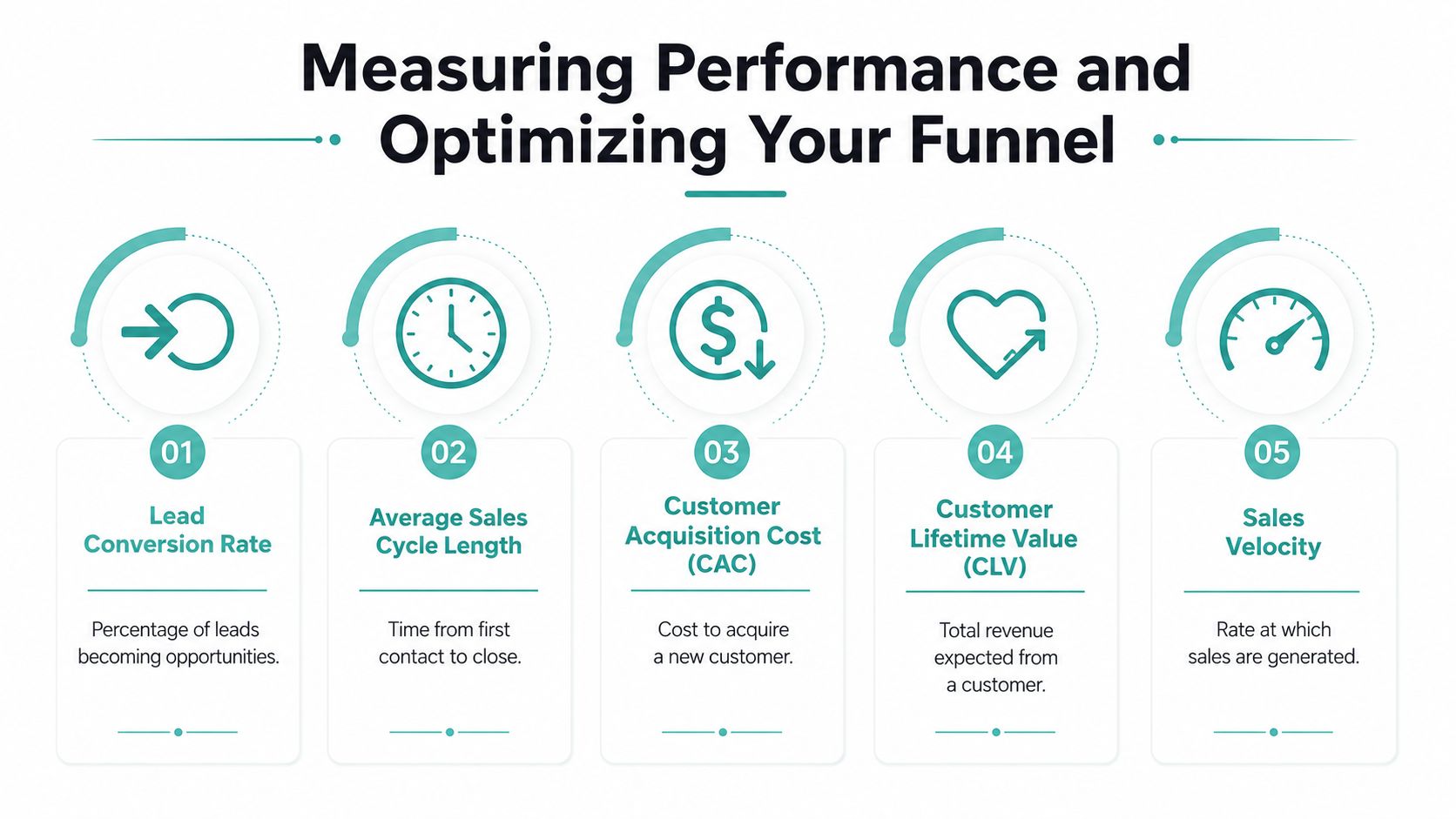
Track the few numbers that reveal friction
Start with a compact dashboard. You don't need dozens of metrics to spot trouble. You need a handful that tie directly to behavior.
A useful dashboard often includes:
Review those numbers with context. If cycle length rises, inspect follow-up first. If conversion falls early, check lead quality and discovery discipline before rewriting pricing.
Optimize the funnel where handoffs break
Most sales leaders focus on closing because that's the visible pain. In small businesses, the bigger issue is usually upstream. Marketing generates names, sales treats them as opportunities too early, and the pipeline fills with deals that were never real.
You fix that by tightening handoffs:
Define what counts as a real lead
Set entry criteria for the pipeline
Require a next step on every active opportunity
Log loss reasons in plain language
That's how you turn anecdotal complaints into decisions. “Leads are bad” isn't useful. “Discovery calls are full of people outside our target profile” is useful.
For owners refining unit economics alongside sales performance, this guide on customer acquisition cost calculation is worth reading because it forces sales and marketing to look at the same scoreboard.
Make lead generation repeatable too
A repeatable sales process needs a repeatable way to feed the top of the funnel. Consistency here proves challenging for many small businesses. They market heavily for a few weeks, get busy, stop, and then panic when the pipeline thins out.
The better approach is to treat marketing like controlled input. Test, measure, keep what works, and expand only after you have signal. That's why low-risk launch models matter. A repeatable sales process should include a testing phase for lead generation, and Adwave supports that by allowing campaigns to launch at exactly $50 with automatic pacing as described in Adwave's SMB TV advertising report.
That matters for sales because it creates a disciplined starting point. Instead of debating TV as a big all-or-nothing move, a small business can test, watch for branded search, direct traffic, or inbound inquiries, and decide from actual results. For companies that want a practical top-of-funnel channel without the usual production burden, Adwave fits this model well.
Good sales teams don't just manage deals. They manage inputs. When lead flow becomes testable, the pipeline becomes easier to forecast.
Your Path to Predictable Business Growth
The shift is simple to describe and hard to fake. You move from founder memory to documented stages, from random follow-up to fixed cadence, from scattered notes to CRM discipline, and from intuition-only management to a short list of visible performance measures.
That's what creating a repeatable sales process for your small business really means. It gives the founder room to stop being the emergency closer. It gives reps a clearer path to execution. It gives the business a way to grow without rebuilding the sales motion every quarter.
If you want a practical checklist, it comes down to four deliverables:
Defined sales stages with clear entry and exit rules
An usable playbook with qualification questions, scripts, and follow-up cadence
A CRM setup that mirrors the process and prompts next actions
A KPI dashboard that shows where the funnel is healthy and where it leaks
None of this removes judgment from sales. It puts judgment where it belongs. On strategy, coaching, positioning, and deal quality. Not on remembering whether anyone followed up last Thursday.
The businesses that build this early waste less pipeline, onboard people faster, and make revenue less dependent on one person's stamina. That's the true payoff. Not more process for its own sake. More control over growth.
If you want a practical way to make lead generation more repeatable, Adwave is worth a look. It gives small businesses a low-risk way to launch TV campaigns, test demand, and add a measurable top-of-funnel channel without the usual complexity.


