-
$37.95B
Projected U.S. connected TV ad spending in 2026 (eMarketer)
-
85%
Share of small-business advertisers now investing in CTV, up from 60% in 2024 (IAB)
-
$50
Minimum to start advertising on connected TV with Adwave
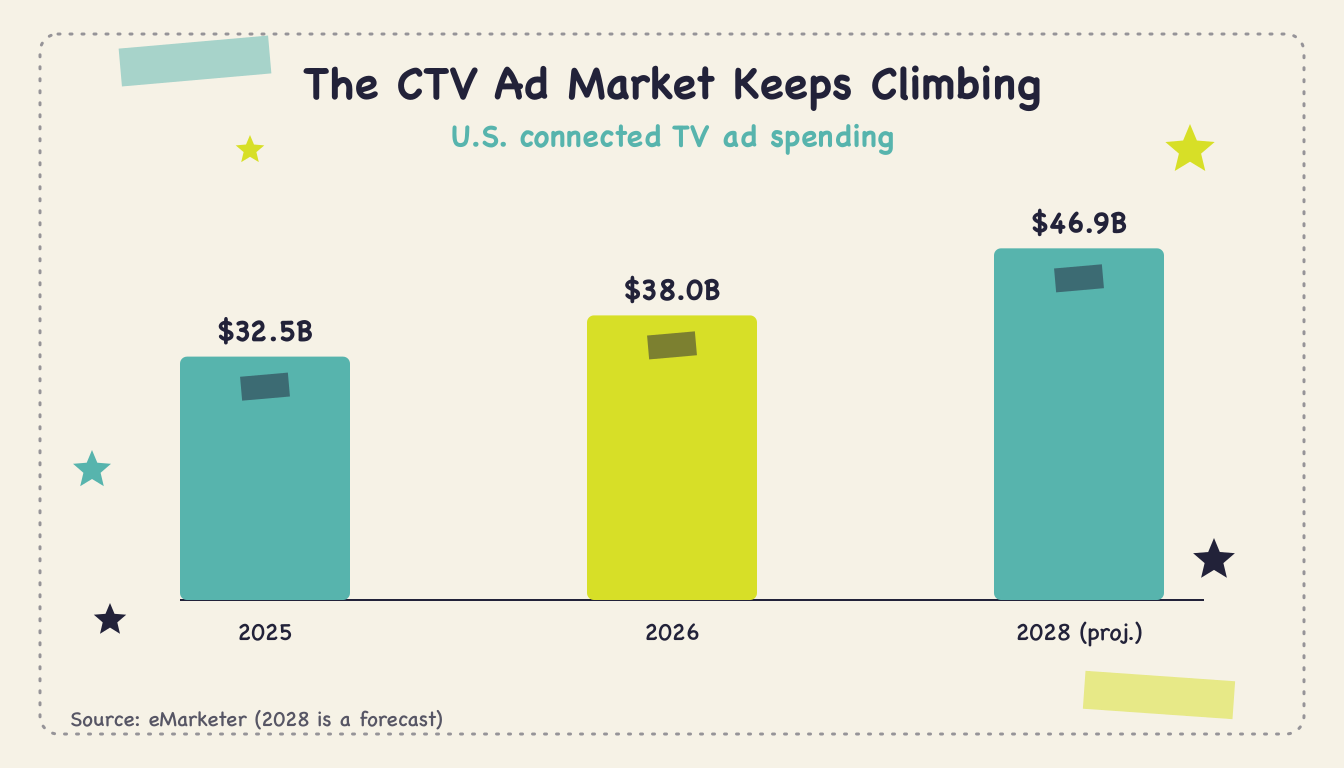
The U.S. connected TV advertising market is on track to reach $37.95 billion in 2026, up roughly 15% from a year earlier, according to eMarketer. That's a market that has roughly doubled in a handful of years, and in 2026 it hit a milestone that would have seemed impossible a decade ago: streaming outsold primetime broadcast and cable in the upfronts for the first time.
Here's why the size of this market matters to a small business. A growing share of that $38 billion isn't coming from national brands, it's coming from smaller advertisers who couldn't touch TV before. The share of small-business advertisers investing in connected TV jumped from 60% in 2024 to 85% in 2026. The market got huge, and it got accessible at the same time. Let's break down how big CTV advertising really is in Q2 2026, what's driving the growth, and how a local business fits into a $38 billion market.
What the data shows
Connected TV advertising means ads that run on streaming services watched on a television set, from YouTube and Hulu to Roku, Tubi, and Peacock. It's the fastest-growing major category in all of advertising, and the 2026 numbers show why the industry is reorganizing around it.
Here are the headline figures for the CTV market in 2026:
$37.95 billion: projected U.S. CTV ad spending in 2026, per eMarketer
Roughly 15%: year-over-year growth, up from around $33 billion in 2025
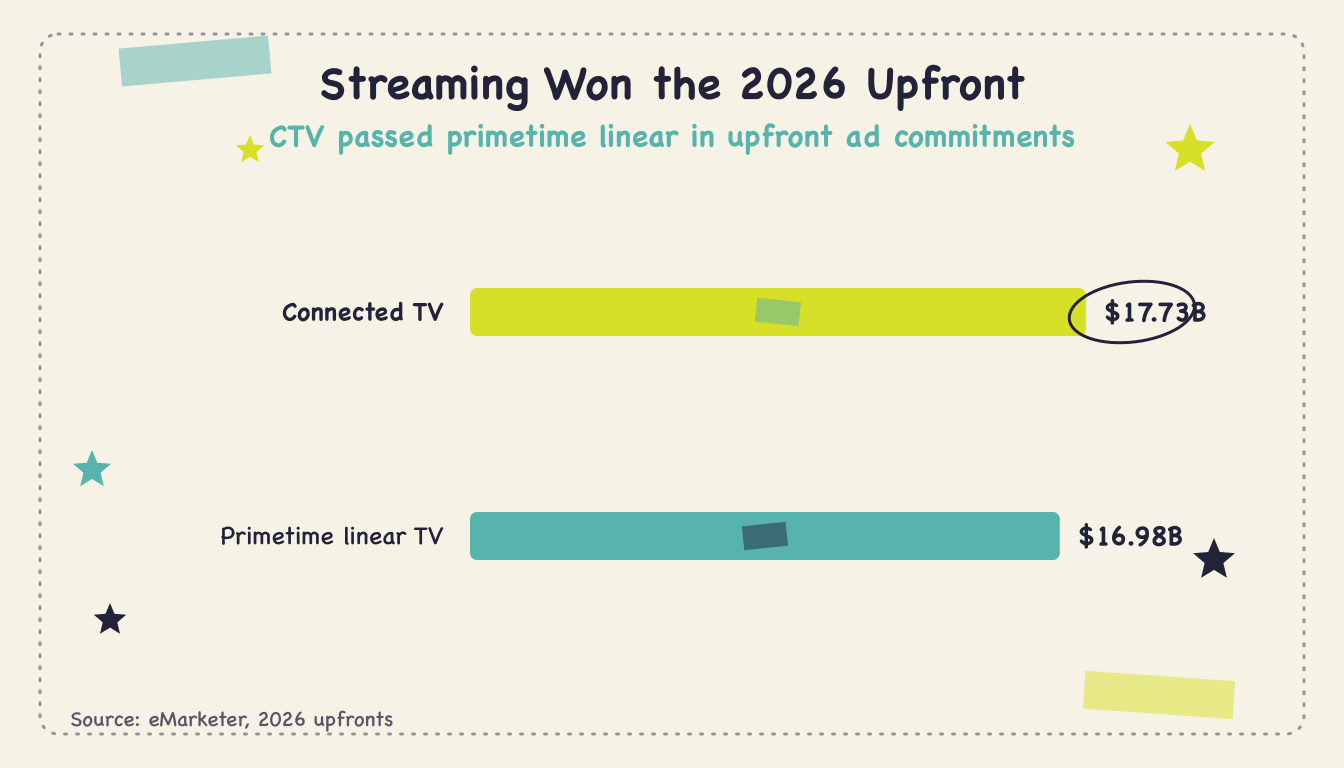
$17.73 billion: CTV upfront ad commitments in 2026, which passed primetime linear TV's $16.98 billion for the first time
61%: digital video's share of all TV and video ad spending in 2026, pushing linear below 40% for the first time
One note on definitions, because you'll see different numbers cited. eMarketer counts a broad CTV universe and lands near $38 billion. The IAB uses a narrower definition in its Video Ad Spend Report and puts CTV at $20.7 billion, growing about 14% year over year. Both are credible, they just measure different things, so we won't blend them. The takeaway is the same either way: CTV is a large market growing at strong double-digit rates while traditional TV shrinks.
That growth isn't abstract. It reflects the audience shift we track across our stat snapshots, where streaming took a record 47.6% of U.S. TV viewing in April 2026. Ad dollars follow eyeballs, and the eyeballs moved to streaming.
The 2026 milestone: streaming won the upfront
The single most telling data point of 2026 wasn't the total market size, it was where the money got committed. In the annual upfronts, when advertisers lock in TV budgets for the year ahead, connected TV outsold primetime linear television for the first time ever.
The numbers are close but historic:
CTV upfront commitments: $17.73 billion
Primetime linear TV upfront commitments: $16.98 billion
That roughly $750 million gap represents a tipping point. For decades, primetime broadcast and cable were where the biggest TV money went, the crown jewel of the ad market. In 2026, streaming took that crown in the most-watched daypart. eMarketer described it as a substantial threshold, and it confirms that CTV isn't a supplement to TV advertising anymore, it's becoming the main event. Our look at CTV's share of TV ad spend traces how that balance tipped.
Why should a small business care about how national brands spend in the upfronts? Because the upfront is a leading indicator. When the biggest advertisers move their committed dollars to connected TV, the whole ecosystem follows: more premium inventory becomes available, measurement tools mature, and the self-serve platforms that let a local shop buy CTV get better funded and easier to use. The upfront crossover is the enterprise end of the same shift that pushed small-business CTV adoption from 60% to 85%. Big brands and corner shops are moving in the same direction, just through different doors, and the market infrastructure improving for one improves it for the other.
How the market got this big
A $38 billion market doesn't grow 15% a year by accident. Several forces are pushing CTV ad spending up at the same time, and understanding them tells you the growth is structural, not a fad.
Viewing moved to streaming. With streaming at a record 47.6% of TV viewing, advertisers have to be on connected TV to reach the audience. The ad market is simply catching up to where people watch.
Ad-supported tiers exploded. Netflix's ad tier passed 250 million monthly active viewers, Amazon Prime Video defaults to ads, and Disney+ and Hulu draw the majority of new sign-ups to ad plans. Every new ad-tier viewer is new CTV inventory. Our ad-supported streaming viewers page tracks that surge.
Programmatic made it buyable. More than 84% of CTV inventory is now transacted programmatically, per the IAB, which means automated, self-serve buying that opens the market to advertisers of every size.
Live sports came to streaming. Major sports rights keep moving to streaming platforms, adding the premium, appointment-viewing inventory that commands the highest ad value.
Put together, these forces created a market that's both enormous and still growing fast. And importantly, the same programmatic plumbing that made CTV efficient for big brands also made it accessible to small ones.
Where CTV fits in the wider video market
CTV doesn't exist in isolation. It's one piece of a digital video ad market that has grown to roughly $82 billion in 2026, up about 11% year over year, per the IAB. Seeing how the pieces compare puts CTV's size in perspective.
Under the IAB's definitions, the 2026 digital video market breaks down like this:
Social video: about $31.9 billion, the largest single category, spanning short-form and feed-based video
Online video: about $29.3 billion, video that runs on websites and non-TV screens
Connected TV: about $20.7 billion, the fastest-growing of the three, up nearly 14% year over year
Connected TV is smaller than social and online video advertising and is growing faster. Its full-screen placements combine television viewing with digital targeting and measurement.
That distinction, digital precision on a television screen, is what makes the CTV slice of this market so valuable, and why its share of total video spending keeps climbing.
Why it matters for your business
A $38 billion market number can feel like it's about someone else, the national brands and agencies. It isn't. The most important CTV growth story of 2026 is how much of it comes from small advertisers.
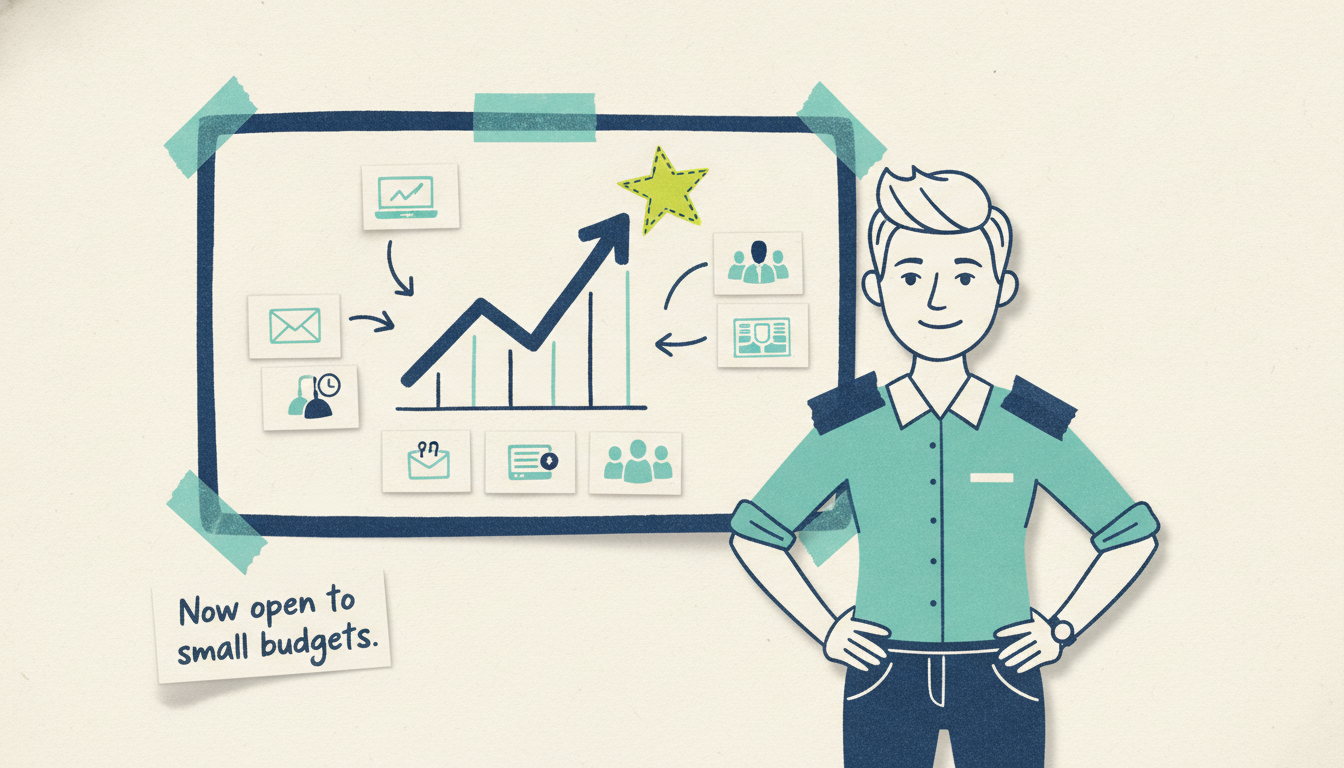
The standout stat: the share of small-business advertisers investing in connected TV rose from 60% in 2024 to 85% in 2026, per the IAB. That's not big brands driving the growth, that's small businesses discovering that TV is finally in reach. Here's why that shift matters for you specifically:
The barrier fell. CTV's growth is heavily fueled by advertisers spending under $10 million a year, enabled by self-serve programmatic tools. The market grew precisely because it opened up to smaller budgets.
You're not late, you're early. At 85% adoption among small spenders, CTV has crossed from novelty to norm, but it's still early enough that a local business can build presence before the space gets crowded and prices rise.
The economics work at your scale. The average CTV CPM runs roughly $15 to $35, which means a few hundred dollars buys real, targeted reach in your service area, not a rounding error on a national buy.
The big-picture point is that CTV stopped being a big-brand-only market. A $38 billion industry that used to be gated behind national budgets now has a wide-open door for local businesses, and 85% of small advertisers have already walked through it. The question isn't whether CTV is for businesses like yours. The data says it already is.
How to take advantage
A big, growing, accessible market is an opportunity, but only if you act on it. Here's how a small business claims a piece of the $38 billion CTV market.
Start now, while it's still early. Adoption is climbing fast. Building presence on connected TV now is cheaper and less crowded than it will be in a year or two.
Target your service area. Set a geographic radius, usually 15 to 25 miles, so your slice of the market reaches actual potential customers, not a national audience you're paying for.
Budget for frequency. Plan enough spend to reach the same households several times over two to three weeks. On CTV, meaningful frequency costs hundreds of dollars, not thousands.
Use the self-serve tools. The programmatic buying that made CTV a $38 billion market also makes it a two-minute setup for a small business. AI turns your website into a broadcast-quality 30-second ad without a production crew.
Measure the return. Track branded search, direct traffic, and calls during and after a campaign, since connected TV ties to results in ways traditional TV never could.
The mechanics are simple. With Adwave, ad creation is free, a campaign starts at a $50 minimum, and you can be live across 100+ premium streaming channels in under 10 minutes. You're buying into the same $38 billion market as the national brands, just at a scale built for a local business. For the full picture of how connected TV advertising works, our guide walks through the basics.
The bigger picture
The size of the CTV market in 2026 is really a story about a permanent shift in where advertising money lives, and the trend lines all point the same direction.
A few forces give the $38 billion figure its weight:
The crossover with traditional TV is near. eMarketer projects connected TV ad spending will surpass all traditional TV ad spending around 2028, at roughly $47 billion to traditional TV's $45 billion. The lines are converging fast. Our CTV advertising forecast lays out the trajectory.
Linear is shrinking as CTV grows. Traditional linear TV ad spending is falling while CTV climbs double digits. Digital video already makes up 61% of all TV and video ad spending, pushing linear below 40% for the first time. The money is voting with its feet.
Small advertisers are the growth engine. The jump from 60% to 85% small-business CTV adoption in two years shows the market's growth increasingly comes from the bottom up, not just the top down. This is the CTV advertising growth rate story from the small-business side.
For a local business, the throughline is that CTV isn't a market you're watching from the outside. It's one you can join today, at a $50 minimum, alongside the biggest advertisers in the country. The market got to $38 billion by opening up, and the door is still open.
It's worth appreciating how unusual this moment is. Most markets that reach $38 billion have long since closed to newcomers, priced and gated so that only the largest players can participate. CTV grew the opposite way. It got bigger by getting more open, pulling in hundreds of thousands of smaller advertisers rather than concentrating spend among a few giants. That's why the 60%-to-85% small-business adoption jump sits right alongside the upfront crossover in the 2026 story. A market can grow by getting more exclusive or by getting more inclusive, and connected TV, remarkably, chose inclusive. For a small business weighing whether TV advertising is finally worth a look, that's the most encouraging signal in all of this data.
What experts are saying
Analysts have been unusually direct about 2026 as a turning point. eMarketer called the upfront crossover, CTV passing primetime linear, a substantial threshold, framing it as the moment streaming stopped being TV's challenger and became its center of gravity. The firm's forecasts consistently show CTV climbing double digits while linear declines, converging toward a full crossover around 2028.
The IAB's 2026 Video Ad Spend Report added the detail that matters most for small businesses: the sharp rise in CTV adoption among smaller advertisers, from 60% to 85% in two years. Industry observers read that as evidence that the barriers, cost, complexity, and minimums, have come down, not just for enterprise buyers but for the long tail of local advertisers. The consensus is that CTV's growth is no longer just a big-brand migration off linear TV, it's a broadening of the entire advertiser base, with programmatic self-serve tools putting television in reach of businesses that never could have bought it before. For a small business, the expert takeaway is simple: the market is big, it's growing, and it's built for you now in a way it wasn't a few years ago.
What the numbers don't tell you
A $38 billion headline is impressive, but read it with a few caveats so you plan around reality.
Definitions vary, so numbers vary. eMarketer's ~$38 billion and the IAB's $20.7 billion measure CTV differently. Neither is wrong. When you see a CTV market figure, check what it counts before comparing.
Market size isn't your budget. The $38 billion is the whole market. What matters for you is that your slice, a few hundred dollars targeted at your service area, buys real reach. Big market, small entry point.
Growth invites competition. As more advertisers pile in, popular inventory can get pricier over time. That's an argument for starting now, while CTV is still relatively early and efficient.
Averages hide variation. CPMs and results vary by service, targeting, and season. Treat benchmarks as directional, and let your own campaign data guide budget decisions.
Read the $38 billion as a signal of momentum and accessibility: the market is large, growing, and increasingly built around advertisers of every size, including yours.
Common questions answered
How big is the CTV advertising market in 2026? U.S. connected TV ad spending is projected to reach about $37.95 billion in 2026, up roughly 15% year over year, per eMarketer. Using the IAB's narrower definition, CTV is $20.7 billion, growing about 14%. Both show a large market growing at strong double-digit rates while traditional TV ad spending shrinks.
Connected TV passed primetime linear TV in the 2026 upfronts, at $17.73 billion versus $16.98 billion. eMarketer projects it will pass total traditional TV ad spending around 2028. Digital video accounts for 61% of TV and video ad spending.
Can small businesses advertise on CTV? Yes, and increasingly they do. The share of small-business advertisers investing in CTV rose from 60% in 2024 to 85% in 2026. Self-serve programmatic tools and platforms like Adwave let a local business run TV ads from a $50 minimum, with no national budget required.
Why is CTV advertising growing so fast? Viewing shifted to streaming, which now takes a record 47.6% of TV viewing, and ad-supported tiers on Netflix, Prime Video, Disney+, and others created huge new ad inventory. More than 84% of CTV is bought programmatically, making it efficient and accessible. Ad dollars are following the audience to streaming, and a growing share of the growth now comes from small and mid-sized advertisers rather than national brands alone.
How much does CTV advertising cost? The average CTV CPM runs roughly $15 to $35, with about $25 a common benchmark. With Adwave, a campaign starts at a $50 minimum and ad creation is free, so a local business can buy into the same market as national brands at a small-business scale.
The numbers at a glance
Key figures on the Q2 2026 CTV market, with sources:
$37.95 billion: projected U.S. CTV ad spending in 2026 (eMarketer)
~15%: year-over-year growth from around $33 billion in 2025 (eMarketer)
$20.7 billion: CTV ad spend under the IAB's narrower definition, up ~14% (IAB Video Ad Spend Report 2026)
$17.73B vs $16.98B: CTV upfront commitments passing primetime linear for the first time in 2026 (eMarketer)
85%: share of small-business advertisers investing in CTV, up from 60% in 2024 (IAB)
61%: digital video's share of all TV and video ad spending in 2026 (IAB/eMarketer)
84%+: share of CTV inventory bought programmatically (IAB)
~2028: when CTV ad spending is projected to surpass all traditional TV (eMarketer)
Join a $38 billion market, starting at $50
The connected TV advertising market reached nearly $38 billion in 2026 and passed primetime linear TV in the upfronts for the first time. The most important part for a small business is that 85% of small advertisers are already in, because the market that got huge also got accessible.
You don't need a national budget to be part of it. See how Adwave works to turn your website into a broadcast-quality 30-second ad in minutes, or check pricing to launch a connected TV campaign from a $50 minimum. The market is big, it's growing, and there's room for your business in it.