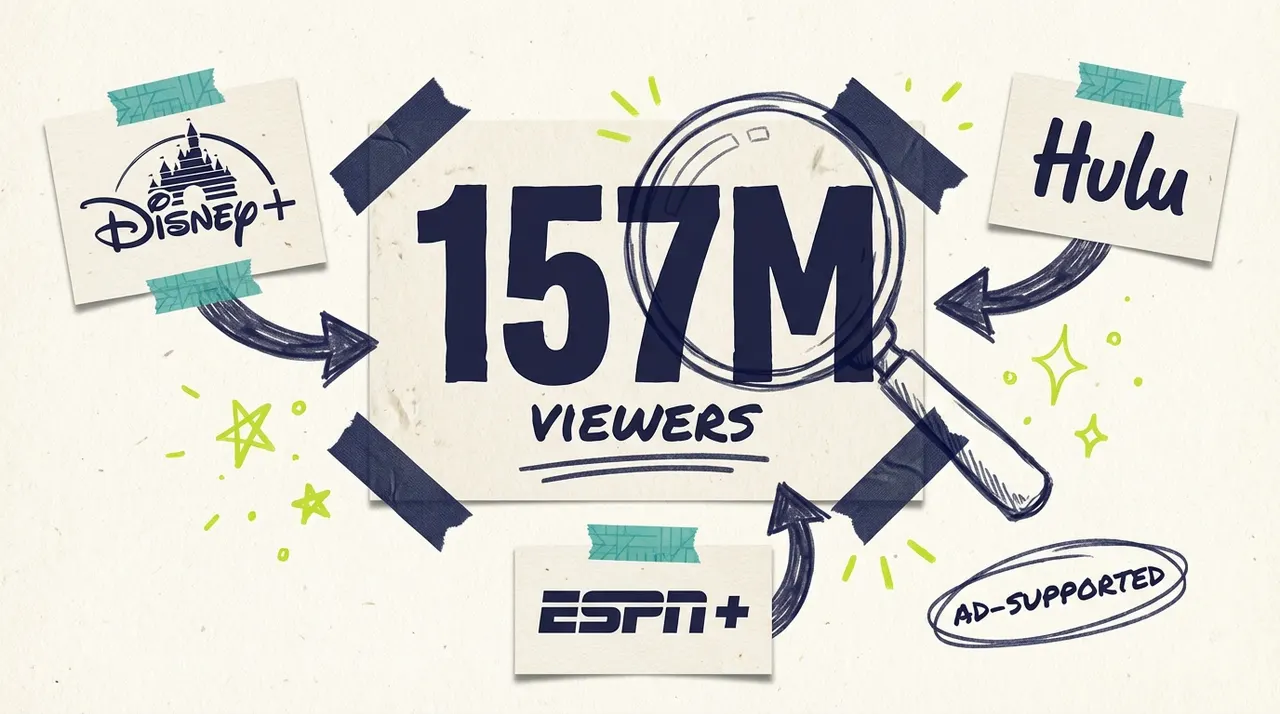
Disney's streaming platforms now reach 157 million monthly active users on ad-supported tiers globally, according to the company's January 2025 announcement at CES. This figure, which includes Disney+, Hulu, and ESPN+, represents the first time Disney has provided transparency into its combined streaming advertising audience. For advertisers, this means one of entertainment's most valuable content portfolios, from Marvel and Star Wars to live sports and next-day television, is now accessible at scale through ad-supported viewing.
What makes Disney's ad-supported audience especially valuable is the diversity of content and viewers. Unlike platforms built on a single content type, Disney's streaming ecosystem spans family entertainment on Disney+, premium television on Hulu, and live sports on ESPN+. Advertisers can reach families watching Pixar movies on Saturday morning, adults streaming prestige dramas on Hulu that evening, and sports fans watching ESPN's live events on Sunday. This breadth creates advertising opportunities across virtually every consumer demographic and interest.
The 157 million figure has already grown. By May 2025, Disney reported 164 million monthly ad-supported viewers across its three streamers, a 4% increase in just four months. This growth trajectory suggests Disney's ad-supported business is accelerating as more subscribers choose cheaper options with commercials over premium ad-free tiers. For small and mid-sized businesses, reaching Disney's audiences directly remains challenging due to the platform's pricing and minimum budgets. But the same viewers who watch Disney content also stream other services where advertising is more accessible. Platforms like Adwave enable advertisers to reach similar demographics on other streaming services starting at $50.
What the data shows
Disney's combined streaming ad-supported audience represents one of the largest advertising reach opportunities in streaming.
According to Disney's official January 2025 announcement, the company reaches an estimated 157 million global monthly active users across Disney+, Hulu, and ESPN+ ad-supported tiers. This figure represents an average per month over the prior six months. Domestically, in the United States and Canada, Disney reaches 112 million monthly active users on ad-supported content.
By May 2025, Disney updated this figure during a press event ahead of its upfront presentation to advertisers. The company reported 164 million monthly ad-supported viewers, representing 4% growth from the January announcement. Disney did not provide an updated domestic versus international breakdown at that time.
The methodology behind these numbers deserves attention. Disney calculates ad-supported monthly active users from active accounts across its streaming ecosystem that have viewed ad-supported content continuously for more than 10 seconds. Each active account is then multiplied by the estimated number of users per account to capture household co-viewing. Globally, the average multiplier is 2.6 users per account, though this varies by application and region. Multipliers are determined by first-party survey data from more than 13,000 individuals ages 18-64 in regions with advertising tiers.
An important note on methodology: Disney's estimated active users are added across applications without de-duplication. A subscriber who has both Disney+ and Hulu on ad-supported plans would be counted in both tallies. This approach differs from some competitors and affects how the total figure should be interpreted.
Disney's total subscriber base provides context for the ad-supported figures. According to Disney's November 2024 earnings report, Disney+ had 122.7 million Core subscribers (excluding Hotstar in India and other regional services), Hulu had 52 million subscribers, and ESPN+ had 25.6 million paid subscribers. The 157 million ad-supported users figure suggests significant overlap in multi-service households and substantial co-viewing effects.
Disney executives have noted that more than half of new U.S. Disney+ subscribers now choose the ad-supported tier. During the November earnings call, executives stated this pattern "bodes well for the future" of the ad-supported business. This aligns with broader industry trends showing ad-supported tiers driving the majority of streaming subscriber growth.
Breaking down the numbers
Disney's 157 million ad-supported audience distributes across three distinct streaming platforms, each serving different content needs and viewer demographics.
Platform breakdown
Hulu remains Disney's largest and most mature ad-supported platform. As the only major streamer built from the ground up with advertising, Hulu has years of ad-tech infrastructure and advertiser relationships. The platform offers next-day access to broadcast television from ABC, NBC, and Fox, along with Hulu Originals and a deep library of licensed content. Hulu's ad-supported tier has long been the default option for most subscribers, with approximately 63% of Hulu subscribers on ad-supported plans as of 2024.
Disney+ launched its ad-supported tier in December 2022, significantly later than competitors. Despite the late start, adoption has been rapid. Disney has strategically priced ad-free options higher and eliminated lower-priced ad-free tiers to encourage migration to ad-supported plans. More than half of new Disney+ subscribers in the U.S. now choose the ad tier, according to company statements.
ESPN+ offers the sports-focused streaming experience in Disney's portfolio. While smaller in total subscribers than Disney+ or Hulu, ESPN+ reaches highly engaged sports fans willing to watch advertising in exchange for access to live events and sports content not available elsewhere.
Domestic versus international distribution
Of Disney's 157 million global ad-supported users, 112 million (71%) are in the United States and Canada. The remaining 45 million (29%) come from international markets where Disney has launched ad-supported tiers.
This heavy domestic concentration reflects several factors:
Hulu operates exclusively in the United States, contributing its entire subscriber base to the domestic count
Disney+ launched ad tiers in international markets later than in the U.S.
ESPN+ is primarily a U.S. service
International ad markets have different pricing dynamics and adoption patterns
For advertisers targeting U.S. consumers, Disney's domestic concentration means the platform offers substantial scale in the American market specifically.
The co-viewing multiplier
Disney's methodology applies a 2.6x global average multiplier to convert accounts to viewers. This co-viewing factor recognizes that streaming, like traditional television, is often a household activity.
The multiplier varies by platform and region:
Family-oriented Disney+ content likely drives higher co-viewing as parents watch with children
Sports content on ESPN+ often features group viewing, especially for major events
Hulu's prestige dramas may skew toward individual or couple viewing
This co-viewing factor makes Disney's figures more comparable to traditional television ratings, which have always counted viewers rather than households. An advertiser considering Disney alongside broadcast television can make more direct reach comparisons.
Growth trajectory
Disney's ad-supported audience has grown meaningfully since the company began focusing on advertising:
December 2022: Disney+ ad tier launches
January 2025: 157 million global ad-supported users announced
May 2025: 164 million global ad-supported viewers reported
The 4% growth from January to May 2025 suggests continued momentum. As Disney raises prices on ad-free tiers and expands ad-supported options internationally, this figure will likely continue climbing.
Why it matters for your business
Disney's ad-supported scale has different implications depending on your advertising budget and objectives.
For large advertisers
Disney offers premium inventory that commands premium prices. The combination of high-quality entertainment content, family-safe environments, and scaled reach makes Disney streaming attractive for major brand campaigns.
Advertisers can target specific content environments. A toy brand might focus on Disney+ family programming. An auto brand might concentrate on ESPN+ sports content. A retail brand might spread across all three platforms to maximize reach.
Disney has expanded its ad technology capabilities significantly since launching advertising. The company now offers programmatic buying through its Disney Ad Server, with connections to major demand-side platforms including Amazon, Google Display & Video 360, and The Trade Desk.
However, Disney's minimum budgets and CPM rates put direct advertising out of reach for most small and mid-sized businesses. The platform is designed for national advertisers with substantial budgets.
For small and mid-sized businesses
Disney's 157 million ad-supported viewers represent a significant and growing pool of streaming audiences. While direct Disney advertising may be inaccessible, these same viewers don't watch exclusively on Disney platforms.
A family that watches Disney+ on Saturday morning might watch Peacock on Saturday night, Tubi on Sunday afternoon, and other ad-supported services throughout the week. The same viewer demographics, including families, sports fans, and entertainment enthusiasts, are reachable across the broader streaming ecosystem.
Platforms like Adwave enable small business advertising across 100+ streaming services where many Disney viewers also spend time. Starting at $50, a local restaurant or home services business can reach premium streaming audiences in their market without Disney-sized budgets.
For the streaming advertising industry
Disney's transparency about ad-supported audience methodology sets a precedent. The company acknowledged that "unlike linear advertising, there is no industry standard methodology for measuring global streaming advertising audience size." By publishing its approach, Disney is pushing toward standardization that benefits the entire ecosystem.
The company's first-party measurement approach, using survey data from over 13,000 individuals, demonstrates investment in understanding ad-supported audiences. As other streamers follow with their own methodologies, advertisers benefit from better data and more comparable metrics.
Disney's scale also validates the ad-supported streaming model at the highest level of content quality. If Marvel, Star Wars, and Pixar content can run with advertising, the concerns about premium content and advertising coexisting have been largely resolved.
How to take advantage of this trend
Disney's growing ad-supported audience reflects broader streaming industry trends that benefit advertisers of all sizes.
Recognize streaming advertising's maturity
Disney now actively promotes its advertising business at major industry events like CES. The company that built Disney+ as an ad-free competitor to Netflix has fully embraced advertising as a core business model.
According to Antenna research, ad-supported tiers now account for 46% of streaming subscriptions at platforms offering both options. Over the past nine quarters, ad plans have driven 71% of net subscriber additions for premium streaming services. Nearly 100 million subscriptions in the U.S. market are on ad-supported plans, not including Amazon Prime Video.
This maturation means streaming advertising deserves serious consideration in media planning, regardless of whether specific platforms like Disney are accessible to your budget. Understanding how much streaming TV ads cost helps businesses evaluate where CTV fits in their marketing mix.
Access streaming audiences through aggregated platforms
While Disney's direct advertising requires substantial budgets, the viewers themselves are reachable through other channels:
Multi-platform streaming: Most households subscribe to multiple streaming services. Disney viewers also watch Hulu, Peacock, Tubi, and other ad-supported services where advertising is more accessible.
Aggregated buying: Platforms like Adwave enable advertising across 100+ streaming services, reaching the same demographic profiles as Disney viewers.
Local targeting: Geographic targeting ensures your budget reaches viewers in your market rather than paying for national reach.
Consider content environment priorities
Disney's strength is high-quality, family-safe content. If brand safety and content adjacency matter for your business, streaming environments offer more control than some digital channels.
For family-oriented businesses, reaching viewers during family content viewing creates positive brand associations. For sports-focused advertisers, ESPN+ viewers represent engaged sports fans. Understanding where your ideal customers watch helps prioritize streaming investments. Learn more about CTV targeting options to reach specific audience segments.
Time campaigns strategically
Disney content drives viewing patterns that affect the entire streaming ecosystem:
Holiday releases: Major Disney+ releases increase overall streaming engagement
Live sports events: ESPN+ events drive real-time viewing spikes
Seasonal content: Family programming peaks during holidays and summer
Timing your streaming campaigns around these high-engagement periods increases the likelihood of reaching active viewers, even if you're advertising on other platforms.
The bigger picture
Disney's 157 million ad-supported users represent a fundamental shift in how premium entertainment reaches audiences.
The end of ad-free streaming's dominance
Disney+ launched in 2019 as an ad-free alternative to Netflix, which was also ad-free at the time. The service positioned itself on the strength of content alone, without advertising. Just three years later, Disney launched an ad tier that now accounts for more than half of new subscribers.
This reversal validates advertising as essential to streaming economics. Even the most premium content libraries, including Marvel, Star Wars, Pixar, and ESPN sports, now run with advertising. The streaming industry has concluded that ad-free options at lower price points cannot sustain content investments.
For advertisers, this means unprecedented access to premium content environments. Programming that was once completely off-limits to advertising is now reachable.
Integration across the Disney ecosystem
Disney's approach treats Disney+, Hulu, and ESPN+ as a unified advertising portfolio rather than separate platforms. Advertisers can buy across all three services, targeting specific content types or demographics.
This integration will deepen with the upcoming ESPN standalone streaming service. Disney announced pricing for the new ESPN app in May 2025, with bundle options including Disney+ and Hulu. The advertising inventory across these connected services will grow more sophisticated over time.
Competition for streaming advertising dollars
Disney's transparency about ad-supported audience creates pressure on competitors. Netflix has reported 190 million monthly active viewers on its ad tier. Amazon recently announced Prime Video's ad tier has surpassed 130 million active users in the U.S. alone.
This competition benefits advertisers through:
More inventory: Increased ad-supported viewing creates more opportunities to reach audiences
Better measurement: Platforms invest in proving their audience value
Price pressure: Competition for advertising budgets keeps pricing in check
Improved ad experiences: Platforms differentiate through better ad products
Future trajectory
Disney has committed to growing its advertising business. The company has invested in ad technology, expanded programmatic access, and developed innovative ad formats like pause ads and interactive units.
The upcoming ESPN standalone streaming service represents Disney's largest advertising opportunity yet. Live sports command premium advertising rates and attract engaged audiences that advertisers prize. ESPN's transition to streaming will unlock significant new advertising inventory.
Disney executives have stated confidence that streaming will be "a significant growth area" for the company. Advertising is central to that growth strategy.
What experts are saying
Industry analysts and Disney executives have provided context on the company's ad-supported growth.
Rita Ferro, Disney's president of global advertising, emphasized the company's unique position at CES: "Disney sits at the intersection of world class sports and entertainment content, with the most high-value audiences in ad-supported global streaming at scale." Ferro noted that Disney wanted to be "the first to offer our industry greater transparency into the methodology used to estimate our engaged global ad-supported monthly active users."
Disney CEO Bob Iger has consistently pushed the company toward ad-supported streaming. In earnings calls, Iger has stated the company is "trying to steer its customers toward its ad-supported tiers" through pricing strategies that make ad-free options less attractive.
Antenna's research on streaming ad tiers provides industry context. The firm's May 2025 report found that "advertising has reached a remarkable place of maturity in streaming in a very short period of time." Founders noted that "everyone wins" with ad-supported streaming: "Streamers can build a dual-stream business model and expand their addressable market by offering a lower priced tier for more casual fans. Brands can transition their highly successful TV advertising strategies to streaming. And consumers can afford more services by taking ads on some of them."
CNBC's coverage of Disney's announcement noted the significance of the company's transparency: "While traditional TV outlets have a standard way of measuring ratings and viewership, there is still no industry standard methodology for measuring global streaming advertising audience size." Disney's publication of its methodology represents an industry-leading move toward standardization.
Common questions answered
How many people watch Disney streaming with ads?
Disney's ad-supported streaming reaches 157 million monthly active users globally as of January 2025, including 112 million in the United States and Canada. By May 2025, this figure had grown to 164 million viewers. These numbers combine ad-supported viewing across Disney+, Hulu, and ESPN+.
When did Disney+ launch advertising?
Disney+ launched its ad-supported tier on December 8, 2022, in the United States. The company has since expanded ad-supported options to international markets and raised prices on ad-free tiers to encourage ad-supported adoption. More than half of new U.S. Disney+ subscribers now choose the ad tier.
How many ads do Disney+ viewers see?
Disney+ serves approximately 4-5 minutes of advertising per hour, similar to other premium streaming services like Netflix and Peacock. This ad load is significantly lighter than traditional television's 15-20 minutes per hour. Disney has also developed viewer-friendly ad formats including pause ads and ad selectors that give viewers choice.
What's the difference between Disney+ and Hulu ad inventory?
Hulu is Disney's most mature ad-supported platform with years of advertising infrastructure. It offers next-day TV from broadcast networks plus Hulu Originals. Disney+ focuses on Disney, Pixar, Marvel, Star Wars, and National Geographic content. Both platforms now share ad technology and can be bought together through Disney's advertising sales teams.
Can small businesses advertise on Disney platforms?
Disney's advertising is designed for national advertisers with substantial budgets. The platform's minimum spends and CPM rates make direct advertising inaccessible to most small businesses. However, small businesses can reach similar viewer demographics through aggregated streaming platforms like Adwave, which offer campaigns starting at $50 across 100+ streaming services.
How does Disney's ad reach compare to Netflix?
Netflix reported 190 million monthly active viewers on its ad tier in November 2025, compared to Disney's 157-164 million across Disney+, Hulu, and ESPN+. Netflix's figure is global and represents a single platform, while Disney's combines three services without de-duplication. Both represent massive advertising audiences rivaling traditional television.
What is Disney's advertising CPM?
Disney has not published specific CPM ranges. Industry estimates put standard inventory around $25 to $45, with higher rates for some premium placements. Costs vary by platform, audience, and programming.
Will ESPN streaming have advertising?
Yes. Disney announced pricing for its new ESPN standalone streaming service in May 2025. Both plans, ESPN Unlimited and ESPN Select, include advertising. Bundle options with Disney+ and Hulu are available in both ad-supported and ad-free configurations at different price points.
Supporting data
Key statistics on Disney's ad-supported streaming:
Global ad-supported monthly active users: 157 million (Disney/TWDC, January 2025)
Updated global ad-supported viewers: 164 million (TheWrap, May 2025)
Domestic (U.S. and Canada) ad-supported users: 112 million (Disney/TWDC, January 2025)
Global co-viewing multiplier: 2.6 users per account (Disney/TWDC)
New U.S. Disney+ subscribers choosing ad tier: More than 50% (CNBC)
Disney+ Core subscribers: 122.7 million (Disney Q4 2024 Earnings)
Hulu subscribers: 52 million (Disney Q4 2024 Earnings)
ESPN+ subscribers: 25.6 million (Disney Q4 2024 Earnings)
Industry ad-supported subscription share: 46% of subscriptions at dual-tier SVODs (Antenna/Deadline, May 2025)
Ad-tier net subscriber contribution: 71% of premium SVOD net adds over 9 quarters (Antenna/Deadline)
Disney+ ad tier launch date: December 8, 2022 (Disney)
Survey methodology sample size: 13,000+ individuals (Disney/TWDC)
All sources linked above. Data current as of January 2026.
Get started with streaming TV advertising
Disney's 157 million ad-supported users demonstrate that premium streaming audiences are available to advertisers at unprecedented scale. While Disney's direct advertising requires substantial budgets, the broader streaming ecosystem offers access to similar audiences at accessible price points.
Adwave enables streaming TV advertising for businesses at any budget. Reach viewers on 100+ streaming services including Hulu, Peacock, Discovery, and more. Campaigns start at just $50, with AI-powered creative that generates broadcast-quality commercials from your website in minutes.
The same viewers who watch Disney content also watch other streaming services throughout the week. Reach them where access is affordable. Ready to create your first TV ad? It takes under 10 minutes.