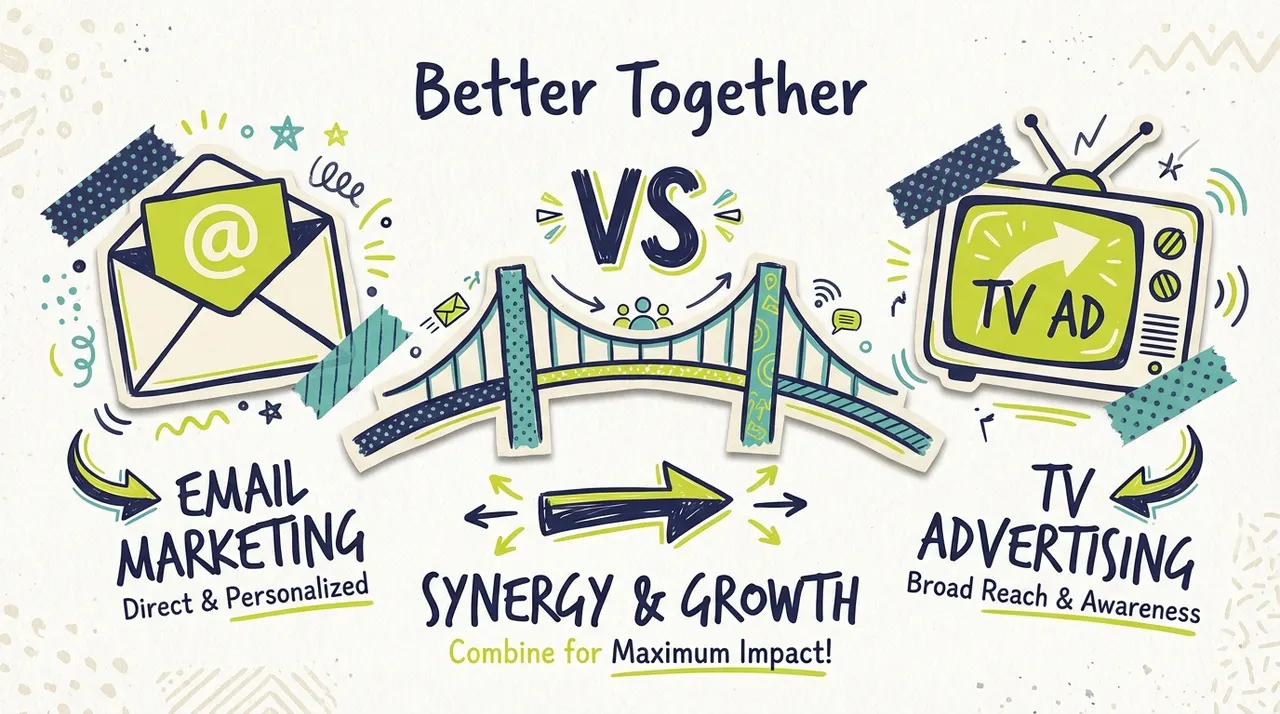
Email marketing and TV advertising sit at opposite ends of the marketing spectrum. Email is cheap, direct, and targets people who already know you. TV is bigger, broader, and reaches people who've never heard of you. Comparing them head-to-head misses the point, because they do fundamentally different jobs.
The real question isn't which one is better. It's when to use each, and how they work together to grow your business.
What email marketing does well

Email is a retention and conversion machine. It's one of the highest-ROI marketing channels available because you're talking to people who have already raised their hand by giving you their email address.
Strengths:
Low cost. Most email platforms cost $20 to $200 per month for small businesses. Sending an email to your list costs essentially nothing per message.
Direct relationship. You're in someone's inbox, not competing with 50 other ads on a page. It's a one-to-one channel.
Measurable. Open rates, click rates, conversion rates, revenue per email. Everything is trackable down to the individual subscriber.
Automation-friendly. Welcome sequences, abandoned cart reminders, birthday offers, and re-engagement campaigns can all run on autopilot.
Great for repeat business. Reminding existing customers about new products, seasonal offers, or appointment reminders is email's sweet spot.
Where email falls short:
You need a list first. Email only works if you have subscribers. Building a list from zero takes time and usually requires other channels to drive sign-ups.
Open rates. Mailchimp benchmarks put average opens for small-business email around 20 to 25%. Most messages are therefore recorded as unopened.
Zero awareness value. Email doesn't help you reach new customers. It only talks to people who already know you exist.
Inbox competition. The average person receives over 120 emails per day, according to Radicati Group. Standing out is harder than ever.
What TV advertising does well
TV is an awareness and trust-building machine. It puts your brand on the biggest, most trusted screen in the house and reaches people who might never find you through search or social.
Strengths:
Massive reach. CTV advertising reaches streaming audiences across 100+ premium channels. You can get in front of thousands of households in your local market.
Trust and credibility. Research from the Video Advertising Bureau shows that consumers trust TV advertising more than any other ad format. Being "on TV" signals legitimacy, especially for small businesses competing against larger brands.
Awareness at scale. TV is the most efficient channel for reaching people who don't know your business exists. It fills the top of your sales funnel with potential customers.
Halo effect on other channels. Businesses running CTV campaigns consistently see improvements across their digital marketing: higher branded search volume, better click-through rates on paid ads, and increased website traffic.
Non-skippable attention. CTV ads have completion rates above 90%. Viewers watch the full 30 seconds, which is far more attention than a banner ad or social post gets.
Where TV falls short:
Not a direct response channel. Viewers can't click a TV ad. The path from impression to conversion is longer and less direct than email or search.
Higher starting cost than email. While Adwave campaigns start at $50, effective CTV campaigns typically require $500 to $2,000 per month for consistent results. That's more than email, though far less than traditional TV.
Attribution complexity. Measuring TV's exact impact requires more effort than checking email open rates. You need to track branded search lift and other indirect signals.
The real comparison: funnel stage

The best way to think about email vs. TV is by where they fit in your customer journey:
Awareness (reaching new people):
TV: Excellent. This is TV's primary job.
Email: Poor. Can't reach people who aren't on your list.
Interest (educating and engaging):
TV: Good. Repeated exposure builds familiarity and trust.
Email: Excellent. Nurture sequences, educational content, and newsletters keep subscribers engaged.
Decision (converting leads to customers):
TV: Moderate. TV builds the credibility that makes conversion easier on other channels.
Email: Excellent. Targeted offers, testimonials, and limited-time deals drive action.
Retention (keeping customers coming back):
TV: Good. Retargeting existing customers on CTV keeps your brand visible.
Email: Excellent. Loyalty programs, reminders, and personalized recommendations drive repeat purchases.
The pattern is clear: TV dominates at the top of the funnel, email dominates at the bottom, and they complement each other in the middle.
When to prioritize email
You have an established customer base but flat growth. If you have hundreds or thousands of past customers but they're not coming back, email is the fastest way to re-engage them. A well-crafted win-back campaign can generate revenue in days.
Your business depends on repeat purchases. Restaurants, salons, fitness studios, subscription services, and any business where the same customer buys multiple times should invest heavily in email. The cost to retain is a fraction of the cost to acquire.
You have a long sales cycle. If your product or service requires weeks or months of consideration (home remodeling, financial planning, legal services), email nurture sequences keep you familiar throughout the decision process.
You're launching a new product to existing customers. When you have something new to announce to people who already trust you, email is the most efficient way to get the word out.
When to prioritize TV

You need new customers. If your growth has stalled because you've saturated your existing audience, TV is the most effective way to reach people who don't know you exist yet. No amount of email will help you reach non-subscribers.
You're entering a new market. Opening a second location, expanding your service area, or launching in a new geography requires awareness building. CTV's geographic targeting lets you focus on exactly the market you're entering.
You need to build brand trust. If you're a newer business or competing against established brands, the credibility that comes from being seen on TV is hard to replicate with any other channel. Consumers perceive TV advertisers as more legitimate and trustworthy.
Your digital ads are getting more expensive. If your Google Ads or Meta costs per lead are climbing (a common problem in competitive markets), adding TV as an awareness layer can reduce your cost per acquisition across all channels by increasing the volume of people who recognize your brand when they see your digital ads.
You're in a visually compelling industry. Restaurants, home services, automotive, fitness, and retail businesses benefit from showing their product or service in full motion on a big screen. A 30-second TV spot communicates things that a subject line never could.
The multiplier effect: using both together
Here's where it gets interesting. Email and TV aren't just complementary. They make each other better.
TV fills your email list. When people see your business on TV and visit your website, a percentage of them will sign up for your email list. TV drives awareness, your website captures the lead, and email nurtures them to a sale. Without TV (or another awareness channel), your list growth stagnates.
Email converts TV-driven awareness. A viewer sees your CTV ad on Monday. They visit your website on Wednesday and sign up for your newsletter. Over the next two weeks, they receive three emails: a welcome message, a customer success story, and a limited-time offer. They book an appointment. TV started the conversation, but email closed it.
Retargeting bridges the gap. CTV retargeting lets you show TV ads specifically to people who have visited your website or are on your email list. This creates a powerful loop: email drives them to your site, CTV reinforces your brand on their TV, and the next email they open feels more familiar and trustworthy.
Shared creative themes reinforce messaging. When your TV ad and your emails tell the same story (same offer, same visual style, same value proposition), the repetition across channels builds stronger recall than either channel alone. A customer who sees your spring promotion on TV and then gets an email about the same promotion is significantly more likely to act.
Budget allocation guidelines
For most small businesses, here's a reasonable starting framework:
If you're new and need awareness first:
TV/CTV: 60 to 70% of marketing budget
Email: 10 to 15% (mainly platform costs and list-building)
Other digital (search, social): 20 to 30%
If you have an established customer base:
TV/CTV: 30 to 40% of marketing budget
Email: 15 to 20%
Other digital: 40 to 50%
If you're balanced (need both new and repeat customers):
TV/CTV: 40 to 50%
Email: 15 to 20%
Other digital: 30 to 40%
These are starting points, not rules. The right mix depends on your industry, customer lifetime value, and growth goals. The important thing is that both channels are represented, because a business that only does email is invisible to new customers, and a business that only does TV is leaving repeat revenue on the table.
Industry-specific recommendations
Different businesses benefit from different channel balances. Here's how the email-vs-TV equation plays out across common small business types:
Restaurants and food service. Email is critical for repeat visits (weekly specials, loyalty rewards, event announcements). TV builds awareness with new diners in the area who haven't tried you yet. A restaurant with a strong email list but no awareness channel will plateau. Add CTV to reach the 80% of local households that haven't walked through your door.
Home services (HVAC, plumbing, roofing). TV tends to drive more value here because most customers need these services infrequently. You can't email someone who doesn't know you exist, and by the time they need an emergency plumber, brand awareness determines who they call. Use email for seasonal maintenance reminders and referral requests with existing customers.
Healthcare practices (dentists, chiropractors, med spas). Both channels are equally important. TV builds trust and awareness in the community (critical for healthcare), while email handles appointment reminders, recall campaigns, and patient education. The combination of TV credibility and email follow-up creates a powerful patient acquisition and retention engine.
Retail and e-commerce. Email drives a disproportionate share of revenue for retail businesses through flash sales, new arrival announcements, and abandoned cart recovery. But growth requires new customer acquisition, and TV advertising is increasingly the most cost-effective way to drive that awareness for local retailers.
Professional services (lawyers, accountants, financial advisors). Trust is everything in professional services. TV builds the credibility and name recognition that makes a prospect more likely to choose you when they need help. Email nurtures that relationship with educational content over the weeks or months it takes them to make a decision.
Real-world scenario: how a dental practice uses both
Let's put this all together with a practical example. Imagine a dental practice with 1,200 active patients and a goal of adding 40 new patients per month.
TV campaign: The practice runs CTV ads targeting families in a 15-mile radius, showing their modern office, same-day appointments, and friendly team. Budget: $1,500/month. The ads run on streaming platforms during prime time, reaching approximately 25,000 unique households per month.
Email program: The practice sends a monthly newsletter to existing patients with oral health tips, seasonal promotions, and referral incentives. They also run automated sequences: new patient welcome, 6-month recall reminders, and birthday greetings. Cost: $100/month for the email platform.
How they work together: A local family sees the practice's ad while watching Hulu. The next day, they Google the practice name (branded search lift from TV). They visit the website, read reviews, and fill out the new patient form, which captures their email address. They receive a welcome email with what to expect at their first visit. After their appointment, they enter the automated email sequence that keeps them coming back for cleanings every six months and encourages referrals.
Without TV, the practice's only awareness channel is word of mouth and Google Ads. Without email, they lose touch with patients between visits and miss referral opportunities. Together, TV fills the top of the funnel and email converts and retains at the bottom.
Common questions answered
Can email marketing replace TV advertising? No. They serve different purposes. Email is excellent for communicating with people who already know your business, but it can't reach new audiences. If you need to grow your customer base, you need an awareness channel like TV. Think of email as your retention engine and TV as your acquisition engine. They're partners, not substitutes.
Is TV advertising too expensive compared to email? The per-message cost of email is lower, but the comparison is misleading. Email only reaches your existing list, which has a ceiling. TV reaches entirely new audiences who could become lifelong customers. With CTV platforms like Adwave offering campaigns starting at $50, the gap between email and TV costs has narrowed dramatically. The question is less about cost per message and more about return on investment across your entire customer journey.
How do I measure which channel is driving more value? Track different metrics for each. For email, focus on revenue per email, conversion rate, and customer lifetime value of email-acquired customers. For TV, track branded search lift, new customer acquisition, and the halo effect on your other channels. Both channels should ultimately tie back to revenue, but the measurement path is different for each.
Should I build my email list before investing in TV? Not necessarily. TV advertising helps build your email list by driving new visitors to your website. If you wait until you have a large email list before running TV, you're waiting for the thing that TV helps create. A better approach is to start both simultaneously: run TV to drive awareness and website traffic, and capture email addresses from those visitors.
What about social media? Where does it fit? Social media sits between email and TV. It can reach new people (like TV) and nurture existing relationships (like email), but it does neither as effectively. Social is a good supporting channel, but most small businesses see the strongest results when TV handles awareness, email handles retention, and social fills the gaps in between.