What the data shows
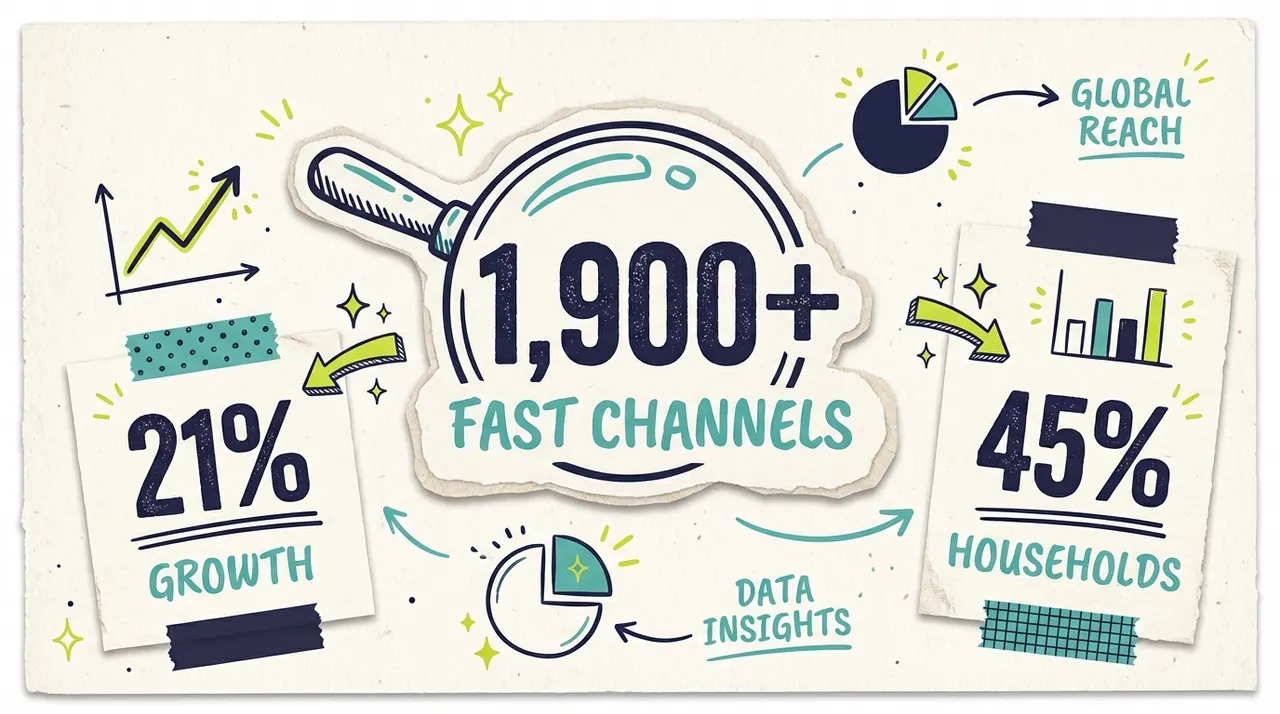
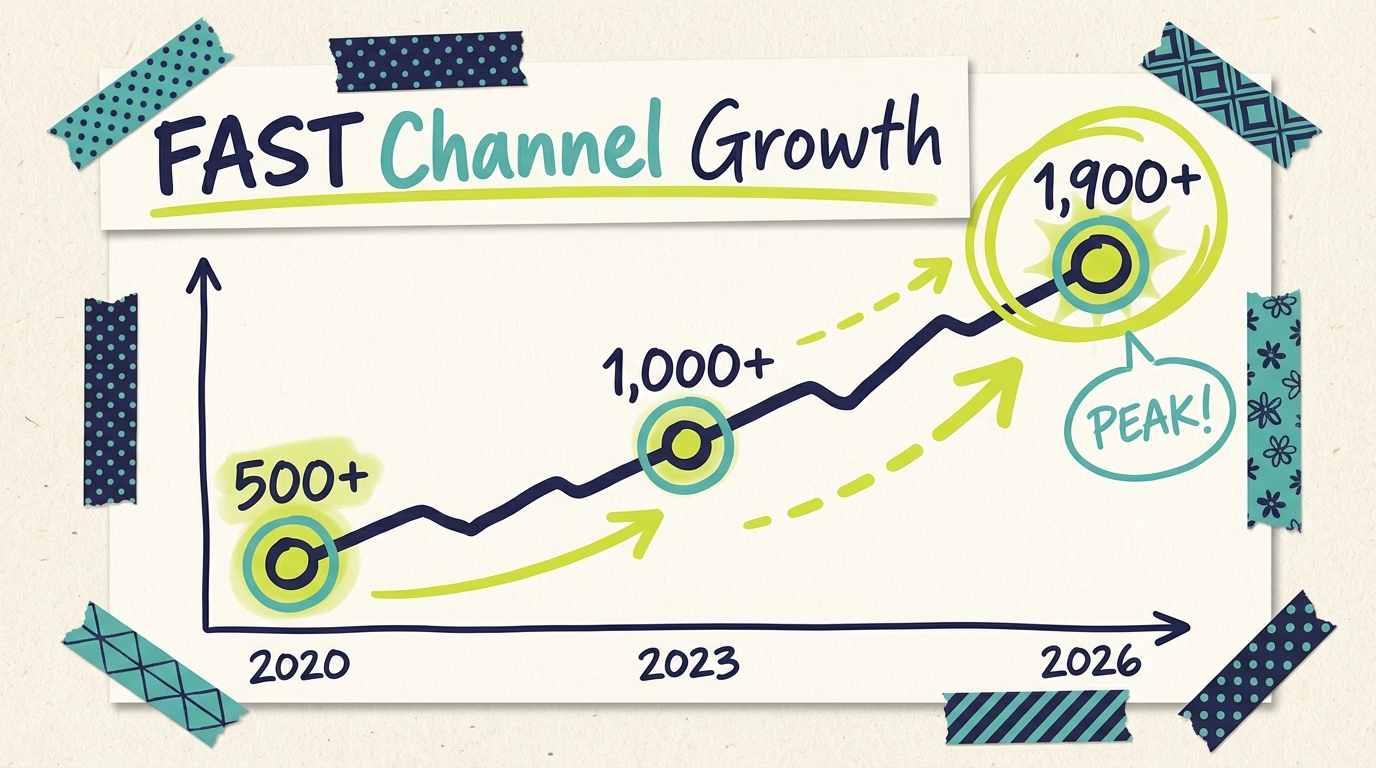
The FAST landscape has expanded at a remarkable pace. According to Gracenote, a Nielsen company, active FAST channels in key markets including the U.S., U.K., Germany, and Canada have nearly doubled since mid-2023, reaching more than 1,610 channels as of March 2025. Nearly three-quarters of these channels are available in the United States, making it the dominant FAST market globally.
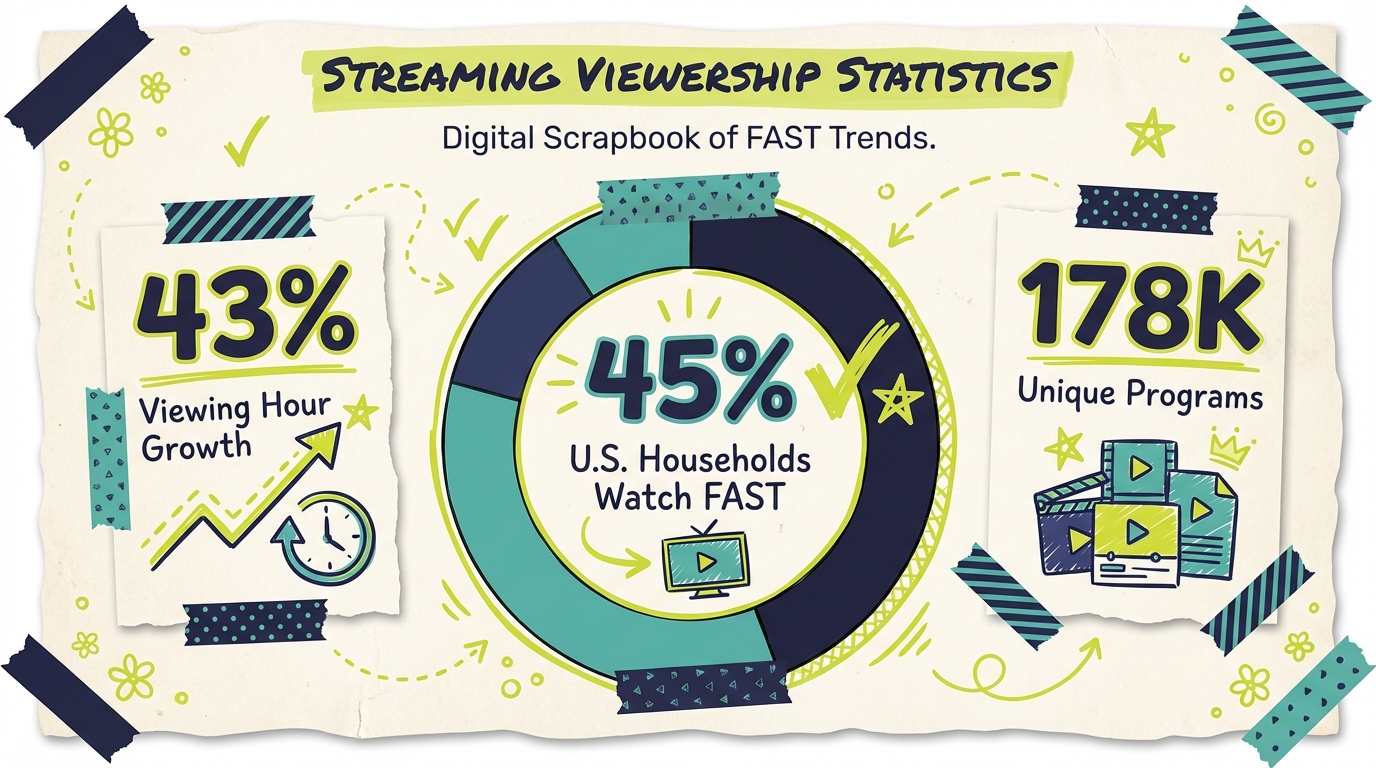
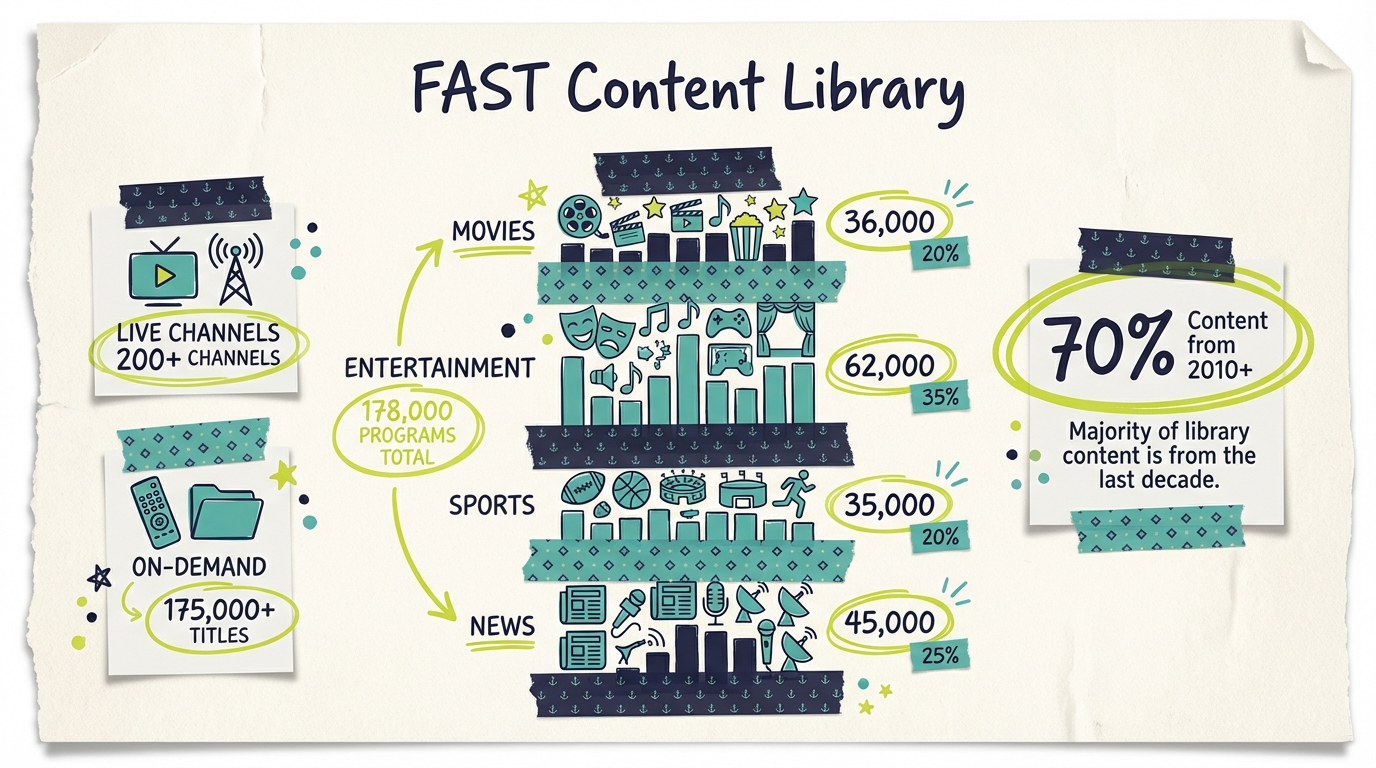
The sheer volume of content is staggering. Gracenote reports that more than 178,000 unique programs, episodes, and movies are now available on FAST channels, giving viewers abundant programming options at no cost. This isn't just back-catalog filler, either. More than 70% of FAST programming has been produced since 2010, according to Nielsen, meaning viewers are accessing relatively recent content, not just decades-old reruns.
The growth trajectory tells the story of rapid adoption. FAST channels rose 21% in 2025 alone, with programming increasing by 11% during the same period, according to Gracenote's analysis. That growth follows several years of double-digit expansion as viewers increasingly embrace free streaming alternatives to paid subscriptions.
Viewing hours reflect this channel expansion. Comscore's analysis found that total viewing hours on major FAST services surged 43% from August 2024 to August 2025. U.S. viewers streamed 1.8 billion hours of FAST content through August 2025, up from 1.3 billion hours during the same period in 2024. This isn't a niche viewing category anymore. It's a mainstream phenomenon.
The audience reach has followed the content growth. Parks Associates reports that 45% of U.S. internet households now watch FAST services, a swift adoption rate for a category that barely existed in its current form five years ago. When nearly half of connected households are watching free streaming TV, that's an advertising opportunity too large to ignore.
What makes this growth especially significant for advertisers is that every one of these 1,900+ channels carries advertising. Unlike subscription services where viewers can pay to avoid ads, FAST channels are inherently ad-supported. That means every hour of viewing on these platforms represents addressable advertising inventory.
---
Breaking down the numbers
The 1,900+ global FAST channel count masks important variations in channel types, content categories, and growth rates that matter for advertisers seeking to understand this landscape.
By content category
Entertainment leads all FAST channel genres, accounting for 303 channels according to Gracenote's breakdown. Gracenote defines entertainment as TV programs presented in non-story-based formats, usually filmed live in studio settings. Think talk shows, variety programs, and game shows.
Sports has emerged as a major growth category, with the number of sports-focused FAST channels more than doubling in the past year to reach 220 channels. This growth reflects both consumer demand and rights holders recognizing FAST as a viable distribution window for sports content. For local businesses, sports-focused FAST channels offer opportunities to reach engaged, often male-skewing audiences during live events and highlights programming.
Reality programming is the fastest-growing FAST category by far, with a 626% increase from 19 channels to 138 channels since July 2024, according to Gracenote. This explosive growth in reality content reflects both consumer appetite for the genre and the relatively lower rights costs that make reality programming attractive for FAST economics.
News and commentary rounds out the top genres, with dedicated news FAST channels capturing audiences who want always-on news coverage without cable subscriptions. For businesses in relevant categories, news-adjacent FAST inventory can offer premium positioning.
By geography
The United States dominates the global FAST market, with approximately three-quarters of all FAST channels available to American viewers. This concentration reflects several factors: higher smart TV penetration, more advanced cord-cutting trends, and the established infrastructure of ad-supported streaming in the U.S. market.
The U.K., Germany, and Canada represent the other major FAST markets tracked by Gracenote. While these markets have fewer total channels, they're growing rapidly as FAST platforms expand internationally. European FAST growth has been especially notable as viewers there increasingly explore free streaming alternatives to paid services.
By platform
The major FAST platforms have differentiated significantly in their channel offerings and audience reach. The Roku Channel, Tubi, and Pluto TV each exceed 50 million viewers according to industry estimates. Each platform curates a different mix of FAST channels, meaning the 1,900+ global channel count doesn't mean every channel appears everywhere.
Platform-specific channel counts vary considerably. Pluto TV, one of the original FAST pioneers, offers approximately 250+ live channels in the U.S. The Roku Channel has expanded its FAST offerings significantly as Roku has invested in original and licensed content. Tubi, owned by Fox, has emphasized both on-demand content and FAST channels.
For advertisers, this platform fragmentation matters less than it might seem. Most programmatic CTV advertising platforms aggregate inventory from multiple FAST services, allowing you to reach FAST audiences regardless of which specific platform or channel they're watching.
By content recency
One of the more surprising findings from Gracenote's analysis is the relative freshness of FAST content. More than 70% of programming available on FAST channels has been produced since 2010. This contradicts the assumption that FAST is primarily a repository for ancient content that can't find a home elsewhere.
The presence of recent content matters for both viewers and advertisers. Viewers get programming that feels current and relevant. Advertisers get to appear alongside content that audiences are actively choosing to watch, not just background noise from decades past.
---
Why it matters for your business
The explosion to 1,900+ FAST channels creates advertising opportunities that simply didn't exist five years ago. For small businesses, this matters for several concrete reasons.
First, more channels mean more inventory, and more inventory typically means more competitive pricing. When FAST was a niche category with limited channels, ad space was constrained. As channels have proliferated, the supply of available ad impressions has grown significantly, creating downward pressure on costs and making FAST advertising more accessible for smaller budgets.
Second, channel specialization creates targeting opportunities. With 220+ sports channels, 138+ reality channels, and 303+ entertainment channels, advertisers can align their messages with content that attracts their target customers. A home services business might prioritize home improvement FAST channels. A restaurant could focus on food and cooking content. The proliferation of niche channels enables contextual targeting that was impossible when TV meant three broadcast networks.
Third, FAST viewers are valuable customers. The 45% of U.S. internet households watching FAST services aren't just cheapskates avoiding paid subscriptions. Research consistently shows FAST audiences skew toward cord-cutters who are often younger, more tech-savvy, and actively engaged with streaming content. These are consumers who've made deliberate choices about their entertainment, not passive viewers letting cable run in the background.
Fourth, FAST advertising delivers the full TV experience. Your 30-second commercial appears full-screen, non-skippable, in a living room environment where viewers are engaged with content. This isn't display advertising competing with dozens of other elements on screen. It's television advertising with all the attention and impact that implies, just delivered through streaming infrastructure.
The accessibility angle is important. Platforms like Adwave enable small businesses to run TV advertising on FAST channels and 100+ other premium networks starting at just $50. No production budget required because AI generates your commercial from your website. No agency needed. The barriers that kept local businesses off television for decades have essentially disappeared.
---
How to take advantage of this trend
Understanding that FAST has exploded to 1,900+ channels is useful context. Acting on that knowledge is what grows your business.
The most practical approach for small businesses new to TV advertising is to start broad and let data guide your focus. Don't try to cherry-pick specific FAST channels for your first campaign. Instead, use a platform that aggregates FAST inventory alongside other streaming TV options and target based on geography and demographics rather than channel selection.
Set up a test campaign with a modest budget, $200 to $500 over two weeks is plenty to generate meaningful learning. Target your service area geographically, typically a 15-25 mile radius for local businesses. Let the platform optimize delivery over the available inventory, which will include FAST channels alongside other ad-supported streaming options.
As your campaign runs, pay attention to the data. Which time slots generate the most impressions? What content categories seem to perform? Most CTV advertising platforms provide reporting that helps you understand where your ads are appearing and how they're performing. Use this data to refine subsequent campaigns.
Consider content alignment as you scale. If you're a fitness business, sports and wellness FAST channels make intuitive sense. If you're a home services provider, home improvement and DIY content could be a natural fit. Many advertising platforms allow you to weight delivery toward specific content categories once you're past the testing phase.
Don't overlook frequency. The goal isn't to reach the maximum number of unique viewers. It's to reach your target audience often enough that they remember you. FAST's large inventory base makes it easier to achieve frequency without paying premium rates, since there's abundant supply to keep your ads running consistently.
For measurement, recognize that TV advertising works differently than click-based digital marketing. Track brand search volume during and after campaigns. Monitor overall website traffic patterns. Use QR codes in your creative if you want a direct response mechanism. Survey new customers about how they heard about you. The ROI is real, but it doesn't show up as a click-through rate.
---
The bigger picture
The growth to 1,900+ FAST channels fits into a larger transformation of how Americans watch television and, consequently, how advertisers reach them.
The ad-supported streaming revolution
FAST is part of a broader shift toward ad-supported streaming. According to Nielsen, ad-supported viewing now accounts for approximately 73% of all TV time, including both traditional linear TV and streaming. The assumption that streaming meant ad-free viewing has been thoroughly disproven. Viewers have shown they're willing to accept advertising in exchange for free or lower-cost content.
This ad-supported shift benefits small businesses directly. Every percentage point of viewing that moves from ad-free premium subscriptions to ad-supported options represents inventory that's accessible to advertisers. The more viewers watch ad-supported content, whether FAST, ad-tiers on Netflix and Disney+, or ad-supported Hulu, the more opportunities exist to reach them.
The fragmentation opportunity
Media observers often frame fragmentation as a problem: audiences scattered over hundreds of options, no more mass-market moments. For major brands seeking 100 million viewer Super Bowl-style reach, fragmentation is indeed a challenge.
For local businesses, fragmentation is an opportunity. You don't need 100 million viewers. You need the households in your service area. FAST's proliferation to 1,900+ channels, combined with programmatic advertising technology that aggregates those channels, means you can assemble your specific audience from fragments of the streaming landscape.
What's next for FAST
Industry analysts project continued FAST growth through at least 2027. Several factors support this trajectory. Smart TV penetration continues to increase, with the devices that make FAST viewing convenient now standard in most American homes. Content owners continue to see FAST as a viable distribution and monetization window. And consumer appetite for free entertainment shows no signs of declining.
The 1,900+ channel count will likely continue climbing. Some channels will fail and disappear. New ones will launch. The overall trajectory points toward more options, not fewer. For advertisers, this means FAST will become an increasingly mainstream component of television advertising strategies.
---
What experts are saying
Industry analysts have taken note of FAST's rapid expansion and its implications for the broader media landscape.
"FAST is in many ways a unique service, but its lifeblood is still content," said Tim Cutting, Chief Revenue Officer at Gracenote, in the company's 2025 report. "So, program-level metadata providing understanding of FAST content is more important than ever to audience engagement and advertising initiatives."
The emphasis on content quality reflects a maturation of the FAST space. Early FAST services were often repositories for obscure content that couldn't find audiences elsewhere. Today, with 70%+ of content produced since 2010 and major media companies treating FAST as a strategic priority, the content on these channels has become considerably more compelling.
Trade publications have highlighted the advertising implications. "The rise of ad-supported streaming, led by YouTube and FAST services, is the biggest shift in TV advertising since cable fragmented the broadcast monopoly," one recent IAB analysis noted. "Except this time, the beneficiaries aren't just big brands. They're any business with a message and a modest budget."
The consensus among industry observers is that FAST represents a permanent structural change, not a temporary phenomenon. The economic model works for content owners, platforms, and viewers alike. That sustainability means the 1,900+ channel ecosystem is likely to remain and grow.
---
Common questions answered
What is FAST (Free Ad-Supported Streaming Television)?
FAST stands for Free Ad-Supported Streaming Television. These are streaming services and channels that viewers can watch at no cost, with advertising supporting the business model. Unlike subscription streaming services such as Netflix or Disney+, FAST doesn't require a monthly payment. Major FAST platforms include Pluto TV, Tubi, The Roku Channel, and Freevee. FAST content is typically accessed through smart TVs, streaming devices like Roku or Fire TV, or mobile apps.
Which FAST platforms have the most channels?
Pluto TV, one of the original FAST services, offers approximately 250+ live channels in the U.S. market. The Roku Channel and Tubi also offer extensive channel lineups, though exact counts vary as platforms continuously add and adjust their offerings. Rather than focusing on any single platform's channel count, advertisers typically work with CTV advertising platforms that aggregate inventory from multiple FAST services.
How is FAST different from other streaming?
FAST differs from subscription video on demand (SVOD) services like Netflix in that it's completely free to viewers and supported entirely by advertising. It also differs from ad-supported tiers on subscription services (like Netflix's ad tier) in that FAST requires no subscription at all. FAST channels typically offer linear, scheduled programming similar to traditional TV, though most platforms also include on-demand libraries. The viewing experience resembles cable TV but delivered through streaming infrastructure.
Can small businesses advertise on FAST channels?
Yes, and this is precisely what makes the FAST explosion significant for local businesses. Traditional TV advertising required five-figure minimum buys and expensive production. Modern CTV advertising platforms allow businesses to run ads on FAST channels and other streaming services with budgets starting as low as $50. Platforms like Adwave generate broadcast-quality commercials using AI, eliminating the production cost barrier entirely.
How do I target specific FAST channels for advertising?
Most small business-friendly CTV advertising platforms don't offer channel-by-channel selection, which is a benefit for most advertisers. Instead, you target based on geography, demographics, and sometimes content categories. The platform then optimizes delivery over available FAST inventory (and often other streaming inventory) to reach your specified audience. This approach typically delivers better results than trying to manually select specific channels.
Is FAST viewership growing or stabilizing?
FAST viewership continues to grow, though some industry analysts have noted signs of potential plateauing in new user acquisition during early 2025. However, viewing hours among existing users continue to increase, with Comscore reporting a 43% year-over-year increase in total FAST viewing hours. The category's long-term growth trajectory remains positive, supported by continued smart TV adoption and cord-cutting trends.
---
Supporting data
Additional context on FAST channels and the streaming landscape:
Global FAST channels: Approximately 1,900 FAST channels exist globally (Gracenote, 2025)
U.S. FAST channels: More than 1,300 FAST channels available in the U.S. market (Gracenote, 2025)
Channel growth: FAST channels rose 21% in 2025 (Gracenote, 2025)
Viewing growth: FAST viewing hours up 43% year-over-year (Comscore, August 2025)
Household reach: 45% of U.S. internet households watch FAST services (Parks Associates, 2025)
Content volume: 178,000+ unique programs available on FAST channels (Nielsen/Gracenote, March 2025)
Content recency: 70%+ of FAST programming produced since 2010 (Nielsen/Gracenote, March 2025)
Sports channels: 220+ sports FAST channels, more than doubled YoY (Gracenote, 2025)
Reality growth: Reality channels up 626% from 19 to 138 since July 2024 (Gracenote, 2025)
Major platforms: Roku Channel, Tubi, Pluto TV each exceed 50M viewers (eMarketer, 2025)
All sources linked above. Data current as of January 2026.
---