You're probably doing what most small business owners do online. You publish on your own site, post on social, maybe send an email now and then, and still feel like you're talking to the same small circle.
Instead of waiting for people to discover your business on a website they've never heard of, you put your expertise on websites they already trust. Done well, guest blogging gets your name in front of established audiences, earns attention you didn't have to buy outright, and gives people a reason to remember you when they need what you sell. For local businesses, that matters more than most SEO advice admits. A placement on the right industry blog, neighborhood publication, trade site, or community outlet can create brand lift, referral traffic, and real conversations with future customers.
Why Guest Blogging Is Your Secret Weapon for Growth
A local business can run good ads, post on social, sponsor community events, and still get overlooked online. The problem usually is not effort. It is distribution. Your expertise keeps showing up only on channels you already own, in front of people who may already know you.
Guest blogging changes that by putting your name in front of an audience another publisher has already earned. For a small business, that reach can do the same kind of brand work as local TV advertising, just in a different format. TV builds familiarity through repeated exposure. Guest posts build familiarity by attaching your name to useful advice on sites people already read and trust.

Guest blogging also remains a common B2B practice. OptinMonster cites industry data showing that 60% of blogs write 1 to 5 guest posts per month, which tells you this is an active publishing channel, not a dated tactic from an old SEO playbook. It is part of a repeatable content system, as noted in these guest blogging statistics from OptinMonster.
Credibility transfers faster than awareness
A useful guest post does something your own blog often cannot do quickly. It shortens the trust gap.
If a respected regional publication, trade association site, neighborhood news outlet, or niche industry blog publishes your advice, readers borrow some of that trust and apply it to your business. That can lead to branded searches, referral traffic, better close rates on sales calls, and more recognition when your company name comes up offline.
For local businesses, that often matters more than a raw link count.
A CPA firm that publishes tax planning advice on a city business journal may hear, "I saw your article," during a consultation. A home services company that contributes seasonal maintenance guidance to a neighborhood publication may become the first name a homeowner remembers three months later. Those outcomes are harder to track than a click. They still produce revenue.
The web is crowded, so distribution matters
WordPress reports that users publish millions of posts each month across WordPress sites alone, which is a useful reminder that publishing on your own site is only one part of the job. The harder part is getting seen by people who do not know you yet, according to WordPress statistics on content publishing volume.
That is why I treat guest blogging as a brand awareness channel first and an SEO benefit second. The best placements do both, but local companies usually get the strongest return when the article reaches the right audience, supports sales conversations, and gives the business another credible place to point prospects. If you are also building visibility around a founder or spokesperson, this guide on how to promote your personal brand fits well alongside a guest posting plan.
Finding and Vetting Your Target Websites
Most guest blogging campaigns fail before the first email goes out. The target list is weak. Business owners chase sites that look impressive on paper but have no audience fit, sloppy standards, or pages built mostly to sell placements.
The fix isn't “find bigger websites.” The fix is building a smarter list.
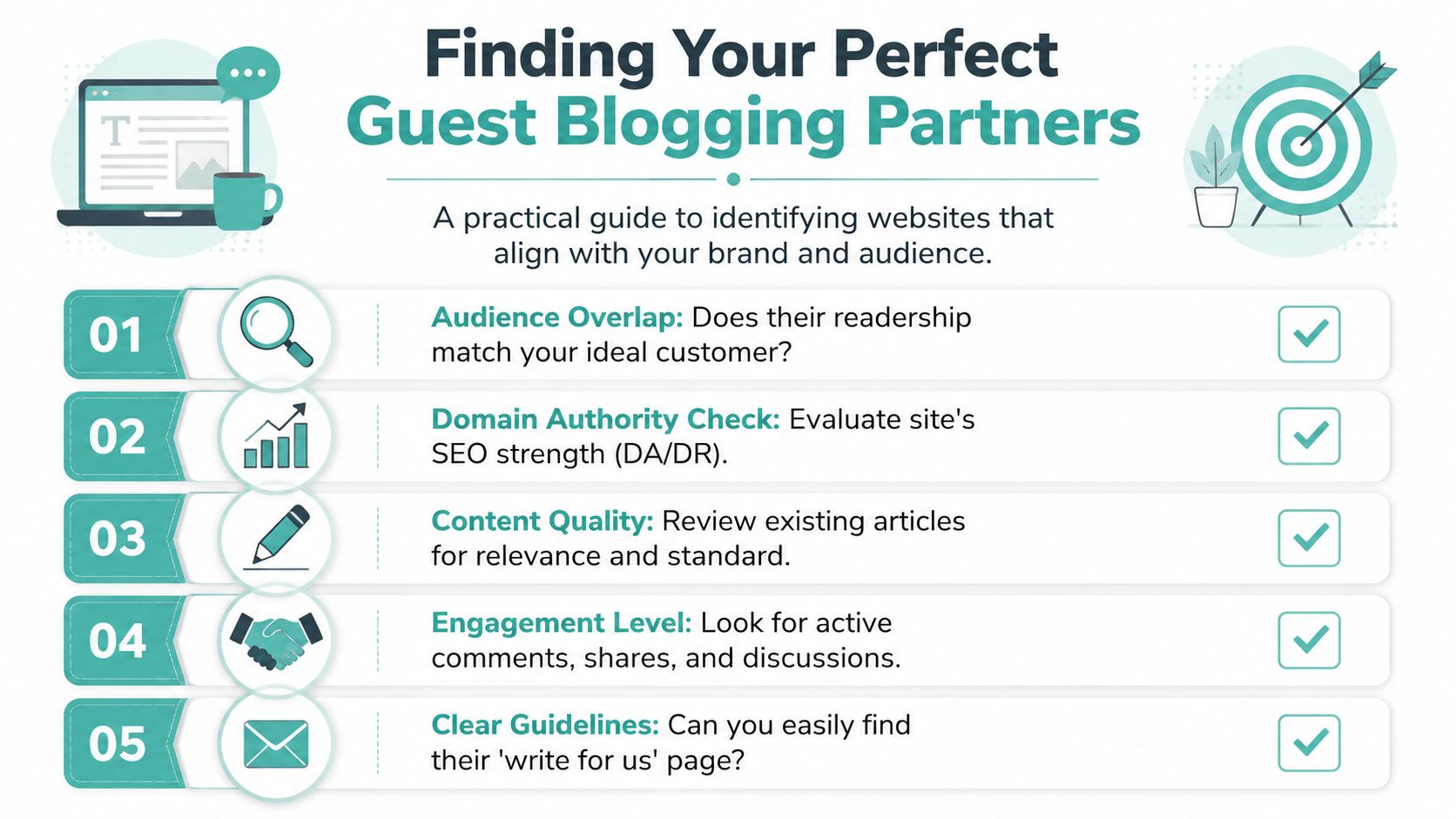
Start with audience fit, not vanity metrics
A local roofing company shouldn't aim only for broad marketing blogs. A family law firm shouldn't assume a national business site is better than a respected regional publication. A specialty retailer may get more value from a tightly matched niche blog than a larger site with a diluted audience.
Recent industry analysis warns about low-quality guest post inventory. Practitioners now screen hundreds of sites because a lower-authority site with a tightly matched audience can outperform a higher-authority but less relevant publication, especially for local or niche businesses, according to this Semrush analysis of guest posts.
That lines up with what works in practice. If the audience is wrong, the placement is wrong.
Build your list from three buckets
Use a simple mix instead of searching only for “write for us” pages.
Industry and trade publications These are blogs, magazines, and resource hubs your customers or peers already read. Think home improvement sites, local business journals, legal resources, healthcare publications, real estate blogs, or restaurant industry outlets.
Local and regional publishers Community newspapers, chamber blogs, city guides, neighborhood magazines, and regional business outlets can be excellent targets. They often care more about relevance and practical expertise than polished thought leadership language.
Adjacent audience sites Some of the best opportunities sit next to your industry, not inside it. A landscaper can pitch home design websites. A physical therapist can write for fitness communities. A CPA can contribute to small business publications.
A clear picture of your reader helps here. Adwave's overview of audience segmentation is useful if you need to define who you want to reach before you start pitching.
Use a simple vetting scorecard
Don't overcomplicate this. Open the site and judge it like a customer would.
If a site looks built for contributors instead of readers, skip it.
What a good prospect looks like
A strong target site usually has:
A clear audience: You can name who reads it in one sentence.
An editorial point of view: The site publishes with standards, not just volume.
A content gap you can fill: You can spot topics they haven't covered well yet.
A business reason to matter: The placement could drive trust, leads, referrals, or partnerships.
Weak sites tempt business owners because they're easier to get into. That's exactly why they're usually worth less.
Crafting a Pitch Editors Can't Ignore
Editors don't need another message that says, “I loved your blog and would like to contribute an article about marketing tips.” They've seen that email a thousand times.
A pitch gets attention when it proves three things fast. You understand the publication. You have a topic their audience would be interested in. You can deliver clean, useful copy without creating extra work.

Do the homework before you write the email
High-performing guest blogging depends on matching your pitch to the publication's coverage and editorial rules. Guidance on guest posting recommends checking what the site recently published, tailoring the subject line and intro to the editor, and waiting about 1 to 2 weeks before following up if there's no response, as outlined in this guest posting workflow guide.
That means your prep should answer four questions:
What has this site covered recently?
What does its audience care about right now?
What angle can you offer that isn't repetitive?
What proof suggests you can write at their standard?
The best pitches feel specific
Editors respond to relevance, not enthusiasm.
A weak pitch says, “I can write about digital marketing.”
A strong pitch says, “You've covered Google Business Profile optimization and local review strategy recently, but I didn't see anything on how service businesses can use guest articles on regional publications to build referral traffic and local trust. I can contribute a practical piece with examples from local service brands.”
That second version shows judgment.
Editors don't want topic ideas. They want confidence that you understand what belongs on their site.
A practical pitch template
Use this as a base, then customize it heavily.
Subject: Guest article idea for [Publication Name] on [specific audience problem]
Hi [Editor Name],
I'm [name], and I work with [who you help]. I've been reading [specific section, article, or topic area] on [site name], especially your recent piece on [relevant article/topic].
I'd love to contribute a guest article for your readers. One idea that seems like a fit is:
[Proposed headline]
The piece would cover:
I can also tailor the angle to match your editorial style and existing coverage. If helpful, I'm happy to send two alternate ideas.
Best, [Name] [Role and company] [Relevant writing sample or website]
What to avoid
Some mistakes kill a pitch immediately:
Generic praise: Editors can spot fake familiarity fast.
Broad topics: “Business tips” isn't an article idea.
Premature self-promotion: The email is about their audience, not your services.
Over-following up: One polite nudge later is enough.
Short subject lines usually help. Plain language helps more. If your email sounds like outreach software wrote it, it will get treated like outreach software wrote it.
Writing a Guest Post That Builds Authority
A local business owner lands a guest spot on a respected city magazine site, then wastes it on a generic article that could have appeared anywhere. The placement looks good on paper, but it does little for trust, search visibility, or sales conversations. The better move is to publish something readers remember and local prospects mention later.
A strong guest post fits the host site and still sounds like you. That balance matters. If your article reads like copied website copy, editors stop inviting you back. If it sounds polished but disconnected from your real expertise, readers may enjoy it without associating the value with your business.
Write for the audience the publisher already earned
Guest posts perform better when they solve a specific problem for the host site's readers and do it with enough depth to feel worth their time. Short, promotional articles rarely carry much weight now. Editors usually want practical pieces with a clear angle, useful structure, and examples that come from real client work, local market experience, or day-to-day operations.
That means every draft needs a job.
For a local roofing company, that job might be helping homeowners compare repair versus replacement after storm season. For a family law firm, it might be explaining the early decisions that reduce stress and cost during a custody dispute. For a med spa, it could be showing how clients evaluate treatment options before they book a consultation.
Strong guest posts usually include:
A clear promise: Readers should know what they will learn in the first few lines.
Specific examples: Use situations, objections, mistakes, or decisions you see in practice.
Useful formatting: Subheads, short paragraphs, and tight transitions make the article easier to scan.
A local point of view: Mention regional patterns, customer behavior, or market realities when they strengthen the piece.
That local angle is often what makes a guest post pay off for a small business. A broad marketing blog can help your reputation. A respected local publication or niche regional site can also support branded search, referral traffic, and sales trust in the same way local TV advertising builds familiarity over time. The difference is that a good guest post keeps working after the publish date because prospects can find it, share it, and return to it.
Use real experience to build trust
Authority comes from judgment, not jargon.
Weak guest posts stay vague because the writer is trying to sound broadly applicable. Strong guest posts make informed choices. They explain what works, where it breaks, and what a reader should do next. That is what makes the piece useful and what makes your business sound credible.
Say you own a landscaping company. “Maintain your yard year-round” is forgettable. A piece on how drought restrictions change planting choices in your county is useful. If you run a dental practice, “tips for choosing a dentist” is too soft. A post explaining how patients compare cosmetic dentistry options, pricing models, and treatment timelines gives people something concrete to act on.
Specificity also protects you from sounding promotional. You are teaching the audience how to think, not forcing them toward a service page.
Handle links and mentions with restraint
Editors and readers can spot a sales pitch quickly. Keep links relevant and limited. One link to a page on your site is often enough if it helps the reader continue the topic. If the publication allows more references, use them to support the article, not to crowd the piece with self-promotion.
Promotion matters after publication too, especially if your goal is local visibility and brand recall. A tool like the LinkedIn Free Promotion Tool can help you get more attention on the post once it is live, which is useful when you want the article to support your broader marketing mix instead of sitting idly on someone else's site.
Treat the byline like part of the strategy
For many local businesses, the byline drives more action than an in-article link. Readers finish the article, decide you know your subject, and check who you are. A weak byline wastes that interest. A strong one turns it into a site visit, a branded search, or a direct inquiry.
Write the bio around three points:
Who you help
What problem you solve
Where to go next
“Jane Smith is the founder of Smith Legal” says very little. “Jane Smith helps small business owners handle contract and compliance issues before they become expensive disputes. Learn more at [brand site]” gives the reader a reason to care.
If you want a cleaner draft before adapting it to a publisher's style, Adwave's guide on how to write a blog post that ranks on Google is a useful reference.
Measuring and Maximizing Your Guest Blogging ROI
A published post feels like a finish line. It isn't. It's the moment measurement starts.
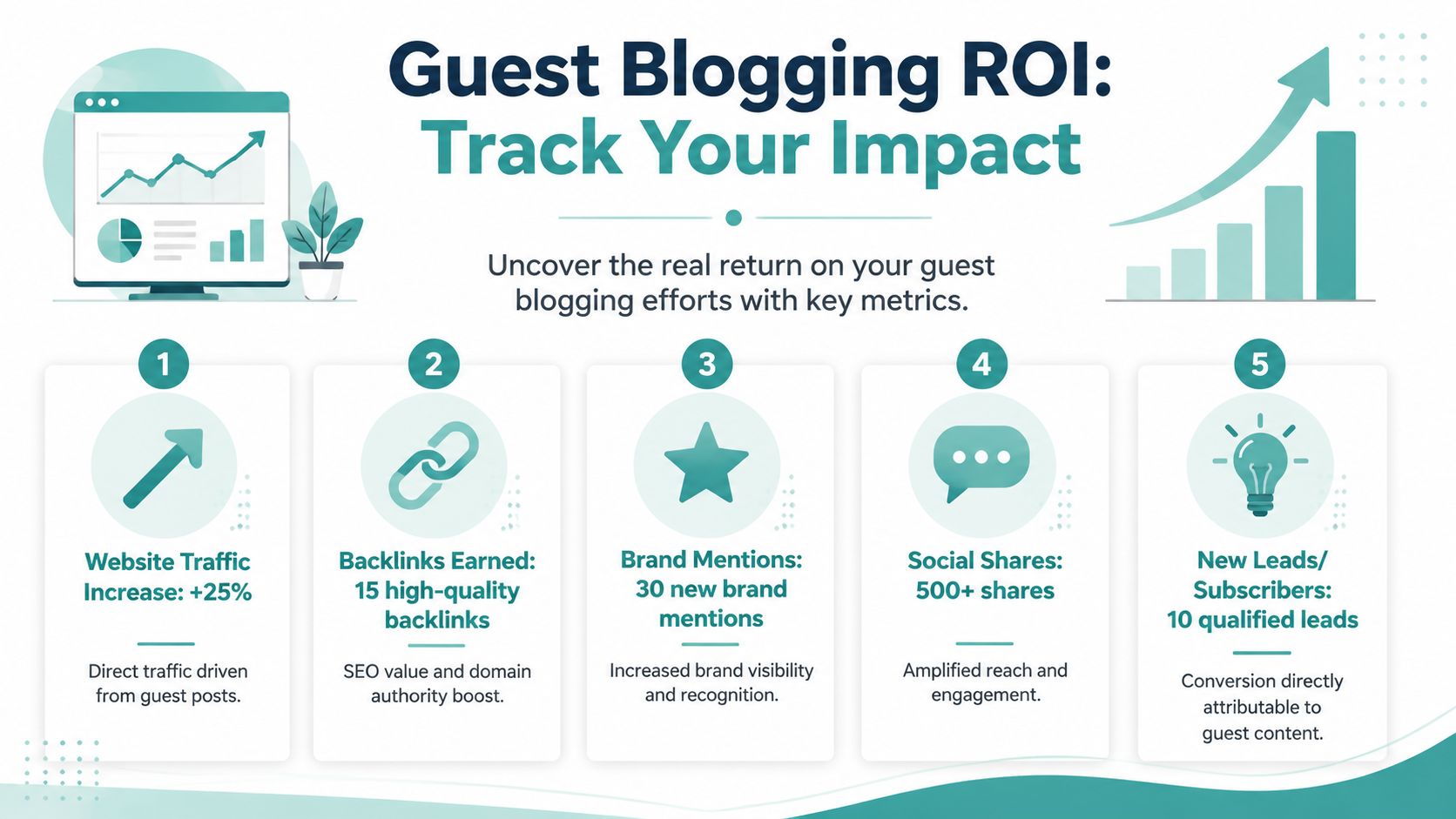
A guest post only becomes a good marketing asset when you can connect it to a business outcome. That outcome might be referral traffic, branded searches, stronger sales conversations, newsletter growth, or introductions that lead to partnerships. The point is the same. You need evidence that the placement moved something that matters.
Track the post against the original goal
The most useful benchmark in guest blogging is measurement discipline. Guidance on guest blogging recommends tracking performance against the initial goal using referral traffic, keyword ranking changes, assisted conversions, and on-page engagement, as explained in this BuzzStream guide to guest blogging. That same guidance emphasizes concise bylines, strong calls to action, and promoting the article after publication.
That means you should decide the purpose before the pitch goes out.
If your goal was local trust, then “we got a backlink” isn't enough. If your goal was direct traffic, look at how many people visited and what they did next. If your goal was partnerships, document conversations that started because someone saw the article.
Use a simple ROI lens
Here's a practical way to review each placement after it goes live.
Not every post needs to perform in every category. One excellent niche placement may drive very little search value and still be worth doing because the audience is full of buyers or referral partners.
A guest post can be a win even when SEO value is modest, if it earns credibility with the right people.
Promote the post after publication
A lot of businesses undercut their own results here. They work hard to land the placement, then share it once and move on.
Do more with it:
Share it several times: Use different angles in social posts instead of repeating the same caption.
Send it to your email list: Frame it as useful reading, not self-congratulation.
Equip your sales team: Give them the article when prospects need proof of expertise.
Repurpose the content: Turn one argument from the article into short-form posts, a video script, a FAQ, or a sales follow-up asset.
If you want a cleaner system for reuse, Adwave's resource on content repurposing from one article into multiple assets is worth bookmarking.
Look at guest blogging as part of your brand stack
For local businesses, guest blogging works best when it isn't carrying all your brand-building weight by itself.
A good guest post builds authority with a concentrated audience. It helps people trust your business when they discover you through search, referrals, or industry research. But broad awareness often needs another channel alongside it. That's why smart local brands combine credibility tactics with visibility tactics. The guest article earns trust in context. Broader advertising helps more people recognize the name when they encounter it elsewhere.
That combination is where small business marketing starts to compound. Someone sees your business name in one place, then again in another, and the second impression works better because the first one already did some trust-building.
Advanced Guest Blogging FAQs
Once you've published a few pieces, the easy advice stops being useful. The key questions are about trade-offs.
Is a guest post still worth it if the SEO value looks weak
Yes, sometimes.
A growing critique of modern guest blogging is that backlink-first thinking isn't reliable on its own. A more useful question for small businesses is whether a post creates meaningful brand credibility, direct traffic, or partnership opportunities, as discussed in
.If a respected local publication puts your business in front of the right audience, that can be worth more than a technically stronger link from a site your customers never read.
Should I choose a niche site over a bigger publication
If the niche site has sharper audience overlap, often yes.
A smaller publication can outperform a larger one when readers are closer to your buyer, referral source, or local market. The mistake is assuming prestige equals return. Relevance usually beats reach when you're trying to drive actual business outcomes.
How many guest posts should a small business do
Enough to make it a system, not so many that quality drops.
The right cadence depends on your capacity to research, pitch, write, and promote properly. One strong post on the right site is better than several rushed posts on weak websites. If the work starts feeling like volume outreach, the quality usually slips fast.
What makes a guest post site a bad bet
Three things usually show up together. Weak editorial standards, loose audience fit, and obvious contributor sprawl.
If every article looks interchangeable, if the topics feel random, or if the site seems built around selling contribution spots, move on. Those placements rarely help your brand.
Can guest blogging help a local business that also relies on offline channels
Absolutely.
That's one of the strongest use cases. A local business often needs repeated exposure across different environments before someone remembers the name and takes action. Guest blogging can provide the expertise signal. Other channels can reinforce awareness. Together, they make your business feel more established than either channel would alone.
If you want more local buyers to recognize your business name, not just click a link once, Adwave is a strong complement to guest blogging. Guest posts build credibility on trusted websites. Adwave helps small businesses turn that credibility into broader local visibility through AI-powered TV advertising across premium channels, with a workflow built for teams that don't have agency budgets or production crews. It's a practical way to pair niche authority with wider market awareness.