You publish a blog post, maybe a few social updates, and wait for something to happen. Traffic barely moves. Leads don't come in. The content isn't wrong, but it also isn't tied to what people are actively looking for when they need help.
That's the problem. Most small businesses don't struggle because they lack ideas. They struggle because they create from the inside out. They write what they want to say instead of what buyers are already asking.
The fastest way to improve content performance is to stop brainstorming in a vacuum. Good topics usually aren't invented. They're uncovered in search data, customer questions, sales conversations, review language, and the searches people make right after they see your brand somewhere else. If you want to learn how to find content ideas your audience searches for, start by listening before you publish.
Stop Guessing What Content to Create
Small business owners waste time on content for one simple reason. They pick topics based on assumptions.
A contractor writes "Why Quality Matters." A dentist posts "Meet Our Team." A retailer publishes "Top Trends This Season." None of those pieces are necessarily bad, but they usually sit far away from buying intent. They reflect what the business wants to say, not what the customer typed into Google five minutes before needing help.
What strong content ideas have in common
Useful content starts with a real signal. That signal might come from:
Search impressions you already earn: Queries in Google Search Console show where Google already sees some relevance.
Repeated customer questions: Emails, phone calls, form submissions, and sales notes reveal friction points.
Search result patterns: Google autocomplete, Related Searches, and People Also Ask expose how people phrase problems.
Community language: Reddit, Quora, and niche forums show the words customers use when they aren't trying to sound polished.
Offline attention that turns into search behavior: Brand awareness from channels like TV often leads to immediate validation searches, local intent searches, and service comparisons.
If your audience keeps asking about financing, turnaround time, warranties, side effects, repairs, scheduling, delivery windows, or service areas, that's your content plan. You don't need another abstract brainstorm session.
Practical rule: If a question shows up in search data and in customer conversations, publish on it before writing another generic brand-awareness post.
What works and what usually doesn't
Here's the trade-off most owners face:
The shift is simple. Stop asking, "What should we post this month?" Start asking, "What is our audience trying to solve, compare, verify, or buy right now?"
That one change usually makes content sharper, more useful, and easier to connect to revenue.
Uncover Hidden Gems in Your Own Data
The cheapest content research tool is usually the one you already have. Your own site data tells you where Google has started testing your relevance, and your customer interactions tell you what people care about enough to ask directly.

Start with Google Search Console
One practical way to find audience-searched topics is to combine Google Search Console with SERP expansion tools. Search Console shows the exact search terms already driving impressions and clicks, while autocomplete and People Also Ask reveal adjacent questions in real wording, as explained in MailerLite's guide on finding content ideas with Search Console and SERP signals.
Look for queries where your site already appears but doesn't rank strongly yet. Those are often easier wins than starting from zero.
Use this quick process:
Open the Performance report: Filter by queries and pages.
Find impression-heavy terms: If people are seeing you in results, Google already associates your site with that topic.
Check weak pages: Sometimes a service page ranks for several related searches but answers only one of them.
Expand the query manually: Type the phrase into Google and review autocomplete plus People Also Ask.
Create a tighter asset: That could be a blog post, FAQ page, city page, comparison page, or service explainer.
A roofing company might notice impressions for "roof leak repair insurance" even if its existing service page barely mentions claims. That's a strong cue to create a dedicated page answering insurance-related roof leak questions.
If you're still getting your tracking foundation in order, this Google Analytics 4 walkthrough for small businesses helps connect content activity to actual business outcomes.
Mine the questions your team hears every week
Search data matters, but it doesn't catch everything. Customers often tell you what they care about before keyword tools do.
Review these sources:
Support inboxes: Repeated questions about refunds, setup, repairs, timelines, and policies should become content.
Sales call notes: Objections often turn into high-value articles. "Do you service my area?" or "What's included?" are classic examples.
Contact form submissions: Short phrases from forms often become strong H2s and FAQ entries.
Review language: Positive reviews tell you what to emphasize. Negative reviews tell you what to clarify.
If customers ask the same question before buying, publishing the answer saves time twice. It helps your team and it helps the next prospect.
Turn internal signals into publishable topics
Don't overcomplicate the jump from question to content. A direct question can become a direct asset.
Examples:
Warranty confusion becomes a full warranty guide.
"Do you work weekends?" becomes an operating-hours FAQ and a local service page section.
"How long does treatment take?" becomes a process article.
"What's the difference between your two services?" becomes a comparison page.
This is the lowest-cost content work you can do because the raw material already exists. You're not guessing. You're documenting what buyers already need clarified before they trust you.
Decode What Your Audience Asks Google
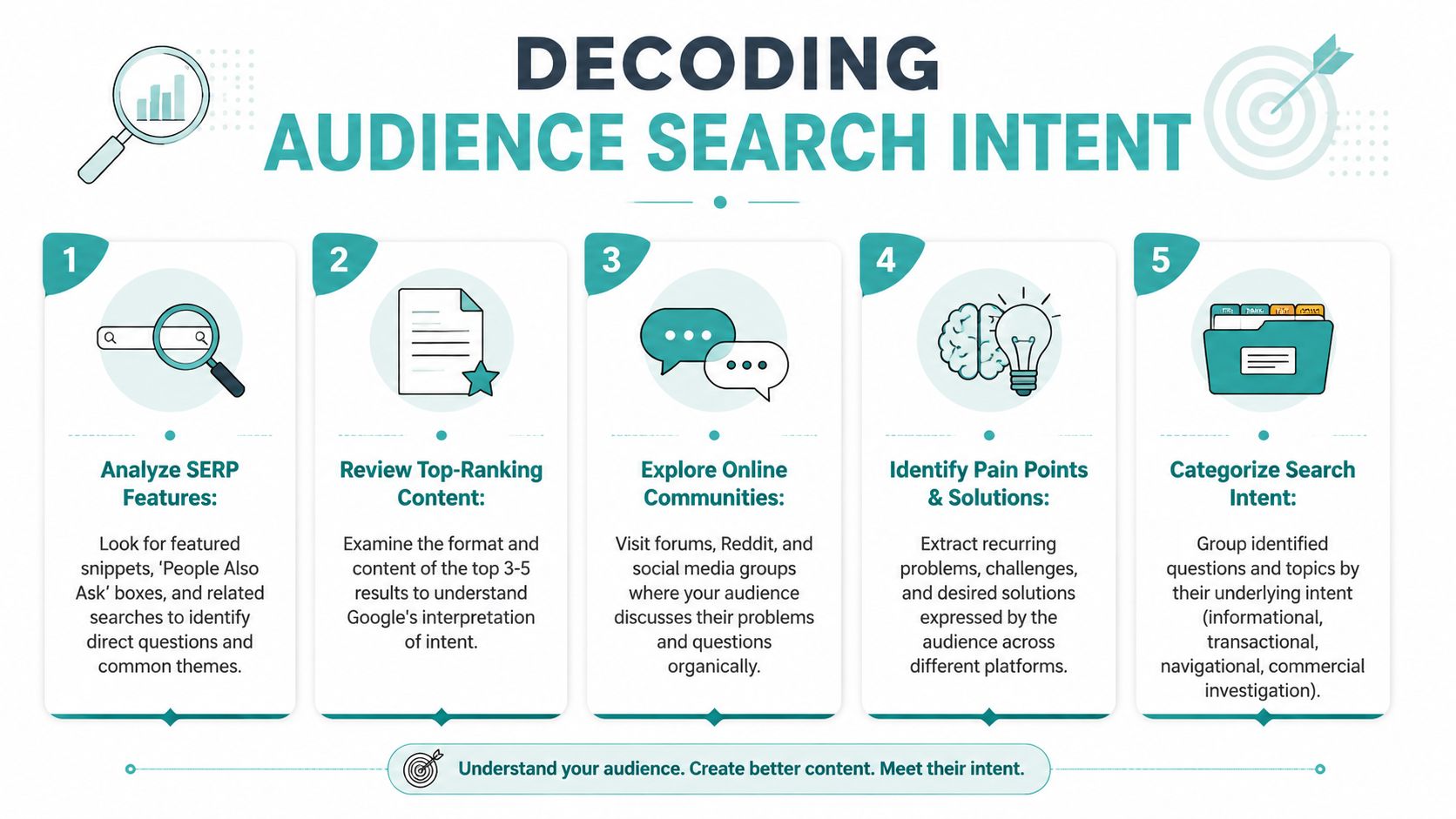
Google is a live record of commercial curiosity. Every autocomplete suggestion, People Also Ask question, and Related Search tells you something about intent.
In 2024, Google reported 8.2 billion daily queries, with People Also Ask appearing in 15% of search results globally, and SEMrush found that 62% of top-ranking pages explicitly address questions from People Also Ask. Those figures come from the verified data provided for this article. The practical takeaway is simple. If you ignore question-based search behavior, you're leaving topic opportunities on the table.
Read the search results before you write
Take a basic query from your market and study the page. Don't just grab the phrase and run.
If you're a local plumber and you search "fix leaky faucet," Google may show:
Tutorials,
Emergency service pages,
Cost questions,
Product recommendation lists,
And local map results.
That mix tells you the query isn't just informational. It's split across DIY intent, problem diagnosis, and service intent.
Use this review process:
Check the top results: Are they guides, category pages, videos, or local service pages?
Open People Also Ask: Expand several questions and note recurring subtopics.
Scroll to Related Searches: These often reveal variants you should cover in headings or separate pages.
Notice modifiers: Words like "cost," "near me," "best," "how long," and "reviews" signal different stages of buying.
A useful article on writing blog posts that rank on Google can help once you've identified the right topic and intent.
Use forums to hear unfiltered language
Forums matter because people type differently when they aren't optimizing for search. They talk in specifics.
Search Reddit, Quora, Facebook groups, and niche forums for phrases tied to your service. Look for:
Frustration,
Comparisons,
Urgency,
Local concerns,
And objections.
A dentist may find people asking about pain, cost, insurance, or whether a certain procedure is worth it. A home services company may notice people asking who shows up fast, who cleans up after the job, and who works after hours. Those are content opportunities because they're tied to buyer hesitation.
Search habit to adopt: Open a forum thread and copy the exact wording people use. Those phrases often work better than polished marketing language.
What doesn't work is lifting random high-volume keywords without checking the SERP first. Search volume can attract attention, but intent determines whether content earns trust or just impressions.
Connect TV Attention to High-Intent Searches
Most content guides treat search behavior as if it begins inside a keyword tool. That misses a major source of demand. People often search because something offline triggered them to act.
Local TV is one of the clearest examples. A viewer sees a business name, offer, service category, or local brand message, then opens a phone and searches to verify, compare, or take the next step.
TV doesn't replace search. It creates search
Verified data for this article states that a 2025 McKinsey study on local media consumption found 74% of local TV viewers search for "near me" services within 15 minutes of viewing an ad, while 85% of content strategists rely solely on national keyword tools. The same verified data states that the 2025 Nielsen TV/Digital Cross-Platform Report found 68% of consumers search for products after seeing them on broadcast TV.
For a small business, that's the opening most SEO content misses.
A local viewer usually doesn't search in broad, textbook terms after seeing an ad. They search in practical, validating language such as:
Brand name + reviews,
Service + city,
Problem + near me,
Price or financing questions,
"is this worth it" comparisons.
That's especially true in home services, retail, dental, automotive, and professional services.
What post-TV search intent looks like
A few examples make this clearer.
National keyword tools often flatten this demand because hyper-local and branded searches may look small in broad databases. But those searches can carry strong intent because the person already knows your name or just saw your offer.
Build content around the searches your ad is likely to trigger
If you're running TV, create content around the second search, not just the first impression.
That means publishing:
Location pages tied to service intent
FAQ pages that answer immediate objections
Review and trust pages that validate the brand
Offer explainer pages if your ad mentions financing, free estimates, or a limited promotion
Comparison pages when buyers are likely evaluating options
A TV campaign works harder when viewers land on pages that match the exact question they ask after seeing the ad. If the ad creates awareness and the search confirms intent, your content becomes the bridge between attention and action.
Broad keyword research tells you what a market searches in general. Post-TV content research tells you what your local audience searches right after they notice you.
There's also a timing lesson here. If an ad is scheduled to run, your related content shouldn't appear weeks later. It should already exist, indexed, and easy to find when search interest spikes.
A practical follow-up is to pair TV exposure with digital remarketing and conversion-focused pages. This guide to retargeting TV viewers for CTV conversions is useful if you want to connect awareness and follow-up more tightly.
Prioritize Ideas and Build a Content Plan
Once you start collecting ideas from Search Console, customer questions, SERP research, communities, and TV-driven search behavior, the core problem changes. You no longer need more ideas. You need a way to decide what deserves attention first.
According to the verified data provided for this article, HubSpot's 2025 Global Content Marketing Report found that 78% of marketers prioritize community-driven content ideas, and verified data from ChartMogul shows content addressing specific pain points generates 3.2 times more organic traffic. The takeaway isn't that you should chase every question. It's that relevance to pain points should outrank vanity topics.
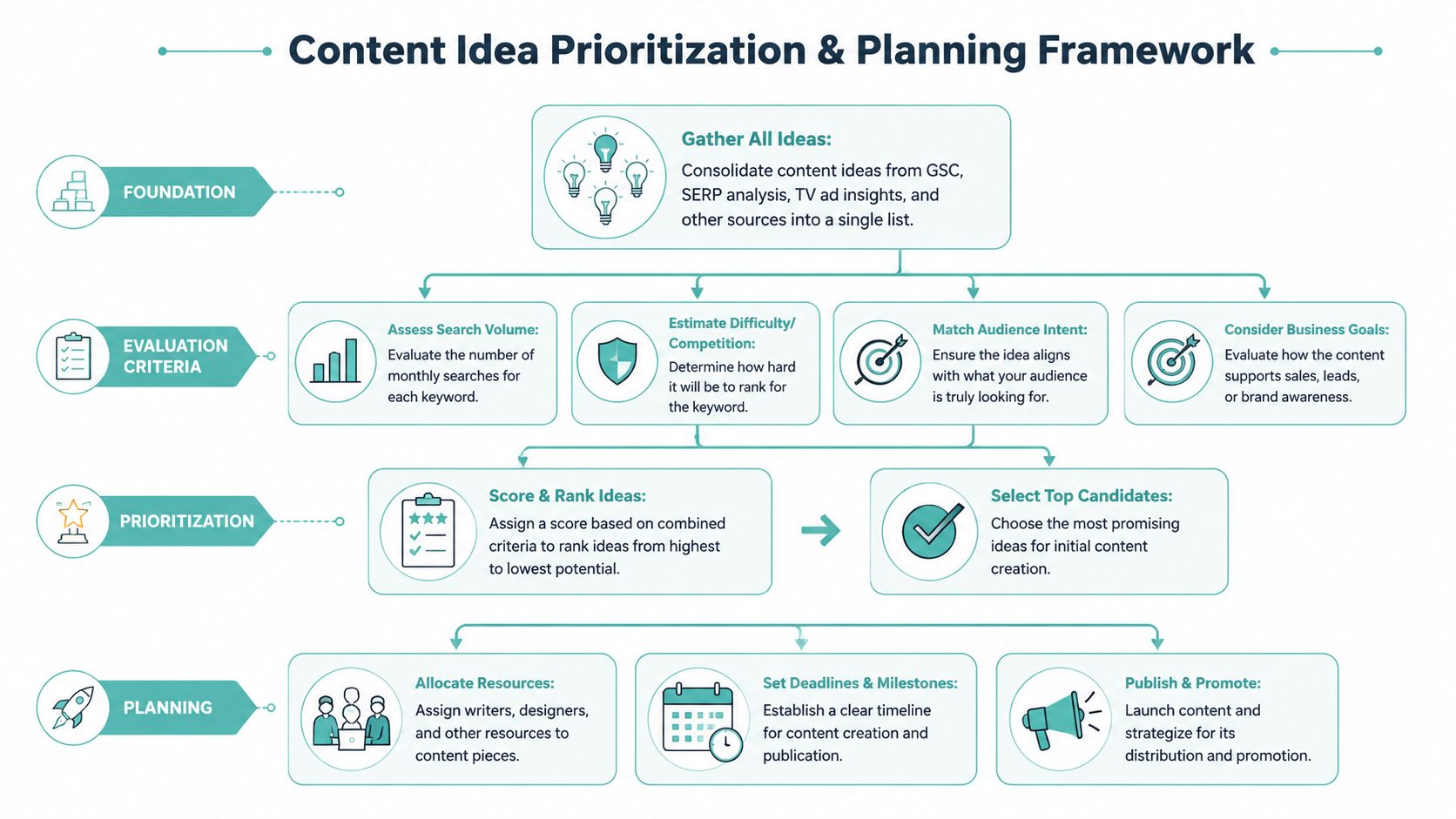
Use a simple scoring system
For a small business, a lightweight scoring model works better than a giant spreadsheet.
Score each idea on three factors:
Audience relevance Does this solve a question buyers ask before contacting you?
Business value If the page ranks or gets seen, can it influence leads, sales calls, bookings, or quote requests?
Difficulty Can you realistically compete with your current site authority and resources?
Rate each one from low to high using your own internal scale. The exact scoring method matters less than consistency.
A topic like "how much does emergency plumbing cost" may score high on relevance and business value. A topic like "history of plumbing technology" may be easy to write but weak for lead generation.
Separate priority ideas from nice-to-have ideas
A short table can keep the decision process honest.
Decision filter: If a topic won't help a buyer choose, trust, or contact you, it probably doesn't belong at the top of the queue.
Build topic clusters instead of isolated posts
One-off articles can work, but clusters usually create a stronger content structure.
Start with one central page, then support it with narrower assets.
Example for an HVAC company:
Pillar page: Homeowner's guide to HVAC maintenance
Cluster post: How often to change your air filter
Cluster post: Signs your AC unit may need replacement
Cluster post: What's included in seasonal HVAC maintenance
Cluster post: HVAC maintenance cost questions homeowners ask
This structure helps in two ways. First, visitors can move from general information to a specific answer. Second, your site sends clearer topical signals because related pages reinforce one another.
If you need a lightweight planning system, this content calendar template for planning three months in 30 minutes is a useful place to start.
Keep the plan realistic
A weak content plan usually fails because it's too ambitious. Small businesses don't need a publishing machine. They need consistency around high-intent topics.
A practical quarterly plan often looks like:
One pillar page,
A handful of supporting posts,
A few FAQ expansions,
And updates to existing service pages.
That approach is easier to maintain, and it keeps your effort tied to topics that can move the business.
From Ideas to Impact
Content starts working when it answers the right question at the right moment. That's the pattern across everything in this guide.
Your best ideas are usually sitting in places you already control or can observe for free. Search Console shows where you have traction. Customer interactions show what needs clarification. Google reveals public intent. Community discussions expose unfiltered pain points. TV exposure can trigger local, high-intent searches that standard keyword workflows often miss.
The working process to keep
Use this as your repeatable workflow:
Check first-party signals first: Review Search Console, email questions, call notes, and review language.
Expand with live SERP research: Use autocomplete, People Also Ask, and Related Searches to sharpen the topic.
Look for real-world phrasing: Pull wording from communities and customer conversations.
Account for trigger channels: If you're running ads, especially local TV, plan content around the searches those ads are likely to create.
Prioritize ruthlessly: Publish what helps buyers decide, trust, and act.
The businesses that improve content performance usually aren't producing more noise. They're reducing guesswork.
The point isn't to "do content marketing." The point is to answer the question that stands between a prospect and a decision.
If you're a small business owner with limited time, that's good news. You don't need a huge team or an expensive stack to learn how to find content ideas your audience searches for. You need a better listening habit and a simpler decision process.
Do that consistently, and your content stops being filler. It becomes part of how customers find you, evaluate you, and choose you.
If you want to turn local TV attention into measurable search demand, Adwave is a strong fit. It gives small businesses a practical way to launch TV advertising without the usual complexity, then pair that visibility with smarter digital follow-up. For brands that want affordable reach across premium channels and a clearer path from ad exposure to search-driven conversions, Adwave is worth a close look.