You're probably in one of two situations right now. Either social media keeps falling to the bottom of the list because no one owns it, or one person in the business is posting inconsistently between sales calls, customer issues, and everything else.
That's usually when owners ask the wrong first question. They ask, “Who can post for us cheaply?” The better question is, “What kind of help fits the work, the risk, and the result we need?”
A social media intern and a social media freelancer can both be smart hires. They are not interchangeable. One is usually a training relationship with tighter supervision and legal guardrails. The other is usually a contract relationship built for speed, specialization, and clearer output expectations. If you treat them the same, you waste time, create avoidable legal exposure, and end up disappointed with the work.
How to Hire and Manage a Social Media Intern or Freelancer starts with that distinction. Then it comes down to writing a role that filters out weak fits, vetting work before you commit, setting operating rules early, and measuring whether the work is helping the business rather than just filling a feed.
Define Your Needs Intern vs Freelancer
Small businesses often hire too early for a title and too late for a job definition. That's where social media starts going sideways. If you don't know whether you need execution, strategy, or both, you'll either underbuy and get stuck coaching constantly, or overbuy and pay for skills you won't use.
The intern versus freelancer decision is the first real strategic choice. It affects budget, management load, legal setup, and how quickly you can expect useful output.
When an intern makes sense
An intern works best when the role is built around learning, supervision, and repeatable tasks. Think content support, basic scheduling, asset organization, clipping short videos, drafting captions from an approved brief, and helping maintain a content calendar.
That can work well for a business that already has brand direction and just needs hands to help execute it. There's also a real talent pool available. There are over 43,002 social media interns in the U.S., 68.8% are women, and they are 53% more likely to work at private companies, which makes them accessible for small businesses according to Zippia's social media internship demographics.
Interns are usually the wrong fit when you need someone to independently build channel strategy, own reporting, or make judgment calls without much oversight.
Practical rule: Hire an intern when you already know what “good” looks like and need help producing it consistently.
When a freelancer makes sense
A freelancer makes sense when the work needs experience, judgment, and speed. That includes campaign planning, channel audits, launch strategy, analytics, performance reviews, audience messaging, and testing creative angles that tie back to leads or sales.
Freelancers also tend to be easier to source for flexible or specialized engagements. The same Zippia source notes that freelancers lead social media job-seeking usage at 91%, which usually means a deeper pool of candidates already operating independently.
If you're not sure whether you need a freelancer or a broader support role, it helps to look at adjacent operating models. Fluidwave's guide to virtual assistants is useful because it shows where admin support ends and higher-skill marketing ownership begins.
For owners trying to map out the actual tool stack before hiring, Adwave's resource on the best social media scheduling tools for small business is also a practical shortcut. It helps clarify whether your hire will schedule approved content or manage a fuller publishing workflow.
Intern vs Freelancer Which is Right for Your Business
A simple test helps. If the job can be documented in checklists and reviewed closely, an intern may fit. If the job requires someone to diagnose problems, choose priorities, and improve results without waiting on you every day, hire a freelancer.
Craft a Compelling Job Post and Find Top Talent
Most weak hires start with a weak brief. If your post says “looking for a social media rockstar” or “must be creative and passionate,” you'll attract people who like social media, not people who can run it.
Write the post around business outcomes, operating constraints, and the exact type of work. Good candidates want clarity because it tells them whether they can succeed.

What to include in the post
Skip buzzwords. Include the actual operating reality.
Role summary Explain what the person is there to accomplish. Example: support weekly content publishing, track engagement trends, and help turn campaign assets into social posts.
Specific responsibilities Name the work. Scheduling posts, drafting captions, building monthly calendars, repurposing testimonials, pulling analytics, or creating short-form video edits.
Required skills Ask for what you'll evaluate. Portfolio links, platform familiarity, writing samples, reporting ability, and experience with tools like Buffer, Hootsuite, Meta Business Suite, or Canva.
Decision environment Clarify whether they'll execute approved work or own strategy. This single line filters a lot of bad fits.
Communication cadence Tell candidates how often they'll report, who approves work, and how feedback happens.
One more point matters. Ask for a short, specific response instead of generic cover letters. A simple prompt like “show two examples of social posts you created and explain why they worked” reveals more than a resume ever will.
Where to look
Job boards still have value, but social channels have become a serious recruiting engine. A projected 91% of U.S. employers will use social media for hiring by 2026, with recruiters most active on LinkedIn at 78%, Facebook at 65%, and Instagram at 58%. The same dataset says 82% use social media specifically to source passive candidates, and candidates sourced this way are 8x more likely to be hired than those from traditional job boards according to HireLab's social media recruitment statistics.
Review a candidate's public work for writing quality, audience fit, and examples of relevant campaigns.
Try a mixed sourcing approach:
Post publicly on LinkedIn and niche freelance platforms.
Search manually for people already making smart content in your category.
Use local college career centers if the role is internship-based.
Consider regional remote hiring if you need strong execution at a sustainable budget. For teams exploring that route, best place to hire LATAM talent is worth reviewing as a starting point.
If your business sells to other businesses, candidate sourcing should reflect that too. Adwave's guide to LinkedIn marketing for small B2B companies is helpful because it sharpens what good B2B social judgment looks like before you start evaluating applicants.
The best candidates don't just talk about content. They talk about audience, distribution, and what the post is supposed to do.
Interviewing Hiring and Legal Essentials
A polished portfolio can still hide weak thinking. Some candidates are great at presenting finished work they barely touched. Others know trends but can't connect content to a business goal. The interview process has to uncover that before you sign anything.

Ask questions that reveal judgment
A useful interview doesn't stay at the level of preferences. “What platforms do you like?” tells you almost nothing. Ask how they think.
Good questions include:
Walk me through a channel you improved Listen for diagnosis, not storytelling. Strong candidates explain what was wrong, what they changed, and how they measured progress.
How do you decide what not to post This exposes whether they understand brand fit and audience fatigue.
What would you do in the first two weeks here You're listening for prioritization, not ambition.
How would you repurpose one asset into multiple posts That shows whether they can produce efficiently.
What metrics would you watch first You want someone who can separate noise from signal.
The strongest answers are usually specific, restrained, and tied to process. Weak answers sound performative. They use trend language but don't show operating discipline.
Use a paid trial task
A paid trial task is one of the best filters you have because it shifts the evaluation from credentials to actual work. The benchmark is strong. You can reject up to 70% of candidates who fail to incorporate data-driven personas into their trial work, and 62% of successful trial tasks convert to long-term hires according to Upwork's hiring guidance for social media managers.
Keep the task small and real. Don't ask for free strategy decks. Ask for something like this:
Review our current social presence.
Propose three posts for next week.
Explain the target audience for each.
State the objective behind each post.
Show what metric you'd watch first.
That's enough to see whether they understand message, format, audience, and business intent.
Pay for the trial. You'll get better effort, better ethics, and a cleaner hiring signal.
Get the legal classification right
Many small businesses get sloppy, especially when the role starts casually. That's a mistake.
According to Indeed's guidance on hiring social media interns, interns must receive training akin to education under Fair Labor Standards Act rules, and misclassifying an intern as free labor instead of an employee can lead to fines of over $1,000 per violation. For freelancers, a 1099 form is required, and the same source notes a 2025 Upwork report found 42% of freelance disputes involve unclear IP rights.
What the paperwork needs to cover
If you hire a freelancer, the contract should clearly spell out:
Who owns the content after payment
Confidentiality obligations
Approval process
Revision limits
Access rules for accounts and tools
Payment terms
Termination terms
If you hire an intern, document the learning component and supervision structure carefully. If the person is doing the work of an ordinary employee without the educational framework that internship rules require, you're creating risk.
A surprising amount of conflict comes from skipping simple language around ownership. If the freelancer designs templates, writes captions, edits videos, or creates campaign concepts, the contract should say exactly when those assets become yours.
Onboarding Setting KPIs and Managing Workflow
A good hire can still fail in a messy system. That's why owners sometimes think they hired the wrong person when the underlying problem was access, approval delays, scattered assets, or vague expectations.
The first month needs structure. Not bureaucracy. Structure.
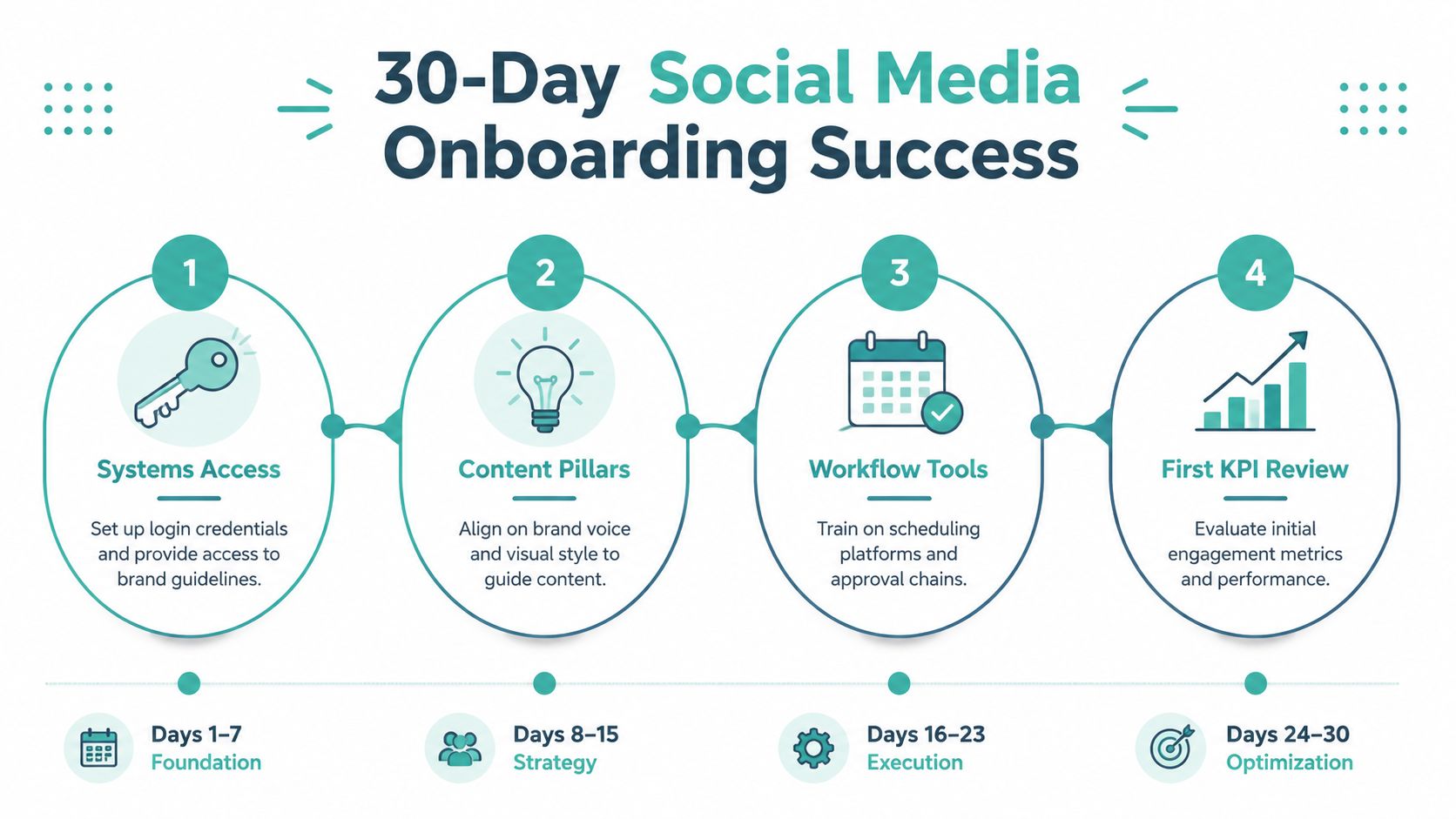
What they need in the first 30 days
Start with access and context before you ask for output. If someone spends the first week chasing logos, login credentials, customer proof points, and approval contacts, they're not onboarding. They're scavenging.
A clean first month usually includes:
Systems access Give access to the platforms, scheduling tools, shared drive, analytics view, and brand files they need.
Brand context Share your offers, audience segments, common objections, best-performing assets, and examples of content that reflects the brand well.
Workflow rules Define how drafts are submitted, who approves them, turnaround expectations, and what can be published without extra review.
Reporting setup Create one place where they track output and results. A simple dashboard or shared sheet is enough if it's consistent.
If you use tools like Buffer, Sprout Social, Meta Business Suite, Google Sheets, Notion, or ClickUp, assign them on day one. Don't let the hire build a workflow from scratch unless that's part of the role.
Set KPIs that guide behavior
Most social media management goes off course when the only target is “post more.” That creates activity, not control. The work needs KPIs that tell the person what matters and tell you whether the effort is improving.
According to Twine's guide on freelance social media manager oversight, misaligned expectations contribute to a 48% turnover rate, and one practical fix is weekly 30-minute standups to review KPIs. The same source gives a 4% to 6% engagement rate benchmark for tech SMB marketing, and notes that managers using data-driven performance audits see 28% higher ROI than those relying on intuition.
That gives you a management model:
Weekly standup to review what shipped, what performed, and what needs changing
Simple KPI sheet tracking core metrics consistently
Periodic audit reviewing quality, timeliness, and analytics together
Useful KPIs depend on the role, but for most small businesses they include:
Engagement quality rather than just raw likes
Click-through behavior when posts are meant to drive traffic
Content production reliability
Lead indicators tied to campaigns, offers, or landing pages
Channel-specific learning such as what hooks, formats, or topics earn attention
For a team trying to clean up process beyond social alone, WeekBlast's piece on improving team productivity in 2026 pairs well with this kind of operating discipline.
Build a workflow they can survive
A freelancer usually needs fewer meetings but sharper briefs. An intern usually needs more review and more explicit guardrails. Manage accordingly.
What works:
A content calendar with approval dates
A single brief template
Weekly standups
Clear escalation rules for legal, customer, or brand-sensitive posts
A shared performance view so no one debates numbers in different systems
What doesn't work:
Random Slack messages replacing a brief
Last-minute “can you just post this” requests all week
No access to past performance
Feedback like “make it pop” with no business direction
Judging performance only by whether the owner personally liked a post
A social media hire should spend time publishing and learning, not decoding your company from fragments.
If you need help deciding which metrics deserve space on that KPI sheet, Adwave's guide to social media analytics and what metrics matter is a practical reference.
Giving Constructive Feedback and Measuring True ROI
Feedback should make the next round better. Too many owners wait until they're frustrated, then give broad criticism that doesn't help the person improve. “This doesn't feel right” is not management. It's a reaction.
Use a simple review rhythm. Look at recent posts, identify what worked, call out what missed, and tie every note to a business objective. If a post got attention but brought the wrong audience, say that. If the copy was clear but the creative didn't stop the scroll, say that too.
Keep feedback specific and reusable
Strong feedback usually fits into three buckets:
What to repeat Keep successful hooks, useful formats, or strong calls to action.
What to change Tighten copy, improve the first line, shorten video intros, or sharpen audience relevance.
What to test next Try a new angle, a different proof point, a different offer framing, or a different visual treatment.
The paid trial task continues to pay off. You already saw how the person thinks before hiring. Compare live work against that baseline. If the trial showed strategic discipline and the subsequent work doesn't, the issue may be internal process rather than talent.
Tie social activity to business outcomes
Follower count is rarely the point. The key question is whether social contributes to pipeline, inquiries, booked calls, purchases, or stronger branded demand.
Use campaign links, landing pages, promo pathways, and platform analytics to connect posts to actions. Then review social in the same room as the rest of marketing, not as a separate creative hobby.
If you want a framework for that conversation, Adwave's guide on how to measure marketing ROI is a solid place to align your reporting.
A good social media hire doesn't just publish. They create repeatable learning. When you can say, “These topics drive clicks, these proof points drive inquiries, and these formats waste time,” the role stops being fuzzy and starts becoming operational.
From Social Media Chaos to a Growth Engine
Small businesses don't need more random posting. They need a system that matches the work to the right kind of person, protects the business legally, and keeps attention on outcomes.
That usually means making the intern versus freelancer decision with more discipline than most guides suggest. If you need supervised support and can provide real training, an intern can work. If you need independent execution, cleaner accountability, and faster progress, a freelancer is often the better first hire.
The hiring process matters because social media is easy to fake in conversation. That's why a strong brief, a structured interview, and a paid trial task do so much heavy lifting. After that, onboarding, KPI reviews, and direct feedback are what turn a decent hire into a productive one.
When owners treat social media like a side task, they get side-task results. When they treat it like a managed channel with clear operating rules, it becomes a useful part of the growth system.
That's the shift. You're not hiring someone to “do Instagram.” You're building a process that can support brand visibility, campaign distribution, customer trust, and measurable demand over time.
If you want to pair stronger social execution with affordable TV reach, Adwave gives small businesses a practical way to create, launch, and measure ads across premium channels without the usual production overhead. It fits especially well when your social hire needs stronger campaign assets to promote and a clearer path from brand awareness to measurable growth.