You're probably in a familiar spot. Traffic is coming in, people are landing on product or service pages, and sales still feel flatter than they should. The photos look decent. The offer is solid. Pricing isn't wildly out of line. Yet too many visitors leave without taking the next step.
In most small businesses, the problem isn't that the product is bad. It's that the page doesn't do the selling. A product description has to answer questions, reduce doubt, build trust, and make the value feel obvious fast. If it doesn't, your visitor keeps scrolling, compares you to someone else, or decides to wait.
That's why learning how to write product descriptions that sell matters so much. Good copy doesn't just describe what you offer. It acts like your best salesperson, every hour of the day, for every shopper who lands on the page.
Why Your Product Descriptions Are Failing to Convert
A lot of business owners assume weak sales come from traffic quality, pricing pressure, or ad fatigue. Sometimes that's true. But often the page itself is what's breaking the sale.
A shopper clicks through with real intent, lands on the product page, and gets a vague paragraph that says almost nothing useful. It lists a few features. It sounds like every competitor. It doesn't answer practical questions. It doesn't reduce uncertainty. That buyer leaves.
A landmark Nielsen Norman study revealed that 20% of all unsuccessful online sales are directly attributed to incomplete or unclear product information. That means one in five failed sales can come down to the description not answering the buyer's questions clearly enough.
Weak descriptions create avoidable doubt
Most bad descriptions fail in one of three ways:
They stay generic: Phrases like “high quality” or “great for everyday use” don't tell a buyer what they're getting.
They hide the important details: Size, materials, compatibility, care instructions, timing, and use cases often get buried or skipped.
They make the customer do the work: The page forces the shopper to figure out why the product matters instead of stating it plainly.
Practical rule: If a customer has to stop and think, “Will this work for me?” your description hasn't done its job.
That's the costly part. Confusion feels small when you write it. It feels huge when someone is about to spend money.
For small businesses, this matters even more. A lost sale isn't just a missed transaction. It's wasted ad spend, wasted traffic, and another chance handed to a competitor. If you want better fundamentals before spending more on promotion, strong product page copy is one of the most impactful places to start. Resources focused on support for small businesses can also help owners tighten the rest of the buyer journey around the page itself.
Your description should sell, not decorate
The right mindset is simple. Your description isn't there to fill space under a product photo. It's there to move a buyer from interest to confidence.
That means it needs to do four jobs quickly:
Show relevance so the shopper knows they're in the right place.
Explain value in terms the customer cares about.
Remove friction by answering the obvious questions.
Prompt action with a clear next step.
If your page isn't converting, don't start by rewriting everything. Start by asking a harder question. What uncertainty is still alive after the visitor reads your description?
Know Your Customer Before You Write a Word
Most product description problems start before the first sentence. The writer hasn't decided who the page is for.
When a description tries to speak to everyone, it sounds safe, polished, and forgettable. The copy gets broad. The promises get bland. The tone drifts toward generic ecommerce language that buyers ignore.
Research from the Edelman Trust Barometer reveals that 74% of local consumers distrust generic product descriptions, yet only 12% of SMB product pages include specific, verifiable local trust markers. That gap is useful. If your competitors are still writing vague copy, clarity and specificity become an advantage.
Build a simple customer persona
You don't need a giant research deck. You need a working profile that helps you write with precision.
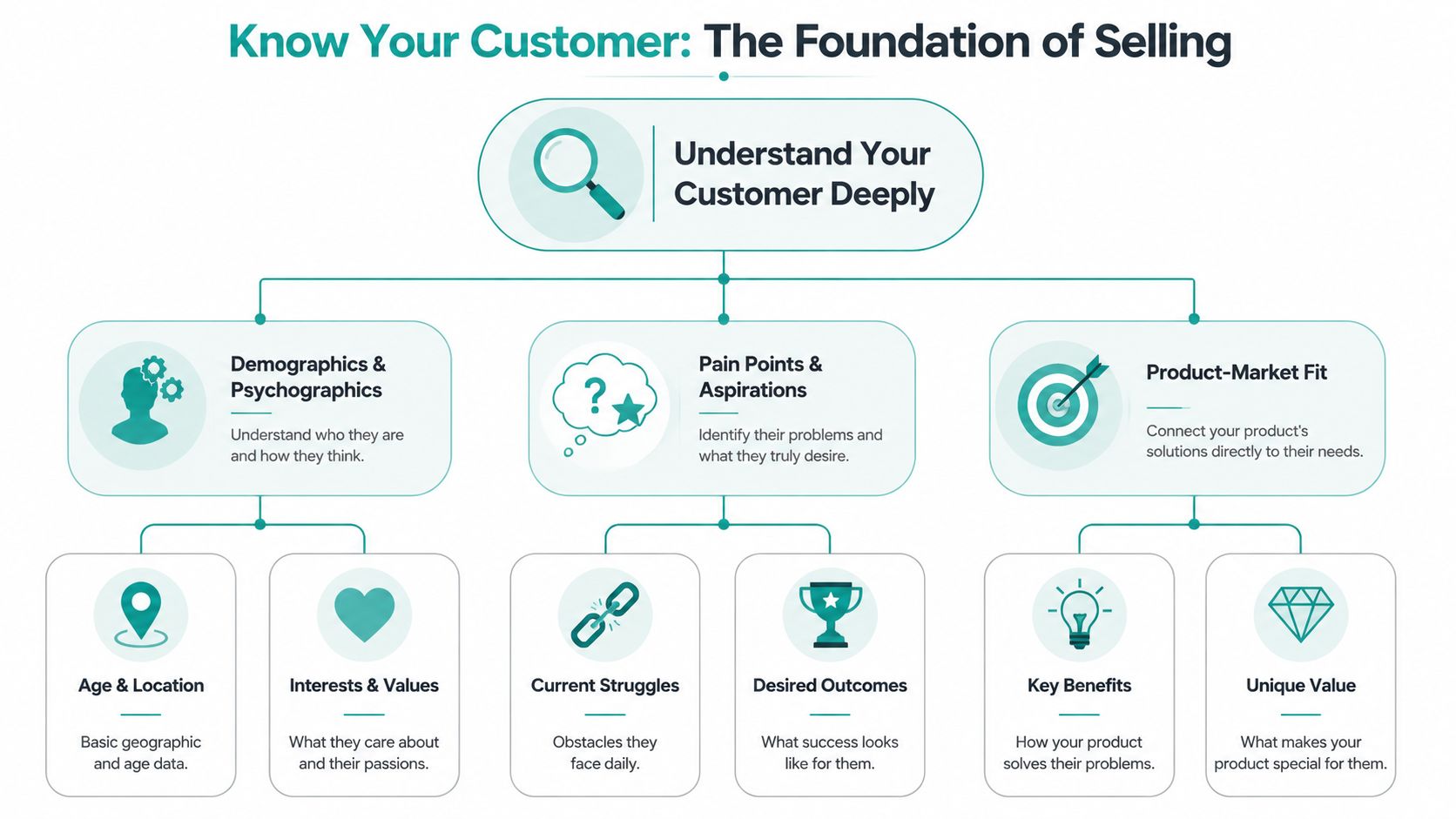
Ask yourself:
Who is buying this most often: A first-time homeowner, a busy parent, a contractor, a commuter, a gift shopper?
What problem are they trying to solve: Save time, reduce risk, look more professional, feel more comfortable, avoid mistakes?
What hesitation slows them down: Price, fit, quality, installation, compatibility, trust, delivery timing?
What outcome do they want: Convenience, confidence, speed, status, relief, simplicity?
This visual is a useful way to organize that thinking:
If you want a tighter process for splitting audiences by need, intent, and message, this guide on audience segmentation for small businesses is worth reviewing before you rewrite your pages.
Write to one buyer, not a crowd
A product page performs better when it sounds like a helpful conversation with a specific person. That changes the language immediately.
Compare these two approaches:
The stronger version works because it sounds like someone understands the buyer's situation.
Generic copy makes a business sound replaceable. Specific copy makes it sound experienced.
Add trust markers inside the description
Many owners keep trust separate from the product description. They place trust in reviews, a badge strip, or an about page. That's better than nothing, but it misses an opportunity.
For local and small businesses, trust should be woven directly into the core copy. Not hype. Not slogans. Specific signals.
Use details like:
Local relevance: Mention the type of customers or situations you commonly serve.
Operational clarity: State what's included, what happens next, and what buyers can expect.
Verifiable specifics: Reference details you can stand behind, such as service area, process, materials, or support.
That kind of language tells the buyer, “This business is real, prepared, and used to helping people like me.”
From Features to Benefits A Framework for Persuasion
A feature tells the customer what something is. A benefit tells them why they should care. That distinction sounds obvious, but it's where most product descriptions break down.
Research indicates that descriptions focusing primarily on features result in a 12% lower conversion rate compared to those focusing on customer benefits and problem-solving capabilities, while descriptions that tell a mini-story about the product's use see a 25% boost in purchase intent.
Use the FAB method
The simplest writing system I know for this is FAB:
Feature is the factual attribute.
Advantage is what that attribute does better.
Benefit is how the customer's life improves.
Here's the mistake owners make. They stop at the feature and assume the customer will connect the dots. Most won't.
For example:
Feature: “Water-resistant fabric”
Advantage: “Handles light rain and spills”
Benefit: “You can use it daily without worrying about small weather changes or messy errands”
That final line is where persuasion happens.
Product Description Transformation Before and After
That's the shift. The product didn't change. The framing did.
Explain the benefit of each service on the relevant page. See our guide to how to write advertising copy.
Add a mini-story, not fluff
A mini-story gives the buyer a use case they can see themselves in. It doesn't need to be dramatic. One sentence can do it.
Instead of: “Durable apron with adjustable straps and front pockets.”
Write: “Designed for long prep sessions, weekend grilling, and messy kitchen work when you need tools close by and clothes protected.”
That works because it puts the product in motion.
What works: Show the product in the customer's routine. What fails: Listing specs and hoping the shopper feels the value on their own.
A quick rewrite formula
If you're staring at a flat product page, use this order:
Open with the main outcome the buyer wants.
Follow with one or two specifics that prove the claim.
Add a real-world use moment.
Finish with scannable details such as size, material, compatibility, or care.
A strong opening sentence often sounds like this:
“Built for…”
“Designed to help you…”
“Made for days when you need…”
“A practical choice for…”
That keeps the focus where it belongs. On the customer, not your internal product sheet.
Format for Scanners and Search Engines
Even strong copy underperforms when it's packed into a dense block of text. Online shoppers don't read product pages the way business owners write them.
Expert analysis reveals that 79% of online shoppers only scan the first few lines of a description, and structuring information with bullet points can increase conversion rates by 20-30% compared to paragraph-only formats.
That means formatting isn't decoration. It's part of the sale.
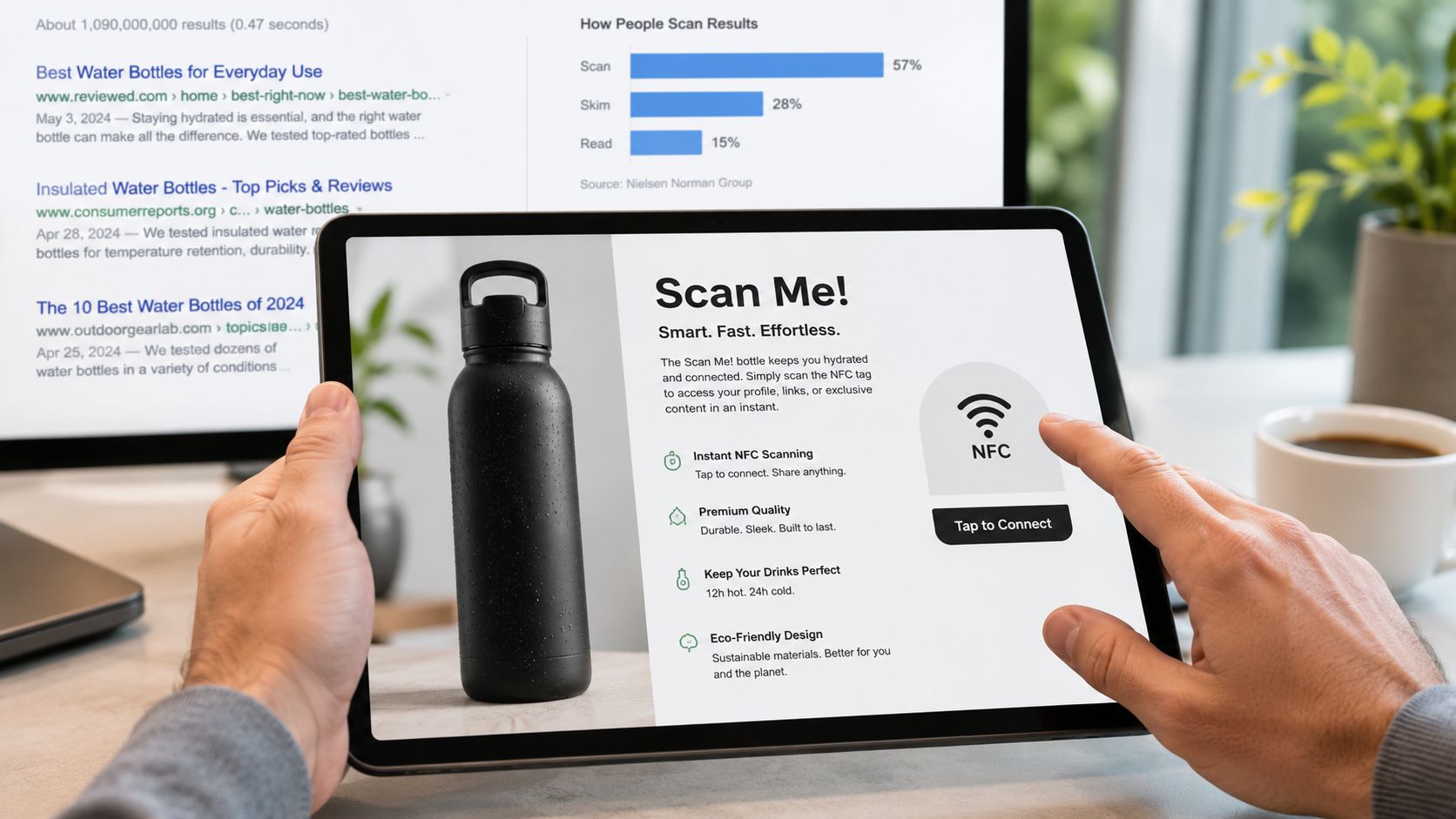
Front-load the important information
The first few lines need to carry the page. Don't open with brand throat-clearing or a broad statement about quality. Start with the core value.
A reliable structure looks like this:
Line one: State the main benefit.
Line two: Clarify who it's for or when to use it.
Line three: Add a concrete supporting detail.
After that, make the rest easy to scan.
Use a layout that helps the eye move
A clean product description usually includes:
A short opening paragraph: One small block, not a wall of copy.
Bullet points: Best for specs, materials, use cases, or compatibility.
Bolded phrases: Useful for drawing attention to key benefits or important product facts.
Short paragraphs: Keep them tight so mobile users don't get buried.
Use consistent product details on marketplace listings and your own site.
If your buyer only reads the opening lines and the bullets, they should still understand the offer.
Basic SEO without sounding robotic
The best SEO product descriptions don't read like they were written for a search engine. They read like useful sales copy that happens to be easy for search engines to understand.
Keep it simple:
Put the primary keyword in the headline or product name when it fits naturally.
Use the primary keyword again early in the description, ideally in the opening lines.
Work in related phrases naturally through the rest of the copy.
Write unique descriptions for each product or service variation.
Add descriptive alt text to product images so the page carries meaning beyond the visible text.
What doesn't work is stuffing the same phrase into every sentence. Buyers notice it. Search engines do too. Write the page for humans first, then make sure the key term appears in sensible places.
A practical formatting checklist
Before you publish, scan the page yourself and ask:
Can the main benefit be understood in seconds
Do the bullets cover the obvious buying questions
Does the first paragraph say who it's for
Would this still read well on a phone
Does the keyword appear naturally, not repeatedly
Most conversion problems on product pages aren't caused by a lack of information. They come from poor ordering. The right details are there, just presented in the wrong sequence.
Amplify Your Message with Adwave
A common small business pattern looks like this. The product page finally starts converting, but the ad copy still sounds generic, the landing page says something slightly different, and every channel ends up doing its own job poorly. Good messaging should travel.
That is the essential value of tightening your product descriptions first. Once the offer is clear on the page, you can reuse that same promise in ads, landing pages, email, and video without rewriting the business from scratch each time.
Good copy gives you more than one sales asset
I've seen this with clients repeatedly. The businesses that write specific, buyer-aware product descriptions usually have a much easier time turning that copy into effective advertising because the hard part is already done. They know the customer problem, the practical benefit, and the words buyers respond to.
Adwave helps small businesses use that work beyond the product page by turning website messaging into TV-ready creative without the usual production process slowing everything down.
The point is not that every business needs TV right away. The point is that strong copy scales across channels. If your description already explains who the offer is for, what outcome matters, and why a buyer should trust you, that message becomes usable far outside ecommerce.
Why this matters for growth
Small businesses often separate product copy from ad copy. In practice, that creates extra work and weaker results. A strong description can act as the source material for multiple campaigns:
Product page: answers buying questions and drives action.
Landing page: keeps the ad promise consistent after the click.
TV creative: brings the same core message to a local audience.
Retargeting and follow-up campaigns: repeat the benefit buyers already recognized.
That consistency matters because buyers do not experience your marketing one channel at a time. They build confidence through repetition. The clearer the message, the easier it is to repeat without sounding vague or inflated.
If you want to extend your product messaging into broader campaigns, this guide on how to advertise on TV for small businesses walks through the creative, targeting, and launch decisions clearly.
The businesses that get the most from advertising usually say the clearest thing, in the same way, across every channel.
Adwave fits that workflow well. Once your product description is doing its job on the page, it can start doing sales work everywhere else too.
Test Refine and Watch Your Sales Grow
No product description is final. The best-performing pages usually got there through revision, not inspiration.
Start with the products or services that matter most. Rewrite those first. Then watch what changes in the business, not just on the page. You're looking for signs that the copy is reducing hesitation.
What to track
Keep your review simple:
Conversion rate: Are more page visitors turning into buyers or leads?
Cart abandonment or drop-off: Are fewer people leaving after showing intent?
Time on page: Are visitors engaging longer with the updated page?
Pre-purchase questions: Are you getting fewer repetitive questions from shoppers?
If questions keep coming in about the same issue, the description still isn't handling that objection clearly enough.
Easy tests without fancy tools
You don't need a complex optimization stack to improve your pages. Test one meaningful variable at a time.
Try changing:
The opening sentence so the page leads with a stronger benefit.
The bullet list order so the most important details appear first.
The call to action so it matches buyer intent better.
The trust language so the page feels more specific and grounded.
Give each version enough time to collect real behavior, then compare outcomes. Don't test five things at once. You won't know what helped.
A strong description doesn't just sound better. It answers better, reassures faster, and closes more cleanly. That's the standard to chase.
If you've already done the hard work of clarifying your offer, Adwave is a strong next move. It helps small businesses turn clear website messaging into broadcast-ready TV ads quickly, so the copy that sells on your page can start working harder across a much wider audience.