You know your customers when they walk through the door. You know which service gets asked about every Monday, which neighborhood calls after heavy rain, and which local event changes foot traffic for a week. Then you look at your website and blog, and it sounds like it could belong to any business in any city.
That gap is where most local marketing underperforms.
Local content marketing for your community works best when it sounds like the place you serve. Not generic tips. Not broad “awareness” posts. Not tourist-board copy written by someone who's never listened to how customers in your area talk about their problems.
Why Local Content Is Your Biggest Untapped Advantage
A lot of small businesses already have the raw material for strong marketing. They hear customer questions every day. They know the local frustrations, the local habits, the seasonal spikes, the neighborhoods that call for one service and not another. But online, many of those same businesses are nearly invisible.

Include your service areas and answers to local customers' questions on your website. Forbes Advisor's content marketing statistics roundup reports that 80% of US consumers search online for local businesses weekly and 46% look specifically in their immediate area.
What local content does
Local content isn't a blog stuffed with city names. It's the digital version of being known in town.
When it works, it does three things at once:
Shows local relevance: Your page reflects the streets, neighborhoods, service area, and common concerns people recognize.
Builds familiarity: Readers can tell you understand their context instead of recycling generic advice.
Pre-qualifies leads: People arrive with a clearer sense of what you do, where you do it, and whether you're the right fit.
Practical rule: If a competitor could swap your city name for another one and reuse the article unchanged, it isn't local content yet.
Why small businesses often miss this opening
Owners usually think they need more content. Most of the time, they need more specific content.
A national brand can publish broad educational posts and still win attention on scale. A local business wins by sounding grounded. That's why strong local writing often outperforms polished but vague brand content. If you need a useful companion read on shaping a practical small-business content plan, Polaris Marketing Solutions' content guide is worth reviewing alongside your own editorial calendar.
Local visibility also depends on how your content fits into your wider presence. Your blog, service pages, Google Business Profile, and distribution all need to reinforce the same local signals. A useful next read is Adwave's overview of local business marketing strategies, especially if you're trying to tighten the connection between your content and how customers discover nearby businesses.
Uncover Your Community's Digital Language
The fastest way to write bland local content is to rely only on keyword tools. They help, but they don't tell you how people in your area describe a problem, complain about a service, or recommend a place to a neighbor.
The better approach is to study the digital spaces where local conversations already happen.
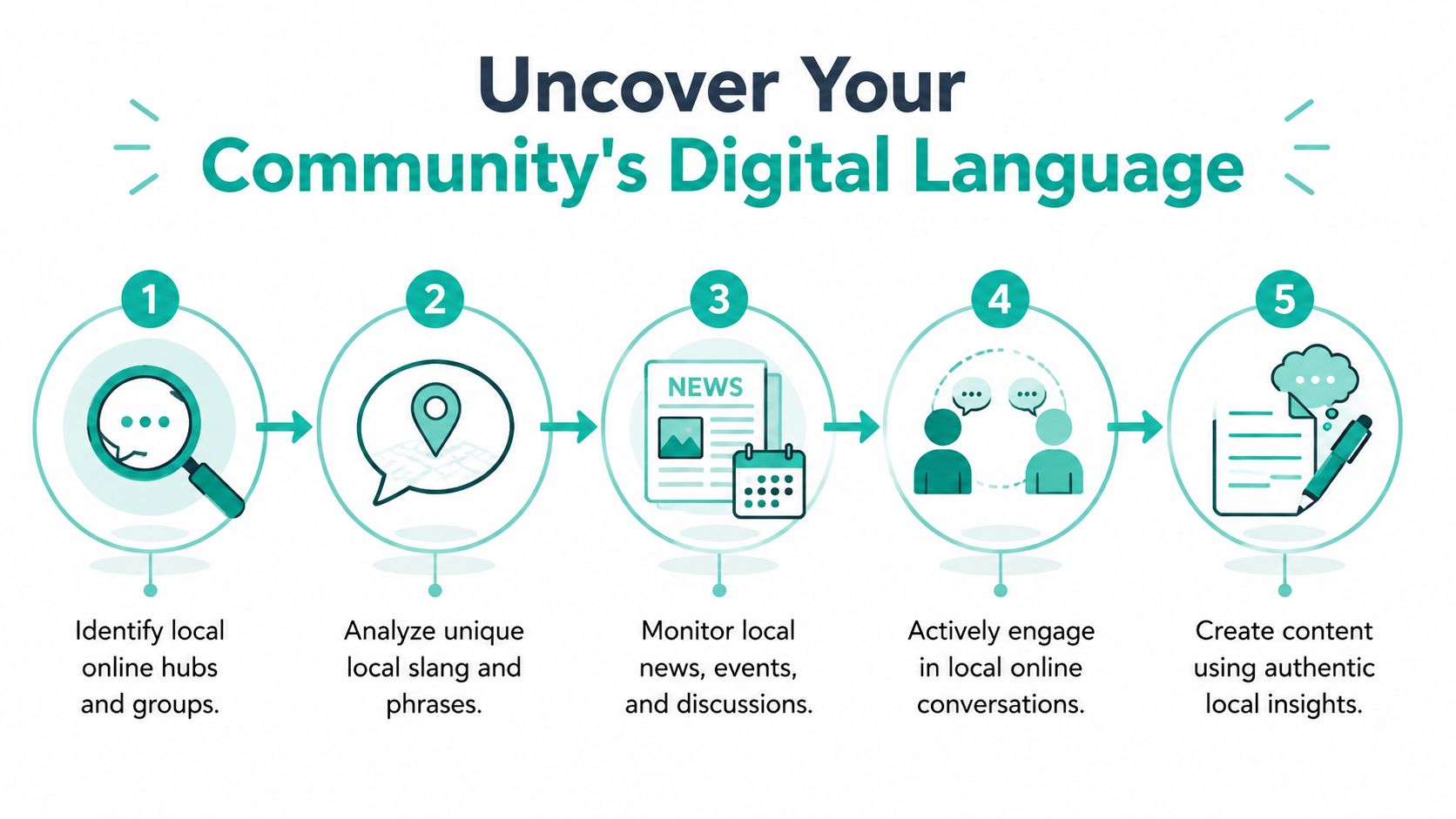
One reason this matters so much is that 68% of local businesses struggle to produce location-specific content that resonates, and the same research argues that businesses can create strong local content without being physically present by pulling stories and pain points from digital community archives. It also reports that this approach can increase engagement by 42% over generic posts, as explained in Strong Automotive's piece on writing local content even when you're not local.
Start with digital places locals already trust
Don't overcomplicate the research phase. Open a document and collect language from places like:
Neighborhood Facebook groups Look for repeat complaints, recommendations, and “who do you use for…” posts.
Local subreddits Reddit is especially good for unfiltered wording. People say what frustrated them, what they expected, and what they wish a business had explained.
Yelp and Google reviews Reviews reveal what buyers value enough to praise and what they resent enough to mention publicly.
Nextdoor and community forums These spaces often surface local trust signals fast. Response time, parking, noise, cleanup, punctuality, kid-friendliness, weekend availability.
Local event listings and comment threads Useful for understanding seasonal rhythms and community interests.
What to pull from those conversations
You're not looking for a perfect quote to copy into your article. You're looking for patterns.
Use a simple capture sheet with these fields:
A few examples:
A plumber might notice residents repeatedly asking about old homes, slow response times, and weekend emergency availability.
A café might see locals discuss parking, laptop policies, outdoor seating, and which area feels busiest before community events.
A realtor might find recurring questions about commute patterns, school pickup traffic, and block-by-block differences that broad housing sites ignore.
The phrases customers use in public are often more valuable than the phrases marketers brainstorm in a meeting.
How remote teams can do this well
Remote marketers often make one of two mistakes. They either write generic city pages from a template, or they overdo “local flavor” and sound fake.
A better workflow is simple:
Assign one person to community listening: They gather recurring language weekly.
Save screenshots or snippets in categories: Parking, pricing, trust concerns, neighborhood names, seasonal issues.
Validate with a frontline staff member: Ask, “Does this sound like what callers say?”
Turn one pattern into one article: Don't cram every local insight into every post.
If your team needs a stronger process for moving from audience research to publishable topics, Adwave's guide on how to find content ideas your audience searches for is a practical complement to this kind of listening work.
Develop Hyperlocal Content Ideas That Connect
Once you've collected real community language, content planning gets easier. You stop guessing. You stop writing broad “helpful” posts that bring weak traffic. You start building articles people nearby can use.
A reliable local editorial plan usually rests on a few repeatable pillars. The most useful framework I've seen is built around local events, community topics, and human stories such as employee spotlights, because that kind of content strengthens authenticity and connection, as outlined in Neil Patel's local content marketing methodology.
Four content pillars that keep working
Community spotlights
Feature the people and businesses your customers already know.
A bakery could publish “Three Nearby Businesses We Love Visiting Before the Weekend Rush.” A physical therapist could interview a local youth coach about injury prevention. A contractor could highlight a neighborhood nonprofit cleanup day.
This works because it signals you're part of the community, not just selling into it.
Local problem-solvers
These are often the highest-intent articles.
Examples:
“What to do when your AC stops working during a heat spike in North Austin”
“Where to park before your dinner reservation downtown”
“How to choose a family dentist if you've just moved to the west side”
These posts should be direct, practical, and close to the language you collected earlier.
Behind-the-scenes stories
People trust businesses more when they can see how decisions get made.
A home services company can explain how technicians prepare for older homes in a certain area. A salon can show how it adjusts scheduling before a major local event weekend. A retailer can introduce staff members who grew up nearby and know what regulars ask for every season.
Curated local guides
Done well, these become long-term traffic and trust assets.
Think:
A realtor's guide to family-friendly parks
A pediatric clinic's list of kid-friendly rainy-day spots
A pet store's roundup of dog-friendly patios and walking areas
Headline formulas that don't sound robotic
Try formulas like these, then rewrite them into your own voice:
What locals should know about [problem] in [area]
A business owner's guide to [local topic]
Where to [solve need] near [neighborhood or landmark]
What we tell customers about [recurring issue]
[Number-free] things to check before you book [service] in [area]
Editorial filter: If the topic helps a real customer make a local decision, it belongs on the calendar. If it only exists to “post something,” cut it.
Keep the calendar simple
You don't need a complex content operation. You need a consistent one.
Use one row per piece. That's enough.
For local businesses trying to earn mentions and authority beyond their own site, Adwave's guide to local link building and getting backlinks from community organizations is a smart next step, especially after you've published a few useful community-focused resources.
Write and Optimize for Local People and Search Engines
Most local businesses don't have a content idea problem. They have an execution problem. The article topic is fine, but the final page sounds stiff, hides the location details, and forgets to make the next step obvious.
Writing for local search works best when the page feels written for a person who lives nearby, not for an SEO checklist.
Write like a useful neighbor
Start with the main question. Then answer it in plain language.
Instead of: “Homeowners often encounter a wide range of plumbing-related issues that require professional consideration.”
Write: “Older homes in the Maplewood area often show the same plumbing warning signs. Slow drains, inconsistent pressure, and leaks around fixtures tend to show up together.”
That second version sounds local because it is local. It names the area. It speaks to a lived situation. It doesn't posture.
A few habits make a big difference:
Use recognizable geography: Neighborhoods, intersections, landmarks, and service areas.
Name the local condition: Parking, weather, event traffic, older homes, school pickup congestion, tourist weekends.
Keep the tone conversational: Short sentences. Clean answers. No corporate filler.
Match the page to intent: An FAQ post should answer questions fast. A service page should build confidence and prompt contact.
Handle on-page SEO without making the page weird
You don't need to force local terms into every sentence. You do need the basics in the right places.
Use this checklist:
Title tag: Include service and location naturally.
Meta description: State who you help and where.
Main heading: Reflect the reader's actual problem.
Subheadings: Break out local questions or scenarios.
Image alt text: Describe the image with local relevance when appropriate.
Internal links: Connect related local pages and blog posts.
Google Business Profile posts: Reuse key ideas from your article in shorter updates.
Here's a simple comparison:
Restaurant owners need especially sharp local signals because intent changes quickly around mealtimes, map results, and neighborhood searches. If that's your category, OrderOut's guide to local SEO for restaurants is a useful niche reference.
For a broader writing workflow that helps pages rank without stuffing them full of keywords, Adwave's article on how to write a blog post that ranks on Google is worth keeping in your swipe file.
Amplify Your Local Story Across Community Channels
Publishing a strong article is only the midpoint. Local content rarely does much if it stays on your blog and nowhere else.
Small businesses usually get better results when they treat every article as a core message to distribute across the places their community already pays attention to.
Start with the channels you already control
One useful article can become several local touchpoints:
Email newsletter: Pull out the main lesson and link back to the full post.
Google Business Profile post: Summarize the local takeaway in a few lines.
Instagram or Facebook post: Use one local insight or quote as a caption.
Sales follow-up: Send the article when a prospect asks a related question.
Front-desk or service team talking points: Share the same advice consistently offline.
This works better than constantly creating net-new content because repetition builds recognition. Customers often need to encounter the same local message in a few different places before it sticks.
Use community distribution, not just brand distribution
A lot of business owners promote content only on their own pages. That limits reach.
Better options include:
Sharing a relevant article in local groups when it effectively answers a question
Partnering with a nearby non-competing business to cross-share a guide
Sending useful pieces to local publications or community newsletters
Asking staff to share content that highlights local issues they see every day
Good distribution doesn't feel like posting everywhere. It feels like placing the right message where local attention already exists.
It also helps to improve the content itself before you distribute it widely. If you want a practical reminder on writing web copy people finish, Boocoo's content writing advice offers some clean fundamentals.
Expand your reach with TV in a local market
There's also a point where written content has done its job. It clarified your message, proved your local relevance, and gave you language that resonates. Then you may want a broader awareness channel that can scale that message beyond organic reach.
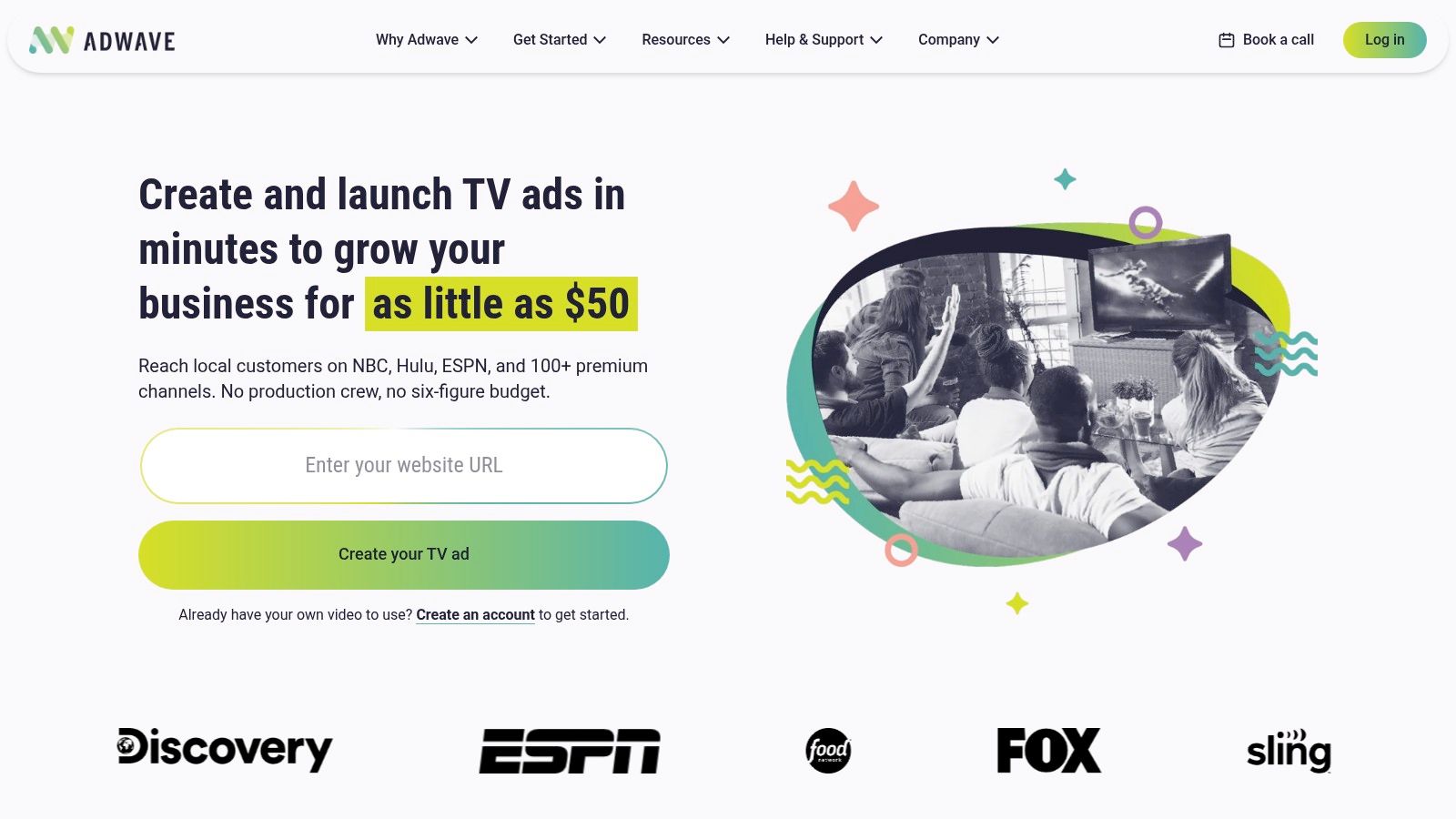
That's where Adwave fits well. According to Adwave's overview of programmatic advertising platforms, the platform lets local businesses generate a broadcast-ready TV ad from a website URL and place it across 100+ premium channels. Campaigns can start at $50, with an estimated $15 to $35 CPM. For small and mid-sized businesses that want to turn a strong local message into wider visibility without a complex production process, that's a practical option.
The key is message continuity. Don't treat the ad as separate from the content. Use the same local promise, the same audience language, and the same community-specific angle that already worked in writing.
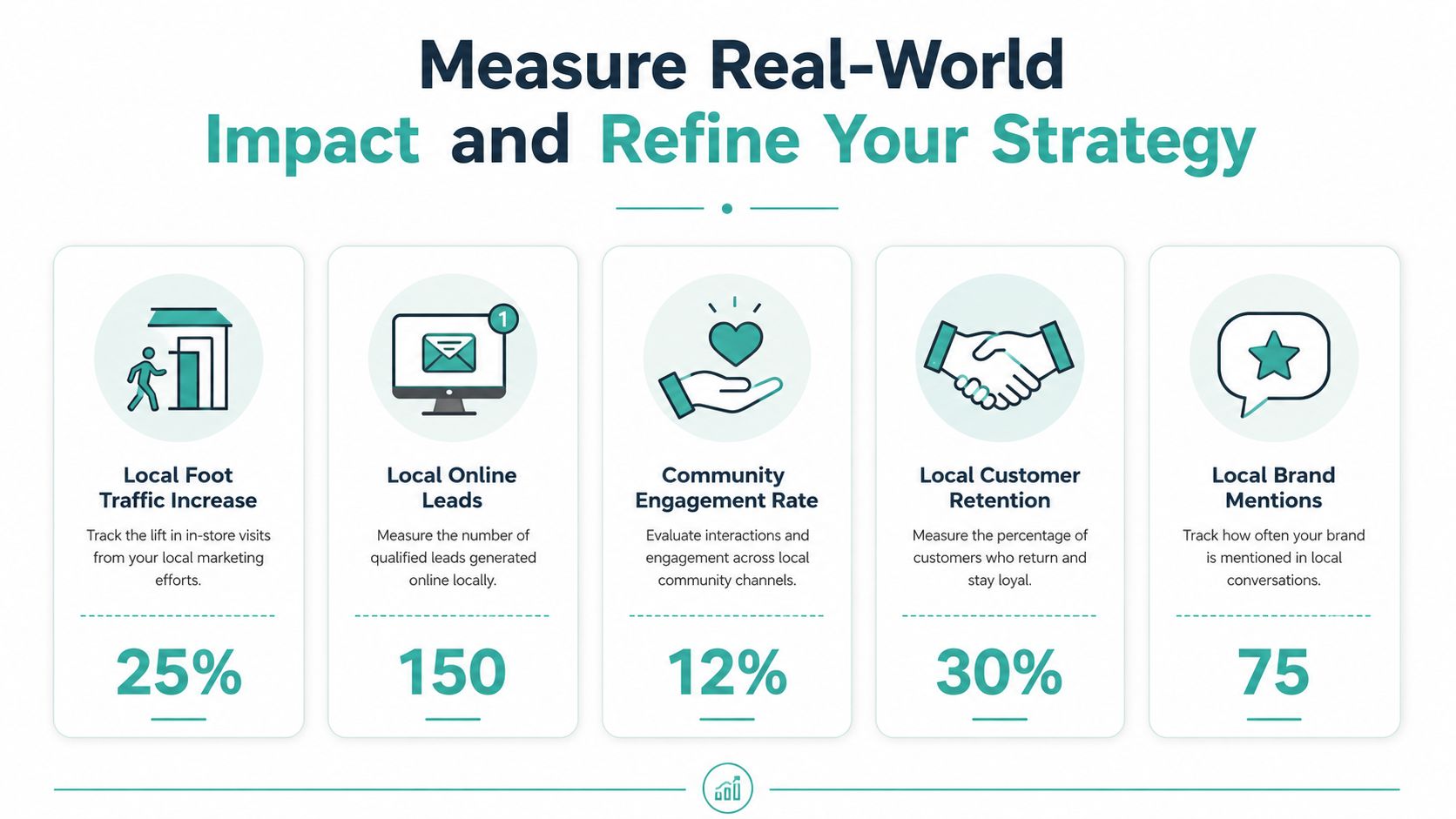
Measure Real-World Impact and Refine Your Strategy
The biggest reporting mistake in local content marketing is treating pageviews as success.
Traffic can be useful. It can also mislead you. One example from local marketing analysis showed a blog driving 90% of site traffic but less than 10% of online conversions, a reminder that attention alone doesn't mean local buying intent, as discussed in the source behind the earlier strategy section. What matters is whether your content changes business outcomes.
Watch for signals tied to action
For local businesses, the useful indicators are usually closer to the moment of contact:
Calls and form submissions: Especially when tied to a specific article or service page
Bookings and appointments: Ask what page or topic helped the customer decide
Google Business Profile actions: Direction requests, calls, and website clicks
Sales conversations: Repeated questions after a post goes live often mean the topic is landing
Lead quality: Are the inquiries more specific, more informed, and more local?
These are less glamorous than traffic charts, but they tell you whether the content is attracting the right people.
Use attention metrics when you expand beyond written content
If you also amplify your message through TV, measurement gets more interesting. Adwave explains that View-Through Rate (VTR) is calculated by dividing total completed views by total measurable impressions and multiplying by 100, and its dashboard surfaces VTR in real time in a way that helps businesses evaluate audience attention directly, according to Adwave's explanation of View-Through Rate.
That's useful because it pushes you past vague awareness language. You can compare which message holds attention better, which offer deserves more budget, and which audience segment is responding.
A local content program is working when it improves both recognition and response. If people read, remember, and act, keep going. If they only read, tighten the message.
Refine based on what customers do
A practical review cycle is simple:
Check which articles drive meaningful actions.
Identify the local angle that made them useful.
Update weak pages with sharper geography, clearer calls to action, or better answers.
Reuse strong themes in email, social, and paid promotion.
Drop topics that generate curiosity but not buying intent.
That's how local content marketing matures. Not through more publishing. Through better alignment between what your community cares about and what your business wants them to do.
If you've already done the hard part of clarifying your local message, Adwave is a smart next move. It helps small businesses turn that message into a broadcast-ready TV ad from a website URL, launch across premium channels, and track engagement in real time without a traditional production process or oversized budget.