-
7.8%
Netflix's share of U.S. TV viewing (April 2026)
-
250M+
Monthly active viewers on Netflix's ad-supported tier (2026)
-
$50
Minimum to start advertising on connected TV with Adwave
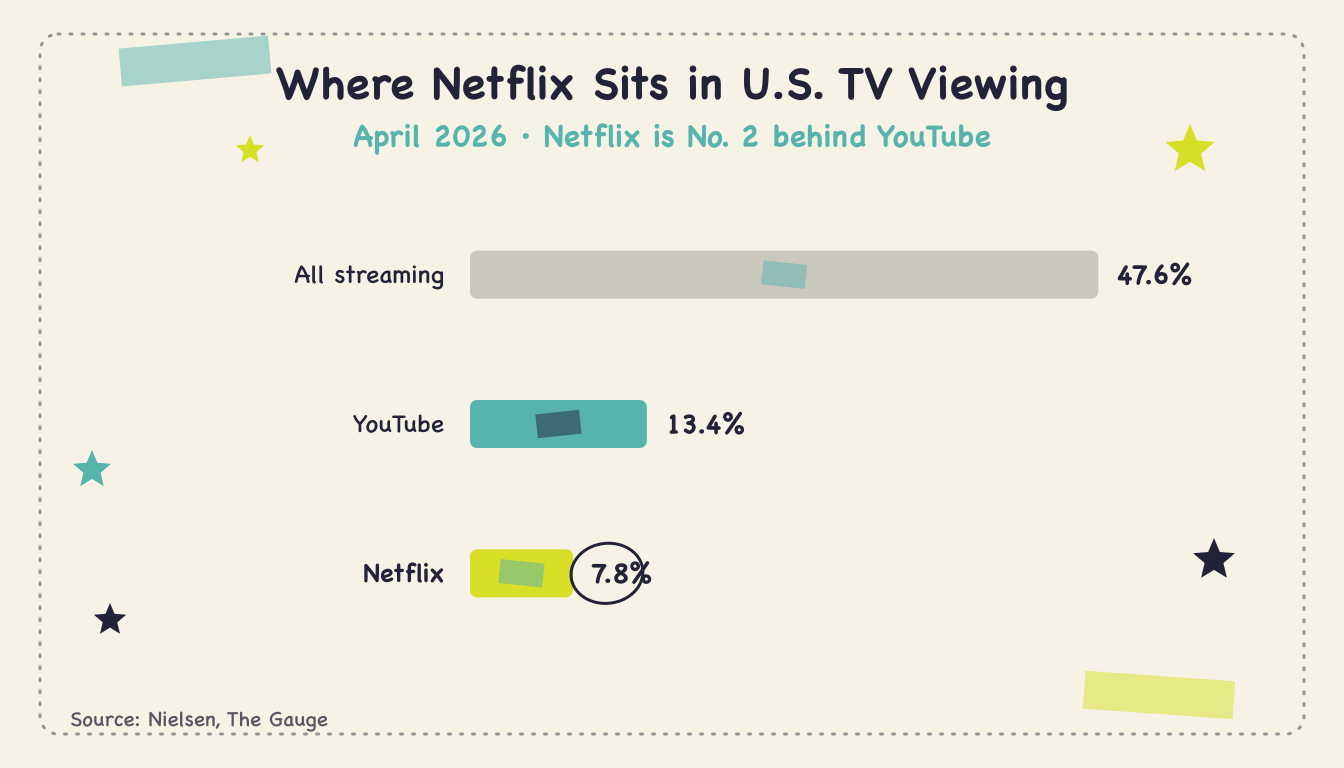
Netflix accounted for 7.8% of all U.S. TV viewing in April 2026, according to Nielsen's The Gauge, making it the second most-watched individual streaming service in the country behind YouTube. That's not 7.8% of streaming. It's 7.8% of everything Americans watch on a TV set, cable and broadcast included, from a single subscription service. Only YouTube, at 13.4%, pulls more.
Here's what makes that number matter for a small business. The same Netflix that reshaped how the country watches television now runs ads, and its ad-supported tier has grown into one of the largest premium streaming audiences on earth. The wall between "prestige streaming" and "reachable advertising inventory" came down, and it came down fast. Let's break down Netflix's Q2 2026 viewing share, how its ad business exploded, and what the shift means for where you can now reach customers.
What the data shows
Nielsen's The Gauge measures how Americans divide their television time across broadcast, cable, streaming, and other uses. In the April 2026 report, released June 25, 2026, Netflix held 7.8% of total TV viewing, holding its position as the top streaming service after YouTube.
A distinction worth getting right, because it trips people up: Netflix is the number-two streaming service by watch time, but when Nielsen rolls entire media companies together in its distributor rankings, Netflix sits further down. That's because rivals like Disney and NBCUniversal bundle many networks and apps into one company total, while Netflix's 7.8% comes from a single service. Measured platform against platform, only YouTube beats it.
Here's how the major individual streaming services and the category looked in April 2026:
YouTube: 13.4% of total TV viewing (the leader)
Netflix: 7.8% (number two streaming service)
Total streaming: 47.6% of all TV viewing, a record high
Cable: 21.6%
Broadcast: 19.9%, below 20% for the first time
Netflix's 7.8% is a slight step down from its winter peak. Netflix ran closer to 9% back in January 2026, lifted by the finale of Stranger Things, which dropped on January 1 and pulled enormous viewing. As that surge faded through spring, Netflix settled back to the high-7% range that reflects its steady baseline. This is normal for Netflix, whose share rises and falls with its biggest releases more than almost any other platform. For the winter picture, our Netflix Q1 2026 viewing share post captured that January peak.
One timing note: April is the last month Nielsen has fully reported as of late July 2026. Nielsen delayed its March Gauge amid a dispute over new measurement methodology, and the recalibrated version isn't expected until the fall. Every figure here reflects data through April 2026, not a May or June estimate.
How Nielsen measures this, and why April is the latest number
Netflix's 7.8% comes from Nielsen's national panel, the same measurement system behind its TV ratings, which tracks actual viewing on television sets across a representative sample of U.S. households. The Gauge splits that total into broadcast, cable, streaming, and other, and in streaming it names the individual services. Because the method is consistent month to month, changes in Netflix's share reflect changes in viewing, not changes in measurement.
The reporting calendar hit turbulence this year. Nielsen delayed its March 2026 Gauge amid a dispute with streamers over a new measurement approach, and it has pushed the recalibrated methodology to the start of the fall season. A few practical points follow for reading these numbers:
April 2026 is the latest confirmed month. Treat 7.8% as Netflix's current reading, not a placeholder for May or June.
The winter and spring months are comparable. January, February, and April all ran on the same methodology, so the move from Netflix's January peak to April's 7.8% is a real seasonal decline, not a measurement artifact.
A methodology reset is coming. When Nielsen's recalibrated Gauge arrives in the fall, it's expected to lift broadcast and cable slightly and trim streaming, so Netflix's share could optically dip even without any real change in viewing. Worth knowing so later numbers don't look like a Netflix collapse.
The headline holds regardless. Netflix remains the clear number-two streaming service, and its real story in 2026 isn't its viewing share, which is steady. It's the advertising business growing underneath it.
Breaking down the numbers
Netflix's viewing share behaves differently from its rivals, and understanding the pattern helps you read the number. Where YouTube's share grinds steadily upward on the back of a device shift to the living room, Netflix's share pulses with its content calendar.
The 2026 pattern shows this clearly:
January 2026: roughly 9%, boosted by the Stranger Things series finale
February 2026: high-7% to 8% range as the finale surge cooled
April 2026: 7.8%, the steady baseline after the winter spike
Year over year, Netflix was up about 0.3 points in April versus a year earlier, a modest gain that put it near 7.5% in April 2025. That's growth, but gentle growth, especially next to YouTube's roughly full-point rise and the streaming category's 3.3-point jump over the same year. Netflix isn't gaining share the way YouTube is. It's holding a strong, stable second place while the whole streaming pie expands around it.
It helps to separate viewing share from raw scale, because they measure different things. Netflix ended 2024 with more than 301 million paid memberships worldwide, its last officially reported count before it stopped disclosing quarterly subscriber numbers. A 7.8% share of any single month's U.S. viewing sits on top of that enormous global base. In other words, the percentage captures how much of the TV day Netflix wins right now, while the membership and ad-tier numbers capture how many people it can reach over time. Both matter, and for advertisers the reach figures are the ones climbing fastest.
What drives Netflix viewing is hits, and the first half of 2026 had several. Bridgerton surged back to become the most-watched show across all of streaming in both May and June, His & Hers ranked as the top TV series of the half, and the Stranger Things finale carried heavy viewing into the new year. When Netflix has a cultural moment, its share spikes. Between those moments, it settles. For a side-by-side with its nearest competitor, our Netflix vs YouTube viewers breakdown compares the two directly.
The steadier and more important trend for advertisers isn't in the viewing numbers at all. It's in how many of those Netflix viewers are now watching with ads.
Why it matters for your business
For years, Netflix was the definition of an audience advertisers couldn't touch. No commercials, no inventory, no way in. That's over. Netflix built an ad-supported tier, and it has become one of the fastest-growing ad audiences in streaming.
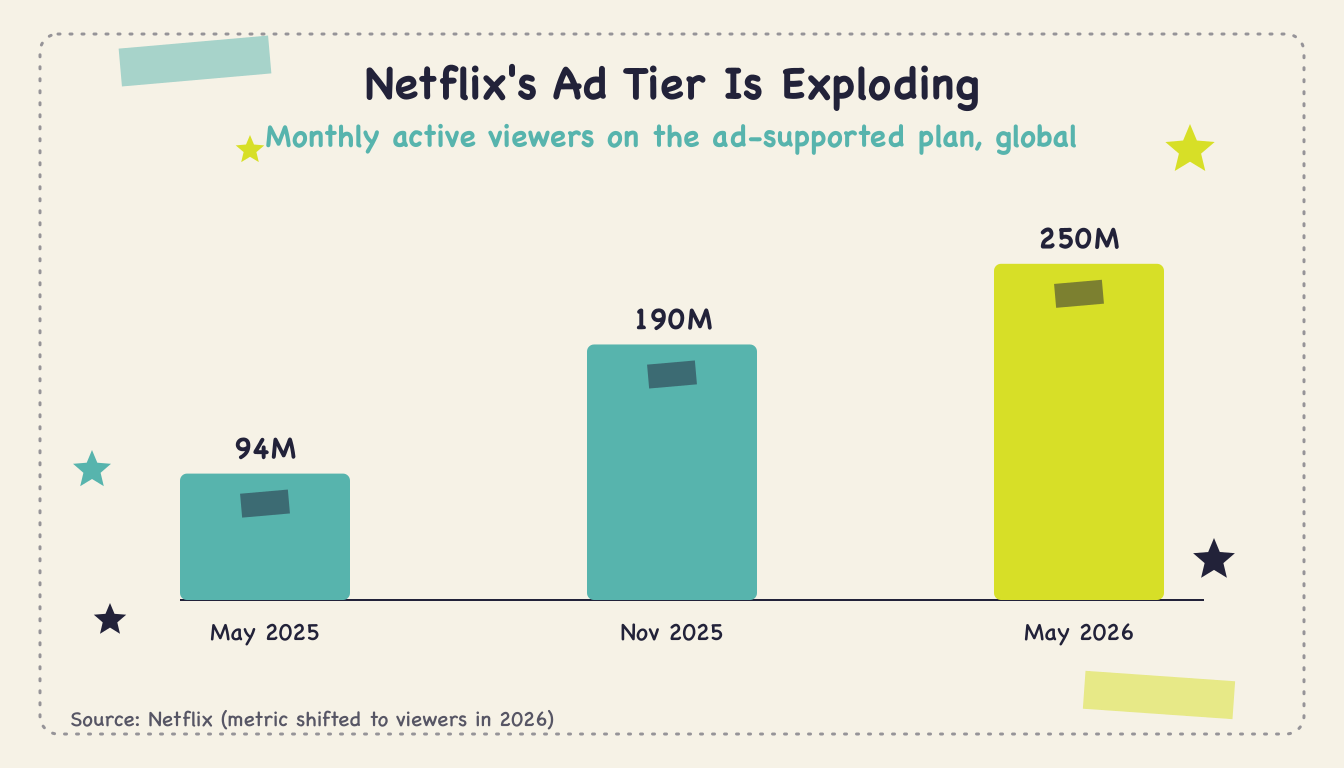
The scale is the headline. Netflix's ad tier reached more than 250 million monthly active viewers globally by its May 2026 upfront presentation, up from 190 million in late 2025. In the countries where the ad plan is offered, more than 60% of new sign-ups now choose it. A meaningful and growing slice of Netflix's audience is watching content with ads in the breaks, on premium shows, on the big living-room screen.
Why does that matter for a local business specifically?
The premium wall came down. The most prestigious streaming service now carries advertising, which means the audience that used to be entirely out of reach is now, in principle, an addressable one.
Ad-supported streaming is the norm, not the exception. When the majority of new Netflix sign-ups pick the ad plan, it signals that viewers accept ads on premium streaming, which is the whole premise of affordable connected TV advertising.
The measurement and targeting match digital. Netflix built an ad platform with first-party targeting and programmatic buying, the same capabilities that make streaming ads accountable in ways a cable spot never was.
Now the honest part, because it matters for planning. A small business generally won't buy Netflix directly. Netflix's direct and upfront deals are built for large national brands. What changed isn't that you can buy Netflix from your phone, it's that the entire category Netflix legitimized, premium ad-supported streaming, is now reachable through connected TV platforms at small-business budgets. Netflix proved the audience is there and willing. The connected TV advertising market is how a local business taps that same shift.
How to take advantage
You can't run a spot on Stranger Things for $50. But you can reach the same kind of premium streaming audience Netflix's rise created, on the same living-room screens, at a budget built for a local business. Here's how to think about it.
Aim at the audience, not the single app. Your customers who watch Netflix also watch Hulu, Roku channels, Tubi, and dozens of other ad-supported streaming apps. Reaching across that whole ecosystem is how a small business builds real frequency, rather than fixating on one platform you can't buy directly.
Target your service area. Set a geographic radius, usually 15 to 25 miles, so every impression lands on a potential customer instead of a viewer three states away.
Budget for repetition. Plan enough spend to reach the same households several times over two to three weeks. On connected TV, meaningful frequency costs hundreds of dollars, not the thousands a national streaming buy demands.
Let AI handle the creative. Netflix-quality production isn't the bar. AI tools turn your existing website into a broadcast-quality 30-second ad in about two minutes, removing the cost that used to keep small businesses off TV.
Measure brand lift. Track branded search, direct traffic, and calls during and after a campaign rather than chasing clicks, since TV builds demand you capture elsewhere.
The mechanics are simple. With Adwave, ad creation is free, a campaign starts at a $50 minimum, and you can be live across 100+ premium streaming channels in under 10 minutes. You point it at your website, it builds the spot, and you're advertising on the same class of premium connected TV inventory that Netflix's ad tier helped make mainstream. For what that budget buys, our guide to the average CTV CPM lays out the costs.
The bigger picture
Netflix's steady 7.8% viewing share tells one story. Its ad business tells a bigger one, and the two together explain why connected TV is the fastest-changing corner of advertising.
A few forces give the Q2 2026 numbers their weight:
The ad tier is a real business now. Netflix's ad revenue grew roughly 2.5 times in 2025 to more than $1.5 billion, and the company expects it to roughly double toward $3 billion in 2026. More than 4,000 advertisers were on the platform by the end of 2025. When the most prestige-conscious service in streaming builds an ad business this fast, it validates the entire ad-supported model.
Ad-supported streaming is where viewers landed. More than 60% of new Netflix sign-ups choosing the ad plan mirrors what's happening across the industry: viewers traded a few commercials for a lower price, and premium ad inventory grew as a result. Our ad-supported streaming viewers page tracks how large that audience has become.
Streaming owns the TV day. Netflix's share sits inside a streaming category that took a record 47.6% of all TV viewing in April 2026, more than cable and broadcast combined. The audience is on streaming, and a growing share of it is reachable with ads.
For small businesses, the throughline is access. Netflix spent a decade building the most-watched premium streaming service, then opened it to advertising. You don't buy Netflix itself, but the shift it led, premium streaming going ad-supported, is exactly what makes affordable connected TV advertising possible. A decade ago, reaching a Netflix-sized premium audience meant a national TV budget and a media-buying team. Today the same class of living-room inventory sits inside self-serve connected TV, priced for a local business. The gatekeepers stopped gatekeeping.
What experts are saying
Netflix has been unusually direct about its ad ambitions. On its 2026 earnings calls, the company has framed advertising as a long-term growth pillar, pointing to the ad tier's climb past 250 million monthly active viewers and a target of roughly doubling ad revenue in 2026. Executives have described the completed rollout of the in-house Netflix Ads Suite as the foundation for first-party targeting and programmatic buying, the features that make streaming ads competitive with digital.
Analysts covering the space read Netflix's ad push as a bellwether. When the service most associated with commercial-free viewing not only adds ads but sees the majority of new subscribers choose the ad plan, it settles a long-running debate about whether premium streaming audiences will tolerate advertising. They will, and in large numbers. The trade consensus is that Netflix's ad business, still young, is on a steep growth curve, and that its success pulls more premium inventory into the ad-supported market overall. For advertisers, the takeaway is less about Netflix as a buy and more about what Netflix proved: the premium streaming audience is now an advertising audience, and connected TV is the door to it.
What the numbers don't tell you
Netflix's 7.8% is a clean headline, but a few caveats keep it useful rather than misleading.
Viewing share understates Netflix's reach. Share measures a moment of viewing. Netflix's total footprint, hundreds of millions of members globally and a 250-million-plus ad audience, is far larger than any single month's percentage suggests.
You can't buy Netflix like you buy connected TV. The 250-million ad audience is real, but access for a small business runs through the broader programmatic CTV market, not a direct Netflix purchase. Treat Netflix as proof of the trend, not a line item you'll book yourself.
The ad-tier numbers changed definition. Netflix's reported ad audience jumped partly because it shifted from counting ad-viewing profiles to estimating household viewers. The growth is real, but the metric isn't perfectly apples-to-apples across every report, so read the trend rather than any single figure.
Share pulses with hits. Netflix's number will rise on a big finale and settle between them. One high or low month isn't a trend, which is why the steady high-7% baseline matters more than any single spike.
Read the 7.8% as a stable floor under a fast-growing ad business. The viewing share is the steady part. The advertising opportunity underneath it is the part that's moving.
Common questions answered
Is Netflix the most-watched streaming service? Netflix is the second most-watched individual streaming service in the U.S., at 7.8% of total TV viewing in April 2026, behind YouTube's 13.4%. When Nielsen groups whole media companies together, Netflix ranks lower because rivals bundle many networks into one total, but service against service, only YouTube tops it. Netflix has been the clear runner-up for some time.
Why is Netflix's share lower than earlier in 2026? Seasonality. Netflix ran near 9% in January 2026 thanks to the Stranger Things finale, then settled to 7.8% by April as that surge faded. Netflix's share pulses with its biggest releases more than most platforms, so a decline from a finale-driven peak is normal, not a sign of decline. Year over year, Netflix was up about 0.3 points.
Can a small business advertise on Netflix? Not directly, in most cases. Netflix's ad deals target large national brands. But the premium ad-supported streaming audience Netflix helped build is reachable through connected TV platforms at small-business budgets. With Adwave, you can run 30-second ads across 100+ premium streaming channels from a $50 minimum, reaching the same class of living-room audience.
How big is Netflix's ad-supported tier? Netflix's ad tier reached more than 250 million monthly active viewers globally by mid-2026, up from 190 million in late 2025. In markets where the ad plan is offered, over 60% of new sign-ups choose it. Netflix's ad revenue is projected to roughly double toward $3 billion in 2026, making it one of the fastest-growing ad businesses in streaming.
How much does streaming TV advertising cost? Less than most people expect. The average CTV CPM runs roughly $15 to $35, and with Adwave a campaign starts at a $50 minimum with free ad creation. That reaches the premium living-room audience that Netflix and the wider streaming shift created, without a national-brand budget.
The numbers at a glance
Key figures behind Netflix's Q2 2026 standing, with sources:
7.8%: Netflix's share of U.S. TV viewing, April 2026, the number-two streaming service (Nielsen, The Gauge)
13.4%: YouTube's share, the only service ahead of Netflix (Nielsen, The Gauge)
47.6%: Total streaming share of U.S. TV viewing, a record (Nielsen, The Gauge)
+0.3 pts: Netflix's year-over-year change, April 2025 to April 2026 (Nielsen)
250M+: Netflix ad-tier monthly active viewers globally, 2026 (Netflix, via TheWrap)
60%+: Share of new Netflix sign-ups choosing the ad plan (Netflix)
$1.5B+ / ~$3B: Netflix 2025 ad revenue and its 2026 target (Netflix earnings)
4,000+: Advertisers on Netflix's ad platform by end of 2025 (Netflix)
301.6M: Netflix global paid memberships at the end of 2024, its last officially reported count (Netflix)
Reach premium streaming audiences, starting at $50
Netflix's 7.8% of U.S. TV viewing confirms it's the top streaming service after YouTube, but the bigger 2026 story is that the most premium name in streaming now runs ads, with an audience past 250 million and growing. The audience that used to be unreachable became addressable.
You don't need a national budget to reach premium streaming viewers. See how Adwave works to turn your website into a broadcast-quality 30-second ad in minutes, or check pricing to launch a connected TV campaign from a $50 minimum. The premium screen opened up. It's a good time to be on it.