
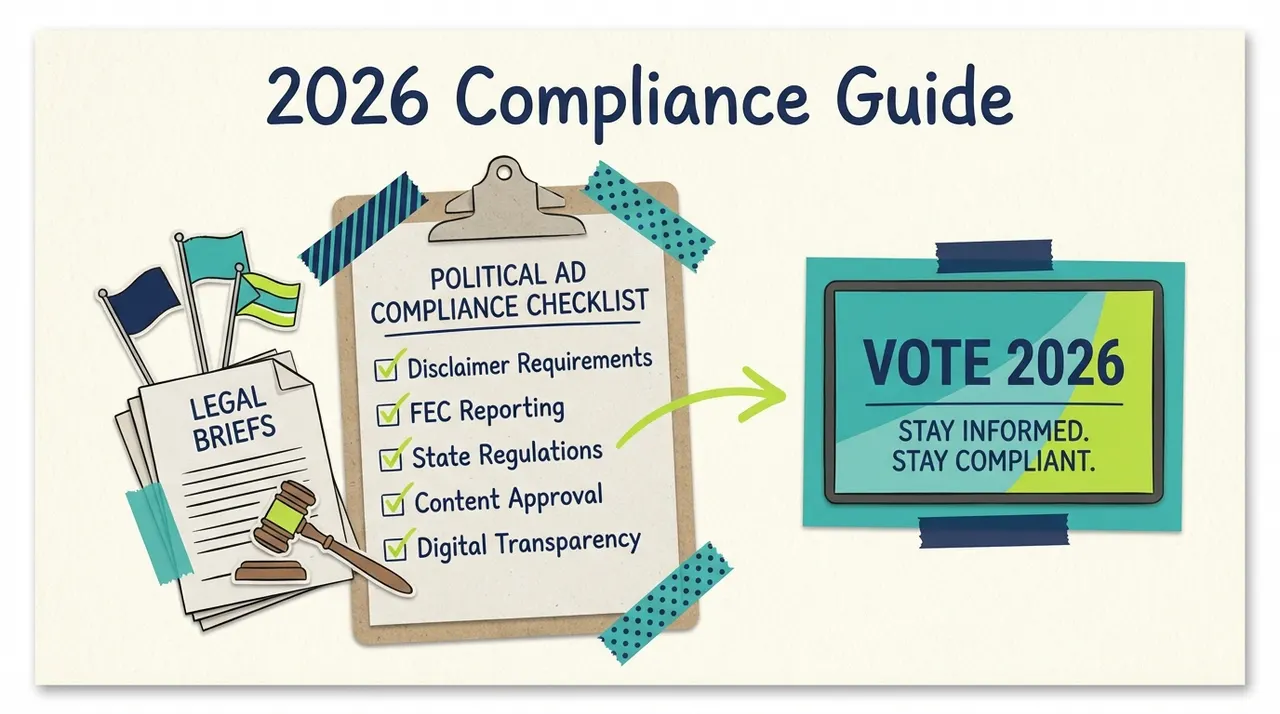
Running political ads on connected TV is one of the smartest moves a campaign can make in 2026. CTV offers precision targeting, strong completion rates, and access to voters who've cut the cord entirely. But compliance on streaming platforms works differently than it does on broadcast TV, and getting it wrong can pull your ads, drain your budget, or create a news cycle your opponent will love.
The regulatory picture for CTV political advertising sits at the intersection of federal law, state election codes, and individual platform policies. None of these sources are perfectly aligned, and all of them are evolving fast. Campaigns that treat compliance as an afterthought often discover problems at the worst possible time, like the final two weeks before election day when every impression counts.
This guide breaks down the compliance rules that matter most for political CTV campaigns in 2026. You'll learn what the FCC requires (and what it doesn't), how major streaming platforms handle political ads, which state laws could affect your campaign, and how to build a compliance workflow that keeps your ads running smoothly from launch through election night.
The federal regulatory framework for CTV political ads
If your campaign has experience with broadcast TV advertising, you probably know the FCC's core political rules: reasonable access for federal candidates, equal time, lowest unit rate, and the no-censorship provision. These are foundational to political TV advertising, and they've governed broadcast stations for decades. (For a full breakdown of those broadcast rules, see our FCC political advertising rules guide.)
Here's what many campaign teams miss: most of those rules don't apply to streaming.
What the FCC does and doesn't control on streaming
The FCC regulates broadcast television licensees, meaning the local stations that transmit over-the-air signals. CTV platforms like Hulu, Roku, Peacock, Tubi, and Pluto TV are not broadcast licensees. They're internet-delivered services, which means the FCC's signature political advertising provisions don't extend to them.
Specifically, CTV platforms have:
No reasonable access obligation. A streaming platform can refuse to sell ad time to any candidate, for any reason. Unlike broadcast stations, there's no FCC mandate requiring them to accept your buy.
No equal time requirement. If a platform sells inventory to your opponent, it has no legal obligation to offer you the same opportunity at the same terms.
No lowest unit rate protection. During the 45 days before a primary and 60 days before a general election, broadcast stations must offer candidates their best rates. CTV platforms set market-driven pricing with no protected windows.
No censorship prohibition. Broadcast stations can't refuse to air a candidate's "use" ad (one where the candidate personally appears and approves the message). Streaming platforms can and do reject political ads based on their own content standards.
This doesn't mean CTV is unregulated. It means the rules come from different places.
FEC requirements that follow your ads everywhere
The Federal Election Commission's disclaimer rules apply regardless of platform. If your campaign is running ads for a federal race (president, Senate, or House), the FEC requires proper "paid for by" disclosures on every ad, whether it runs on a local CBS affiliate or on Hulu.
For candidate ads, the disclaimer must read: "Paid for by [candidate committee name]." Federal candidates must also include the "stand by your ad" statement: "I'm [candidate name] and I approve this message." The spoken approval must come from the candidate directly, either on-screen or as a voiceover with the candidate's image visible for at least four seconds.
PAC and third-party ads need to identify the paying organization and state that the ad is "not authorized by any candidate or candidate's committee" (when applicable).
These FEC rules are non-negotiable for federal races. State and local campaigns may have additional requirements depending on jurisdiction, which we'll cover below.
FTC truth-in-advertising standards
The Federal Trade Commission oversees advertising across all platforms, including streaming. While political speech receives broad First Amendment protection, the FTC can still act on objectively false commercial claims in political advertising. The boundary between "political speech" and "commercial speech" is legally complex and still being tested in courts.
In practice, this means your ads can make strong political arguments, but fabricating statistics, falsely claiming endorsements, or using deceptive commercial representations can create FTC exposure. Most campaigns won't run into FTC issues if they're operating in good faith, but it's worth knowing the guardrails exist.
Platform-specific political ad policies
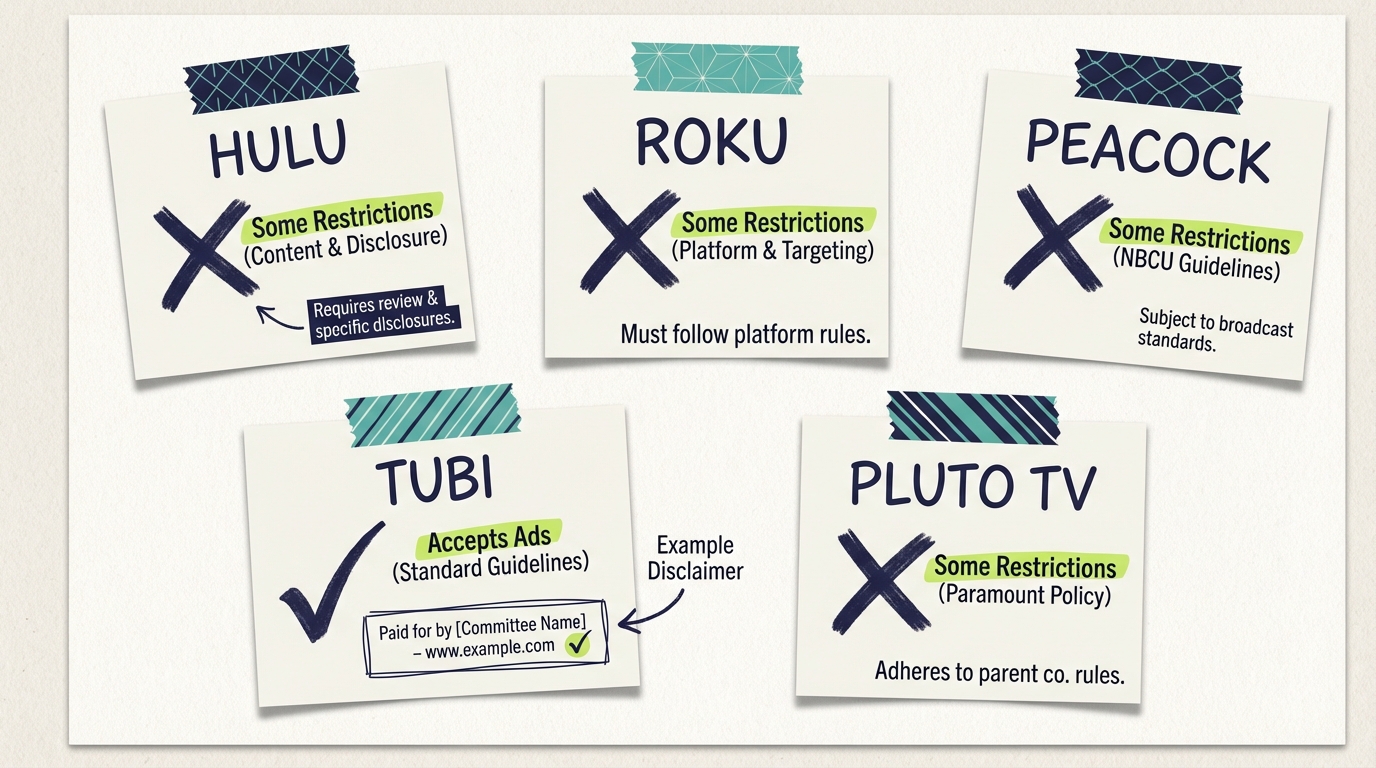
Each major CTV platform has its own rules for political advertising. These policies change frequently, especially during election years, so verify current requirements before committing budget. Here's where things stood as of early 2026.
Hulu
Hulu accepts political advertising but requires campaigns to go through a verification process. Advertisers must confirm they're a registered political committee or authorized campaign entity. Hulu reviews all political ad creative before it runs and can reject content that violates its advertising standards.
Key requirements:
Political advertiser verification before campaign launch
Creative review and approval for all political spots
Proper disclaimer language visible in the ad
Restrictions on ads that contain demonstrably false claims
Geographic targeting must align with the relevant election jurisdiction
Hulu has historically been one of the more accessible platforms for political campaigns of all sizes, from presidential races down to state legislative contests.
Roku
Roku's ad platform accepts political advertising across its FAST (free ad-supported streaming TV) channels and The Roku Channel. Roku requires political advertisers to complete a verification process and submit documentation confirming their status as a registered campaign or committee.
Key requirements:
Advertiser verification and documentation
All ads must include proper "paid for by" disclosures
Creative review process (allow 3-5 business days)
No ads that promote voter suppression or contain demonstrably false election information
Compliance with all applicable federal, state, and local laws
Roku's self-serve platform has made it easier for smaller campaigns to access streaming TV inventory without going through a media agency.
Peacock (NBCUniversal)
Peacock follows NBCUniversal's broader advertising standards for political content. The platform accepts political ads but imposes a more structured approval process than some competitors.
Key requirements:
Advertiser must be a verified political entity
Ads undergo editorial review for compliance with NBC's advertising standards
Content restrictions apply (no misleading claims, no voter suppression messaging)
Proper sponsorship identification required
Campaigns may need to submit ads well in advance of desired air dates
Tubi and Pluto TV
Both FAST platforms accept political advertising through their programmatic ad exchanges. Requirements are generally less restrictive than premium subscription platforms, but both still require:
Standard "paid for by" disclosures
Compliance with applicable election laws
No content that promotes violence or voter suppression
Advertiser verification (process varies)
Because these platforms sell much of their inventory programmatically, political ads may run through demand-side platforms (DSPs) rather than directly with the publisher. This adds a layer of compliance responsibility, since both the DSP and the publisher may have separate political ad policies your campaign needs to satisfy.
Platforms with restrictions or bans
Not every streaming platform welcomes political ads. Some have imposed partial or full bans at various points:
Amazon Prime Video has historically been selective about political advertising and has restricted certain ad categories during election cycles
Netflix launched its ad-supported tier in 2022 and initially did not accept political advertising (check current policy, as this may have changed)
Apple TV+ does not currently accept advertising of any kind
Before allocating budget to any platform, confirm its current political ad policy directly. Policies can shift quickly, especially in the months leading up to an election.
State disclosure requirements that affect CTV campaigns
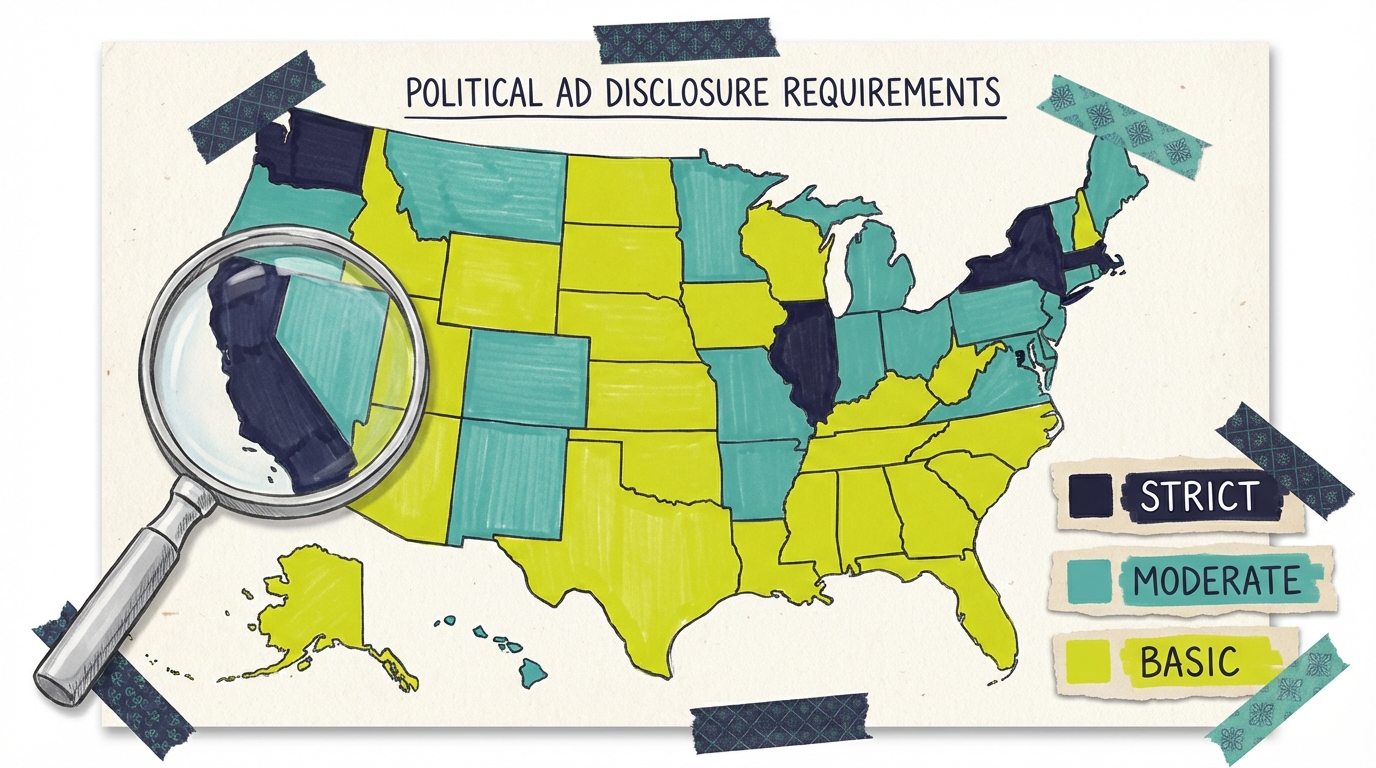
Federal rules set the baseline, but state laws often go further. If your campaign is targeting voters in multiple states (or even a single state with aggressive disclosure laws), you need to understand the state-level requirements that apply to digital and streaming advertising.
States with expanded digital ad disclosure laws
Several states have passed laws that specifically extend political advertising disclosure requirements to digital platforms, including CTV:
Washington State has some of the most detailed requirements in the country. The Washington Public Disclosure Commission requires commercial advertisers (including digital and streaming platforms) to maintain public records of political ad purchases. Campaigns running CTV ads targeting Washington voters need to ensure proper sponsor identification appears on every ad, and platforms serving those ads may have their own record-keeping obligations.
California requires disclaimers on all paid political advertising, including digital ads. The state's DISCLOSE Act mandates that the top three funders of an ad appear in the disclaimer for ads paid for by committees. For CTV, this means your standard "paid for by" line may not be enough if California voters are in your targeting footprint.
New York requires disclaimers on all political communications, including digital advertising. The state's election law specifies that any paid advertisement related to a candidate or ballot measure must include the name of the person or organization that paid for it.
Maryland passed a law requiring platforms to maintain a public file of political ad purchases, similar to the FCC's broadcast political file. While enforcement has been uneven, campaigns targeting Maryland voters should assume platforms will need to collect and store information about your ad buys.
New Jersey updated its election law in 2023 to require disclaimers on digital political advertising, including streaming video. The law requires the "paid for by" disclosure to be "clear and conspicuous" in the ad itself.
AI disclosure requirements by state
This is the fastest-moving area of political ad regulation. As AI-generated campaign content becomes more common, states are racing to establish disclosure rules.
As of early 2026, states that have enacted or are actively enforcing AI disclosure requirements for political ads include:
California (AB 2655): Requires disclosure when political ads contain AI-generated or significantly altered content. Applies to all distribution channels, including streaming.
Michigan: Requires a clear and conspicuous disclosure when a political ad uses AI-generated content depicting a candidate.
Minnesota: Mandates disclosure of "deep fake" content in political advertising.
Texas (SB 1571): Prohibits the publication of deceptive AI-generated videos within 30 days of an election. Applies broadly to digital distribution.
Washington: Requires disclosure when political ads use "synthetic media" that depicts a real person.
More states introduced AI disclosure bills in their 2025 and 2026 legislative sessions. The trend is clearly toward more regulation, not less. If your campaign uses AI tools for ad creation (including platforms like Adwave that generate ads from your content), check whether your target states require disclosure of AI involvement.
Building a state compliance map
For campaigns running in multiple jurisdictions, a state-by-state compliance map is essential. Here's how to build one:
Identify every state where your ads will serve. CTV targeting is geographic, so list every state in your targeting footprint.
Research each state's political advertising laws. The National Conference of State Legislatures (NCSL) maintains a searchable database of state campaign finance and advertising laws.
Check for digital-specific provisions. Many states have updated their advertising laws to cover digital and streaming platforms. Look specifically for language about "internet," "digital," "online," or "electronic" advertising.
Document disclaimer requirements. Some states require more detailed disclaimers than the federal baseline. Build your ad creative to meet the most stringent state requirement in your targeting set.
Monitor for changes. Election law is actively evolving. Set a monthly check during campaign season to review any new legislation or regulatory guidance.
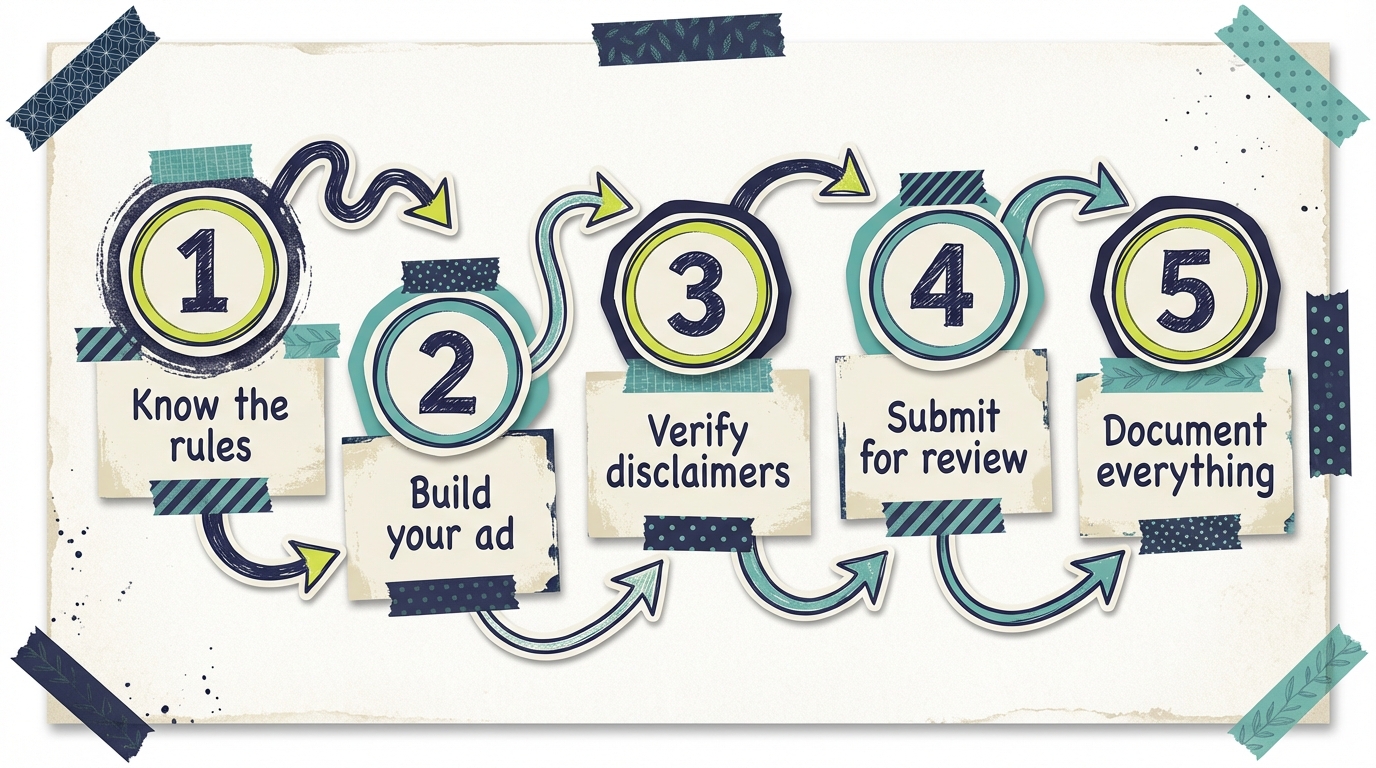
Practical compliance workflow for CTV campaigns
Theory is useful, but campaigns need actionable processes. Here's a step-by-step compliance workflow you can implement before your first CTV ad goes live.
Step 1: Establish your compliance baseline
Before you write a single ad script, document the rules that apply to your specific campaign:
Federal or state/local race? Federal races trigger FEC requirements. State and local races follow state law, which varies widely.
Which states are in your targeting footprint? List every state where your ads will be seen.
Which platforms will you use? Each platform has its own political ad policies.
Are you a candidate committee, PAC, or issue advocacy group? Different entities have different disclaimer obligations.
Create a single compliance reference document that your entire campaign team can access. This prevents the "I didn't know" excuse when someone submits an ad without the right disclaimer.
Step 2: Build compliant ad creative
Every political CTV ad needs to include the proper disclaimer elements from the start. Retrofitting compliance into finished creative wastes time and money.
For your 30-second CTV spots, plan for:
4-6 seconds of disclaimer screen time. The "stand by your ad" requirement for federal candidates needs at least four seconds of candidate visibility. Add time for the "paid for by" text overlay.
On-screen text that meets readability standards. Disclaimer text should be legible on a TV screen, not buried in tiny type. Use high-contrast colors and a font size that's readable from couch distance.
Audio disclaimer when required. Some state laws and platform policies require spoken disclaimers in addition to (or instead of) on-screen text.
AI disclosure language if applicable. If your ad was created using AI tools and your target states require disclosure, build that into the creative upfront.
Platforms like Adwave let you create TV ads quickly, but always review the output for compliance before submitting for platform approval.
Step 3: Complete platform verification early
Don't wait until two weeks before election day to start the platform verification process. Most CTV platforms require political advertisers to verify their identity and authorization before ads can run. This process typically takes 3-10 business days but can take longer during peak political season.
Submit verification documentation as soon as you've decided which platforms to use. Required documentation often includes:
FEC or state campaign finance registration
Committee treasurer or authorized official identification
Contact information for the campaign's compliance officer or attorney
In some cases, proof of candidate authorization
Step 4: Submit creative for review with buffer time
CTV platforms review political ad creative before it runs. During election season, review queues get long. Build at least 5-7 business days of lead time into your media plan for creative approvals.
If your ad is rejected:
Read the rejection reason carefully. Most platforms provide specific feedback.
Revise and resubmit promptly. Don't argue with the platform's content team during crunch time.
Have backup creative ready. If your primary spot gets stuck in review, a secondary version keeps your campaign on the air.
Step 5: Document everything
Keep a compliance file for every ad your campaign runs. For each spot, document:
Final ad creative (video file and script)
Disclaimer text and audio transcript
Platform verification confirmation
Creative approval confirmation
Targeting parameters (geography, demographics)
Flight dates and budget
Any platform correspondence about the ad
This documentation protects your campaign if questions arise after the fact. It's also useful if you're running on broadcast alongside CTV, since broadcast stations' political files are public and your records should be consistent across platforms.
Record-keeping requirements for CTV political ads
Broadcast TV has the FCC's public inspection file, which requires stations to maintain detailed records of political ad purchases. CTV doesn't have an equivalent federal mandate, but that doesn't mean you can skip record-keeping.
Why records matter even without a mandate
Several reasons to maintain thorough records of your CTV political ad activity:
State law may require it. States like Maryland and Washington have passed laws requiring platforms (and in some cases, advertisers) to maintain records of political ad purchases on digital platforms.
FEC reporting. Your campaign's FEC filings must accurately reflect all advertising expenditures. Having detailed records of every CTV buy makes filing accurate and audit-ready.
Internal accountability. Campaigns that track their ad spending meticulously make better decisions about budget allocation. Knowing exactly what you spent, where it ran, and how it performed informs your political advertising cost planning for future cycles.
Legal protection. In the event of a complaint or investigation, documented compliance is your best defense. This applies to candidate campaigns, PACs, and issue advocacy groups alike.
What to keep on file
At minimum, maintain records of:
All ad creative files (final versions as submitted to platforms)
Invoices and receipts from every platform and vendor
Targeting documentation (what audiences, geographies, and platforms)
Performance reports (impressions, completion rates, spend)
All platform correspondence (approval confirmations, rejection notices, policy updates)
Internal compliance review notes
Copies of applicable state filing submissions
Retain these records for at least two years after the election cycle. For federal campaigns, consider keeping them longer, since FEC audit windows can extend beyond two years.
Common compliance mistakes (and how to avoid them)
After working with political campaigns across multiple cycles, certain compliance errors show up again and again. Here are the most common ones and how to prevent them.
Mistake 1: Using the same disclaimer for every platform
Your broadcast TV disclaimer may not satisfy CTV platform requirements or state digital ad laws. Review disclaimer requirements for each platform and state in your targeting footprint, and build creative that meets the most stringent standard.
Mistake 2: Waiting too long for platform verification
Platform verification queues spike before elections. Starting the process 60-90 days before your planned launch date gives you time to resolve any documentation issues without losing ad inventory.
Mistake 3: Ignoring state-specific rules
A campaign running in Washington, California, and Maryland faces three different sets of digital advertising disclosure requirements on top of federal rules. Map your state obligations before you launch, not after you get a cease-and-desist letter.
Mistake 4: Assuming CTV has no rules because the FCC doesn't apply
The absence of FCC authority over streaming doesn't create a compliance vacuum. FEC disclaimers, FTC standards, state laws, and platform policies all govern CTV political advertising. Campaigns that assume "streaming means no rules" are setting themselves up for pulled ads and legal exposure.
Mistake 5: Not budgeting for compliance
Compliance costs money. Legal review, disclaimer production, platform verification, and record-keeping all take time and resources. Build these costs into your campaign budget from the start, not as an afterthought when problems arise.
What's changing in 2026 and beyond
Political ad regulation on CTV is evolving quickly. Here are the trends campaigns should watch.
Federal proposals for streaming transparency
The FCC has signaled interest in extending some form of political ad transparency to streaming platforms. In 2024, the Commission issued a Notice of Proposed Rulemaking exploring whether CTV platforms should be required to maintain public files of political ad purchases, similar to broadcast stations. While no final rule has been adopted, this rulemaking could reshape CTV compliance requirements in future election cycles.
Congress has also introduced legislation (the Honest Ads Act and similar bills) that would require digital platforms to maintain public records of political ad purchases and apply disclaimer requirements to online political advertising. None of these bills have passed as of early 2026, but they reflect bipartisan interest in bringing digital political ads under greater scrutiny.
AI regulation is accelerating
AI-generated political content will face increasing regulation. The number of states with AI disclosure requirements for political ads doubled between 2023 and 2025, and more states are expected to act before the 2026 midterms. At the federal level, both the FCC and FEC are exploring AI-specific rules for political advertising.
For campaigns using AI ad creation tools, proactive disclosure is the safest approach. Even in states that don't currently require it, transparency about AI usage builds voter trust and insulates your campaign from future regulatory changes.
Platform policies will keep shifting
Major streaming platforms revise their political advertising policies before every election cycle. Some expand access, others tighten restrictions, and a few change course entirely. Treat platform policy monitoring as an ongoing campaign function, not a one-time check.
Common questions answered
Do FCC political advertising rules apply to CTV and streaming platforms?
Most FCC political broadcasting rules, including reasonable access, equal time, and lowest unit rate, apply only to broadcast television stations that hold FCC licenses. CTV and streaming platforms are internet-delivered services that fall outside the FCC's broadcast regulatory framework. However, FEC disclaimer requirements still apply to federal candidate ads on any platform, and FTC truth-in-advertising standards apply across all media. Individual state laws and platform-specific policies create additional compliance obligations for CTV campaigns.
What disclaimers are required on political CTV ads?
For federal candidates, the FEC requires a "Paid for by [committee name]" disclosure and the candidate's "I approve this message" statement on every ad, regardless of platform. PAC and issue advocacy ads must identify the paying organization and, when applicable, state that the ad is not authorized by any candidate. Beyond these federal minimums, several states including California, New York, Washington, New Jersey, and Maryland have their own disclaimer requirements that may demand more detailed disclosures on digital and streaming ads.
Can a streaming platform refuse to run my political ad?
Yes. Unlike broadcast stations, which have FCC obligations to provide reasonable access to federal candidates, CTV platforms can accept or reject political advertising at their discretion. Each platform has its own political ad policy, and most require advertiser verification, creative review, and compliance with content standards. Some platforms, like Netflix and Apple TV+, have not accepted political advertising at all. Always confirm a platform's current policy before planning your media buy.
How far in advance should I submit political ads for CTV platform review?
Plan for at least 5-7 business days of lead time for creative review, and longer during peak election season when review queues are backed up. Platform verification (proving you're a registered political entity) should start 60-90 days before your planned launch. Starting early ensures your ads are approved and running when you need them, rather than stuck in a review queue during the final stretch of a campaign.
Do I need to disclose if my political ad was created using AI?
It depends on where your ads are running. As of early 2026, states including California, Michigan, Minnesota, Texas, and Washington have enacted laws requiring disclosure when political ads contain AI-generated or significantly altered content. The list of states with AI disclosure requirements continues to grow. Even where disclosure isn't legally mandated, proactive transparency about AI usage in political ads is becoming a best practice that protects campaigns from regulatory changes and builds voter trust.
What records should political campaigns keep for CTV ad buys?
At minimum, maintain copies of all ad creative files, invoices and receipts from every platform, targeting documentation, performance reports, platform correspondence (including approval and rejection notices), and any state-required filing submissions. Retain these records for at least two years after the election cycle. Thorough record-keeping supports accurate FEC reporting, protects your campaign in the event of complaints or audits, and helps you plan future political media buying more effectively.
Getting your political CTV campaign off the ground
Compliance doesn't have to be a barrier. It's a process, and campaigns that build it into their workflow from day one spend less time scrambling and more time reaching voters.
The bottom line: know your federal obligations, research your state requirements, verify platform policies, and document everything. With the right preparation, your campaign can run effective CTV ads that stay compliant and stay on the air through election day.


