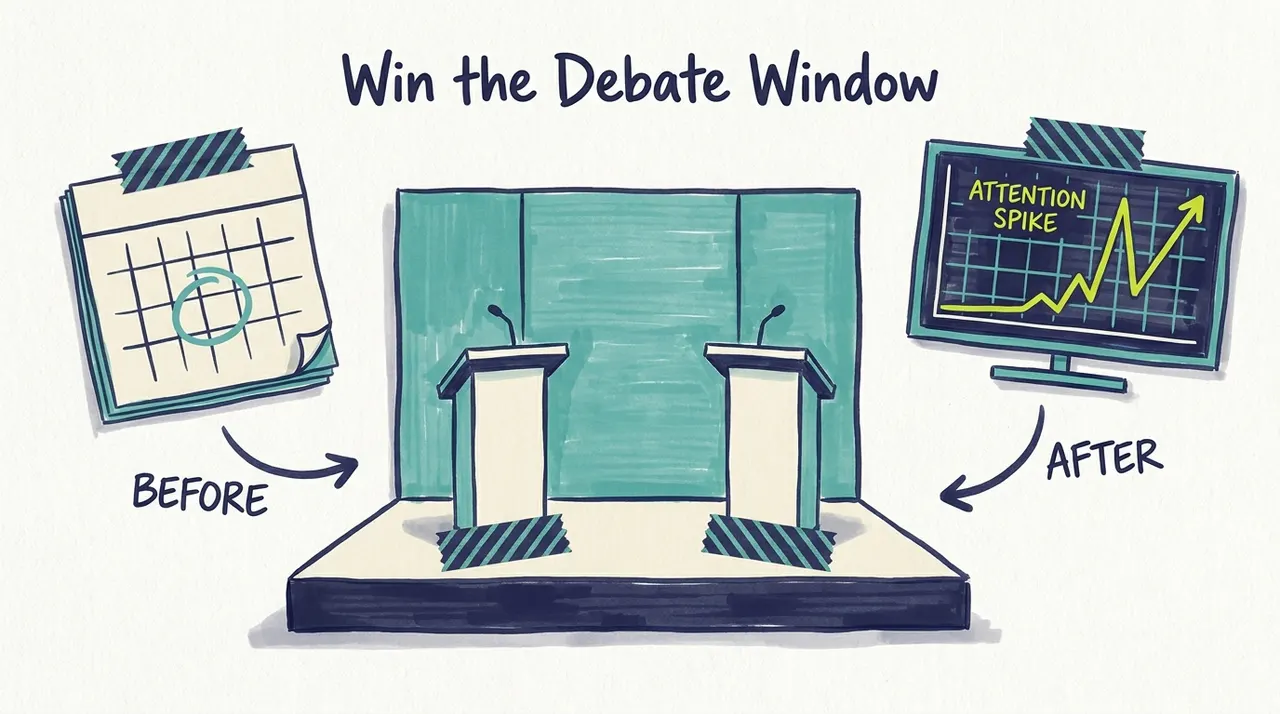
A debate is the rare moment in a campaign when the persuadable voters come to you. For one evening, and the two or three days surrounding it, people who normally tune politics out are watching, talking, and forming impressions: of the race, the issues, and the names on the stage. Most campaigns treat that window as an earned-media event and leave their advertising on autopilot. The campaigns that move numbers treat it as the advertising opportunity of the cycle.
This guide covers the three phases of debate-window advertising (before, during-adjacent, and the critical 72 hours after), how down-ballot campaigns can draft on debates they're not even in, and the speed mechanics that make any of it possible. It's written for the 2026 midterm cycle and applies to any race with a debate calendar, from gubernatorial showdowns to county commission forums.
Why debates are advertising events
Three things spike together around a debate, and each one is an advertising input:
Attention. Debate audiences include exactly the low-information, late-deciding voters that normal political advertising struggles to reach efficiently. They're watching politics voluntarily, often for the first time in the cycle.
Search and chatter. Candidate names get Googled at cycle highs during and after debates. Households discuss what they saw. Impressions formed in this window harden quickly.
Narrative fluidity. For 48-72 hours after a debate, the race's story is being rewritten in real time. Coverage, clips, and conversation are deciding what the debate "meant," and advertising placed inside that window participates in the meaning-making rather than reacting to it after it sets.
The structural insight: debate effects are mostly about what happens around the debate, not on the stage. Campaigns that show up before and after the event shape what the audience tuned in expecting and what they remember deciding.
Pre-debate: one to two weeks out
The pre-debate flight has three jobs, in priority order:
Introduce before the stage does. For challengers and down-ballot candidates, the debate may be the first time many viewers see them. A viewer who has seen your introduction spot six times watches your debate performance as "that candidate I know" rather than a stranger; the same performance lands differently on primed ground. This is the same household-frequency logic covered in our primary season playbook, compressed against a date.
Pre-frame your strengths. Whatever you want the debate to be "about," start saying it now. If your candidate's strength is the local economy, two weeks of economy-focused spots means debate viewers arrive with that frame installed, and they'll score the debate partly on the issue you chose.
Build tune-in among your base. Debate audiences skew toward engaged partisans, and a strong showing in front of your own base produces the volunteer energy and small-dollar surge that fund the post-debate window. "Watch the debate Thursday" creative is cheap, simple, and underused.
Budget shape: lift frequency 30-50% above baseline for the ten days before, concentrated on persuadable-heavy geographies for the framing message and base-heavy geographies for the tune-in push. CTV's zip-level targeting makes running both simultaneously straightforward.
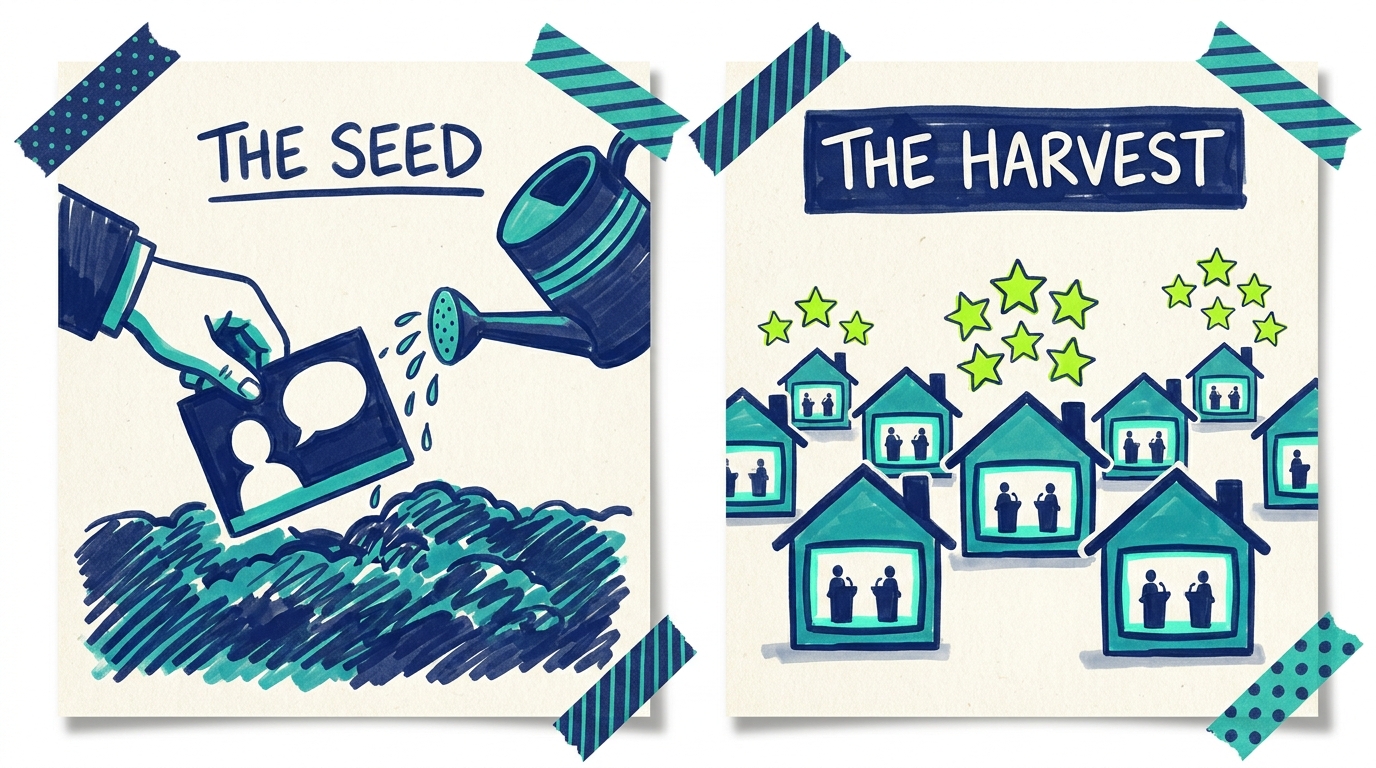
Debate night and adjacency
You can't advertise inside the debate itself, but the attention spike spills across the whole evening and the surrounding programming. Two practical moves:
Saturate the window. Run maximum sustainable frequency the day of, the evening of, and the morning after. Viewers moving between the debate, news coverage, and their regular streaming are in the highest political-attention state they'll occupy all cycle; your spot in the adjacent slots is the closest thing to being on the stage.
Have the right spot loaded. Debate-night creative should be your strongest introduction or framing spot, not an attack or a deep policy cut. The audience includes the persuadable middle at its most attentive; lead with your best face.
The post-debate 72 hours
This is the window that separates modern campaigns from legacy ones, because it runs entirely on speed.
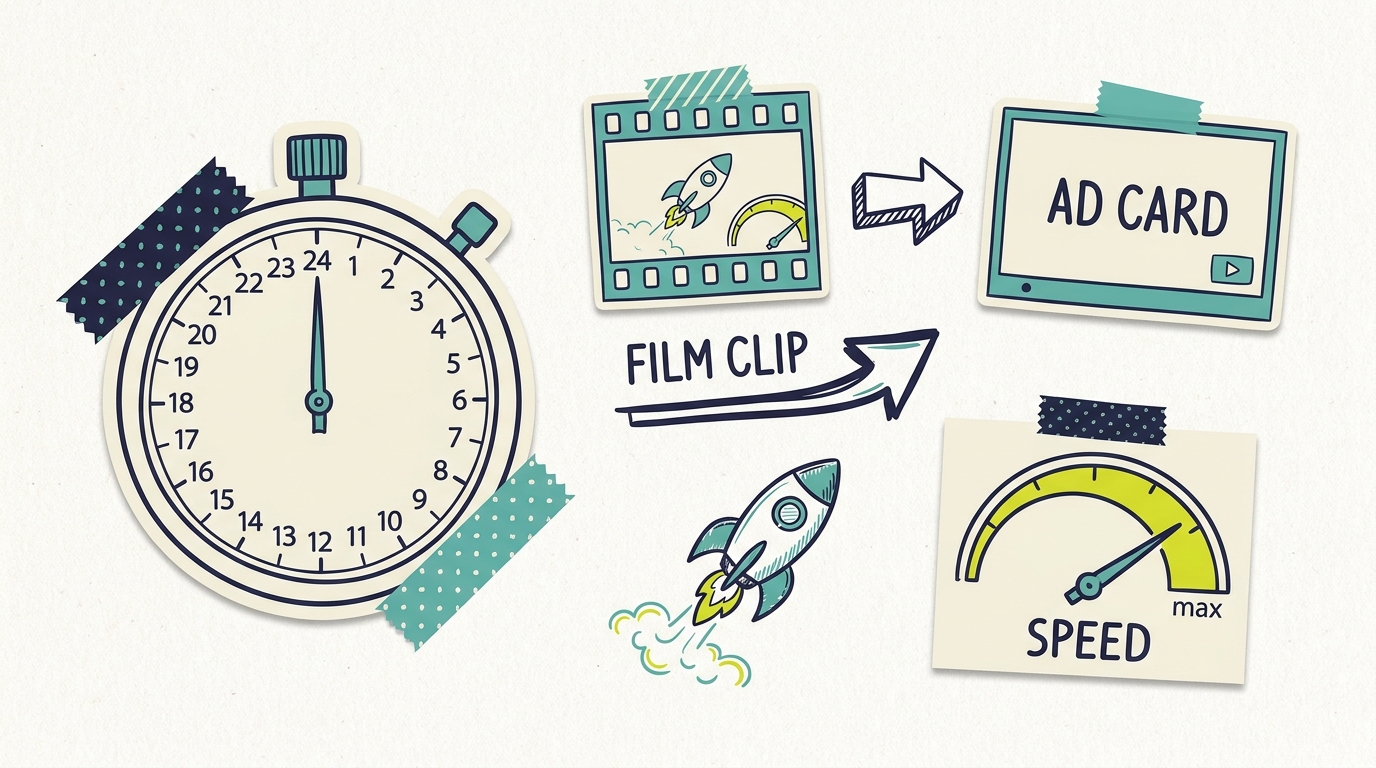
If your candidate won (or had a moment): clip-to-spot turnaround is everything. A 30-second ad built around the debate's strongest moment, live within 24 hours, rides the coverage wave while voters are still deciding what the debate meant. The moment is already being shared; your ad turns organic reach into controlled frequency. With AI generation producing a broadcast-quality spot in about two minutes and campaigns going live in under ten, the bottleneck is now decision speed, not production; our guide to fast-turnaround political TV ads covers the workflow.
If your candidate stumbled: the repair window is the same 72 hours. The error compounds while it's the only thing voters are hearing; a steady, confident spot (back to your core message, ideally with the candidate direct-to-camera) gives supporters something to point to and interrupts the pile-on. Silence reads as confirmation.
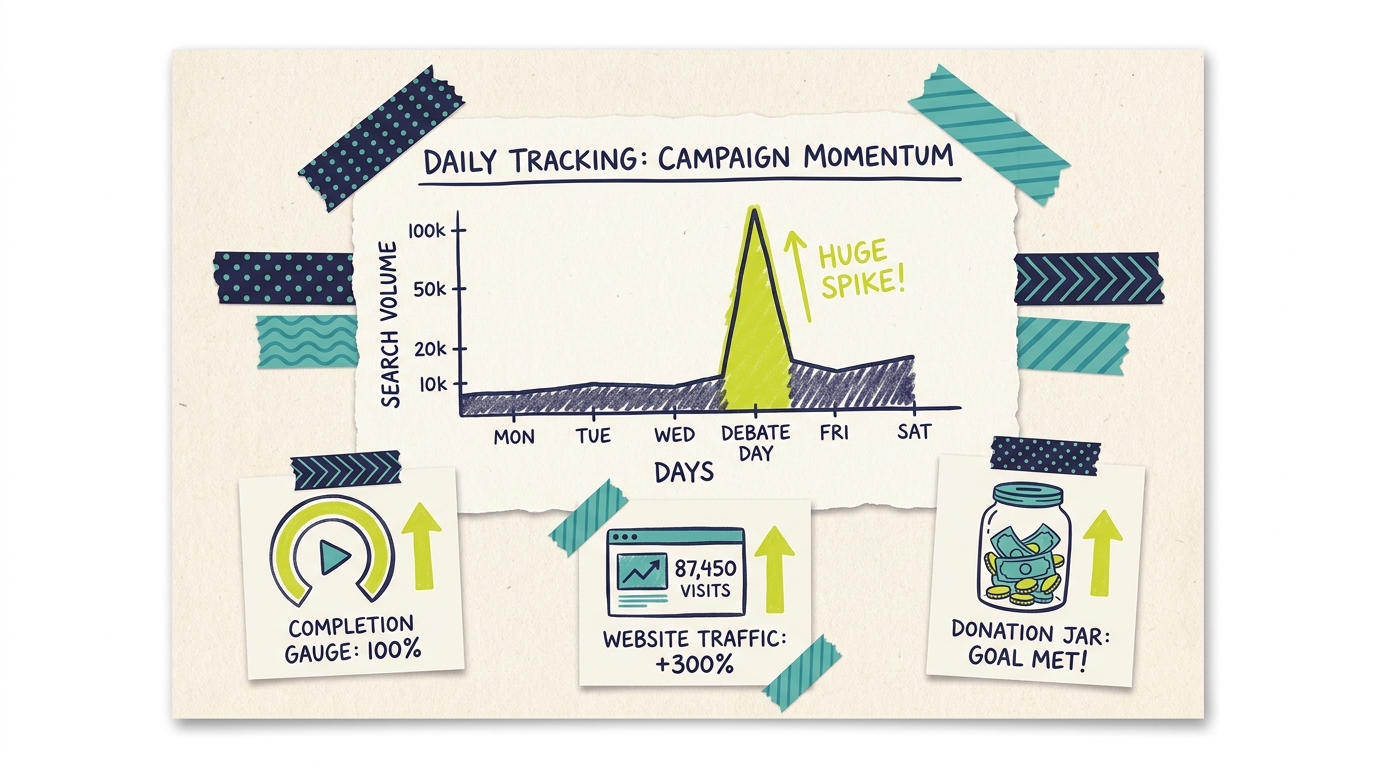
Either way: own the search spike. Candidate-name searches peak for 48 hours post-debate. Branded search ads, a current website, and a pinned best-moment clip catch the curiosity your TV and the debate generated. An impression formed from a search results page is still an impression.
The discipline that makes all three possible: decide before the debate what the playbook is. Draft the "we won" spot framework and the "rough night" spot framework in advance; the post-debate version is an edit, not a creation.
The undercard advantage
Here's the move almost nobody runs: you don't have to be in the debate to advertise around it.
When a governor's or Senate debate pulls a statewide audience, every down-ballot campaign in that state has access to the same attention spike at normal CPMs. The state legislature candidate who runs introduction spots in the adjacency windows around the top-of-ticket debate is buying the cycle's best audience (politically activated, locally concentrated, demographically broad) at no premium, because programmatic CTV doesn't reprice for the moment the way broadcast debate adjacency used to.
The same logic extends to issue-aligned timing: when the debate's expected topics overlap your race's central issue, the audience arrives pre-engaged with your message's subject. For down-ballot campaigns with small budgets, concentrating a meaningful share of the month's spend into the week of a top-of-ticket debate is one of the highest-impact timing decisions available; the broader context is in our down-ballot and programmatic playbooks.
Forums, town halls, and the local debate circuit
Everything above scales down to the events most campaigns have: chamber-of-commerce forums, league-of-women-voters nights, editorial board meetings, local-access debates. The audiences are smaller, but they're made of the most reliable voters and local influencers in the district, and the same three-phase structure applies in miniature.
Pre-frame for a week, not two. Make sure the forum's likely attendees (engaged voters in specific precincts) have seen your introduction spot before they see the folding chairs. Afterward, the rapid-response logic still holds: the best line from a Tuesday forum, in a spot by Thursday, tells the few hundred attendees their impression was widely shared, and tells everyone else what they missed.
Local events also fix the biggest problem with the marquee-debate playbook: scarcity. A statewide race might see two or three debates; a local campaign's forum circuit can run weekly through the fall. Treated as an advertising calendar, that circuit gives a down-ballot campaign a dozen attention windows, each one cheap to surround.
The calendar audit: sit down once, now, with every confirmed debate and forum in your race and above it on the ballot. Mark the windows, assign the budget reserves, and pre-draft the frameworks. Campaigns that do this in June run debate season; campaigns that don't are run by it.
Debate-week timeline
Measuring a compressed window
Debate windows are too short for conversion math; read the fast signals:
Branded search volume, daily, split by your targeted zips. The pre/post-debate jump, and how long it sustains, is your awareness scoreboard.
Completion rates on the post-debate spot within its first 48 hours. A moment-spot that viewers finish at high rates is working; swap quickly if it sags, since the window won't wait.
Site traffic, signups, and small-dollar velocity for 72 hours. Debate windows show up first in the campaign's own funnel.
The durable read comes a week later: did the framing you pushed pre-debate show up in how local coverage and voters described the debate? That's the narrative test, and it's the one that matters in November. Compliance and disclosure basics for all of it are unchanged; see the political TV advertising guide.
Common questions answered
How much should a campaign increase ad spend around a debate?
A working pattern: 30-50% above baseline for the ten days before, maximum sustainable frequency for the 48-hour adjacency window, and a reserved pool (10-15% of the month's budget) held for the post-debate response spot. The reserve matters most; campaigns that spend to zero before debate night can't buy the cycle's best window when it opens.
Can a campaign really produce a response ad within 24 hours of a debate?
Yes, and in 2026 the production step is the easy part: AI tools generate a broadcast-quality 30-second spot in about two minutes, and CTV campaigns go live in under ten. The real constraints are decision-making and compliance review, which is why the playbook is to pre-draft both scenarios (strong night, rough night) before the debate and treat the post-debate version as an edit with the new clip or line dropped in.
Should down-ballot candidates advertise around debates they're not in?
It's one of the best timing opportunities available to them. A top-of-ticket debate concentrates politically attentive local voters into a known window, and programmatic CTV pricing doesn't spike for it. An introduction spot for a county or legislative candidate, running in the adjacency windows, reaches engaged voters at routine CPMs exactly when they're thinking about their ballot.
What kind of ad works best right after a debate?
If you had a strong moment, anchor the spot on it while it's circulating; the ad converts organic buzz into controlled repetition. If the night was rough, go steady and direct: the candidate on camera, returning to the core message, unbothered. In both cases, simple beats clever, because the audience is processing the debate, and your spot's job is to tell them what to keep.
Do debates change votes in local and midterm races?
The stage moments themselves move fewer votes than the narrative that forms in the 72 hours after, which is shaped by coverage, clips, conversation, and advertising. That's precisely why the window strategy matters: campaigns that participate in the meaning-making (pre-framing expectations, amplifying or repairing immediately) consistently get more from debate season than campaigns with better stage performances and silent airwaves.
Make the calendar work for you
Speed is the priority, and it's never been more available. See how Adwave works: a response spot generated in about two minutes, live across 100+ networks in your district before the morning-after coverage cycle ends.