Ready in minutes
AI builds your ad from a single prompt


June 12, 2026
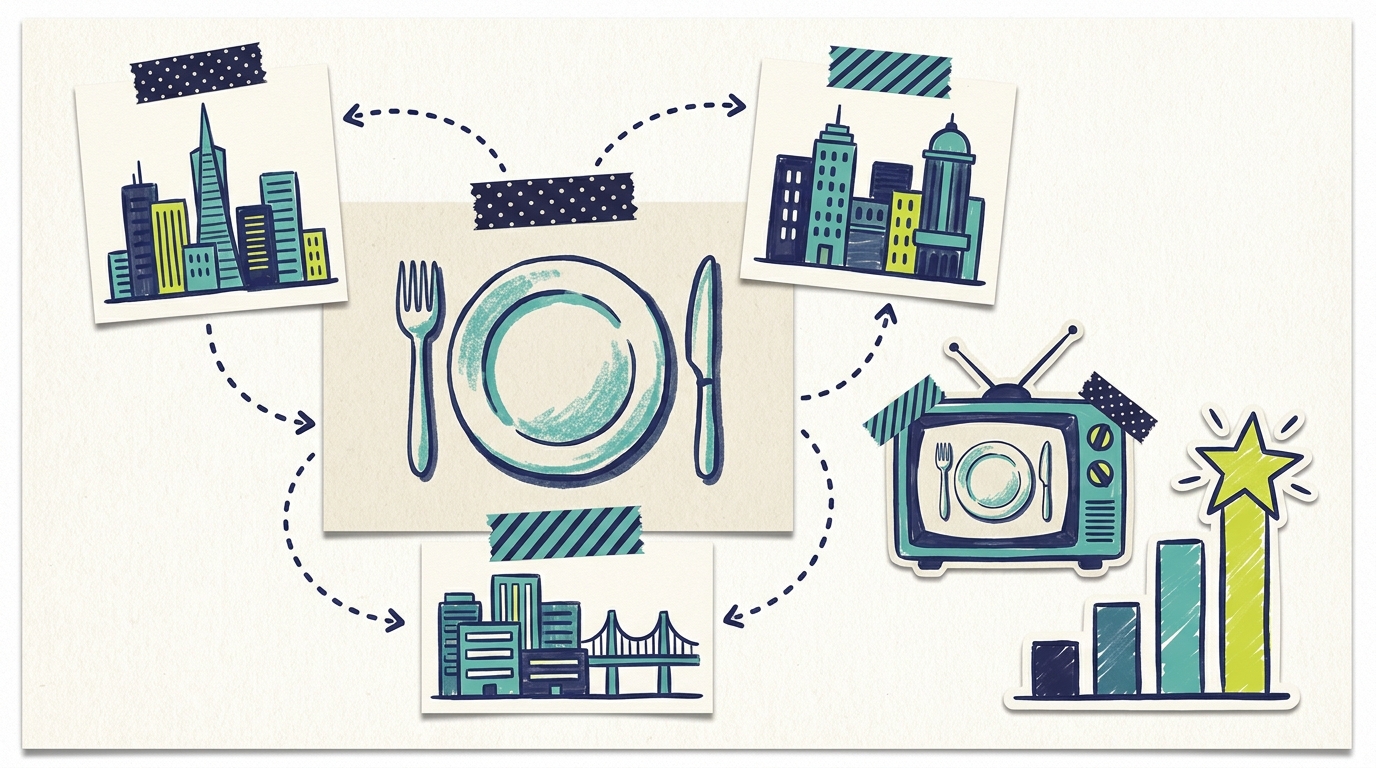
Harvest Table Kitchen is a casual-dining chain with eleven locations spread across three metro areas. Good food, loyal regulars, fifteen years of steady growth, and by early 2025, a problem familiar to every multi-location operator: same-store visits had gone flat. Up 1% year over year, chainwide, for two years running.
The chain's marketing mix was respectable and entirely digital: roughly $14,000 a month across Google Ads, Meta, email, and a loyalty app. Each channel performed acceptably on its own dashboard. None of them was moving the number the leadership team actually watched: guests through the door.
This is the story of how Harvest Table used a single-market CTV test, a control-market measurement design, and a staged rollout to turn flat into +16% same-store visits in advertised markets, and what other multi-location operators can take from it.
The relevant numbers at the start of the test, in early 2025:
11 locations: 5 in the home metro, 4 in a second metro, 2 in a newer third metro
Same-store visit growth: +1% YoY chainwide
Average ticket: $34
Existing marketing: ~$14,000/month digital, chainwide
TV history: none, ever
The leadership team's hypothesis came from their own customer surveys: in the home metro, where the brand was 15 years old, awareness wasn't the problem. But survey-aware diners visited infrequently, and in the two newer metros, even basic brand recognition lagged badly. The chain didn't have a performance problem; it had a presence problem, and presence is what television does.
The marketing director's constraint was equally clear: no leap of faith. Any TV spend had to prove itself against a measurable baseline before it scaled.
Rather than sprinkle budget across all three metros, Harvest Table ran a 90-day test in the home metro only: $3,000 a month, targeted to zip codes within 8 miles of its five home-market locations.
The design choice that made everything afterward possible: the two unadvertised metros became control groups. Same brand, same menu, same promotions, same seasonality, same digital spend per location. The only difference between markets was CTV. Whatever gap opened between the test metro and the controls could be attributed to the campaign with reasonable confidence.
Creative was generated through Adwave's AI tools from the chain's menu and locations pages: a single 30-second brand spot built around dinner-table imagery, with the restaurant's name spoken twice and on screen throughout. A QR code in the final five seconds offered a limited-time seasonal appetizer, giving the team a direct-response tracer on top of the brand campaign.

The test window closed with a clean separation between test and control:
Same-store visits, test metro: +11% versus the same period a year earlier
Same-store visits, control metros: +1.5%, in line with the chain's two-year trend
Branded search volume, test metro: +24%, with no equivalent movement in controls
QR offer redemptions: 1,160 across the five test-market locations, a direct-response bonus the team hadn't counted on
Video completion rate: 96%, confirming the creative was holding attention
Back-of-napkin economics: roughly 9.5 percentage points of visit lift attributable to the campaign worked out to about 4,300 incremental visits over the quarter against $9,000 of spend, or roughly $2.10 per incremental visit. At a $34 average ticket, the team estimated the test returned about $146,000 in incremental revenue, a result that ended the internal debate about whether TV "counts" for restaurants.
Phase two scaled the program to all three metros at $8,500 a month for six months, but not evenly. The team weighted spend by awareness gap rather than by location count:
Third metro (2 locations, newest, weakest awareness): 40% of budget. Highest frequency, because the brand was starting from nothing.
Second metro (4 locations): 35%.
Home metro (5 locations): 25%, a maintenance level, since 15 years of presence needed reinforcing rather than building.
Creative stayed efficient: one brand spot chainwide, with a per-metro closing tag naming the local locations. The chat-based editor made the three versions a same-day job rather than a production cycle.

At the end of the rollout period, measured against the same months a year prior:
Chainwide same-store visits in advertised markets: +16%
Third metro: +21%, the fastest-growing market in the chain for the first time ever
Second metro: +14%
Home metro: +12%, on top of its already-high baseline awareness
Cost per incremental visit: $2.10-$2.60 depending on market
Estimated incremental revenue: ~$46,000/month against $8,500/month in spend, roughly a 5.4x return before margin
Two second-order effects showed up that the team hadn't planned for. Loyalty-app signups rose 19% in advertised periods, seeded by the QR creative. And the chain's franchise-development inquiries ticked up, which leadership attributes at least partly to looking like a brand on television; that effect is hard to price but easy to appreciate.
In keeping with honest accounting:
The first offer creative underperformed. A second spot built around the limited-time offer (price-forward, promotional tone) drew noticeably weaker completion rates than the brand spot. The team retired it after six weeks and folded the offer into the brand spot's QR close instead. For a dining brand, atmosphere sold; discounting didn't.
Lunch targeting was a dead end. A four-week attempt to push weekday lunch traffic with daypart-skewed delivery produced no measurable lunch lift. The team concluded their lunch problem was about workplace proximity, not awareness, and reallocated the budget to the third metro.
Attribution debates never fully ended. Even with control markets, some fraction of lift rides on weather, road construction, and luck. The team's answer was practical: the control-market gap stayed wide and consistent across nine months, and the program kept paying for itself by any reasonable reading of the data.

Use your own footprint as the lab. Multi-market operators have a measurement advantage single-location businesses don't: built-in control groups. Test in one market, hold the others steady, and read the gap. It's the cheapest credible TV measurement available, covered more broadly in our guide on how CTV drives foot traffic to physical stores.
Weight by awareness gap, not location count. Harvest Table's fastest growth came where the brand was weakest, because that's where each impression had the most work it could do. Budget allocation by "where are we least known" beat proportional allocation.
One brand spot, local tags. Chains don't need per-market creative; they need per-market relevance. A shared spot with localized closes kept production cost near zero while preserving the local feel that drives restaurant visits; the fundamentals are in our TV advertising for restaurants guide.
Let the QR code be the tracer, not the goal. The offer redemptions gave the team a real-time pulse, but the visit lift dwarfed the redemption count. Treat direct response as the canary; the brand effect is the bird.
For the single-location version of this story, see our restaurant CTV case study, and for the channel comparison view, the best advertising for restaurants.
How much should a restaurant chain budget for a CTV test?
Harvest Table's numbers are a reasonable template: $3,000 a month for 90 days in a single test market, concentrated within an 8-mile radius of the test locations. The point of the test isn't scale; it's a clean read. Fund one market properly rather than three markets thinly, and let your unadvertised markets serve as the control.
How long before a restaurant sees traffic lift from TV?
Harvest Table saw separation from control markets within six weeks and a clear quarter-end result at 90 days. Restaurants generally read TV faster than high-consideration categories because the purchase cycle is short: a household that sees your spot on Tuesday can be at a table on Friday. Brand-new brands in new markets need longer; established names see movement sooner.
Do chains need different ads for each market?
Usually not. A shared brand spot with a market-specific closing tag (locations, neighborhood names) captures most of the local-relevance benefit at almost no added cost. Full per-market creative only earns its complexity when menus, concepts, or price points genuinely differ between markets.
What's a good cost per incremental visit for restaurant TV?
Harvest Table landed between $2.10 and $2.60. Against a $34 average ticket, that's a comfortable margin even before repeat-visit effects. As a rule of thumb, a cost per incremental visit below 15-20% of average ticket gives a casual-dining operator room to win on first visit alone, with loyalty economics as upside.
Can a single-location restaurant use this playbook?
The budget mechanics scale down well ($500-$1,500 a month covers a single trade area), but the control-market measurement doesn't, since there's no second market to hold steady. Single locations should lean on pre/post baselines, branded search, and QR tracers instead. The creative lessons (atmosphere over discounts, name early and often) apply at any size.
Harvest Table's program is still running, now a permanent line in the marketing budget alongside the digital mix it reinvigorated. Flat same-store traffic became double-digit growth not through a bigger budget but through a channel that finally addressed the actual problem: presence in the markets where the brand was a stranger.
If you operate multiple locations, you already own the test lab. See how Adwave works: generate your spot from your menu page in about two minutes, pick your test market's zip codes, and start your own control-market experiment this month.