-
~3%
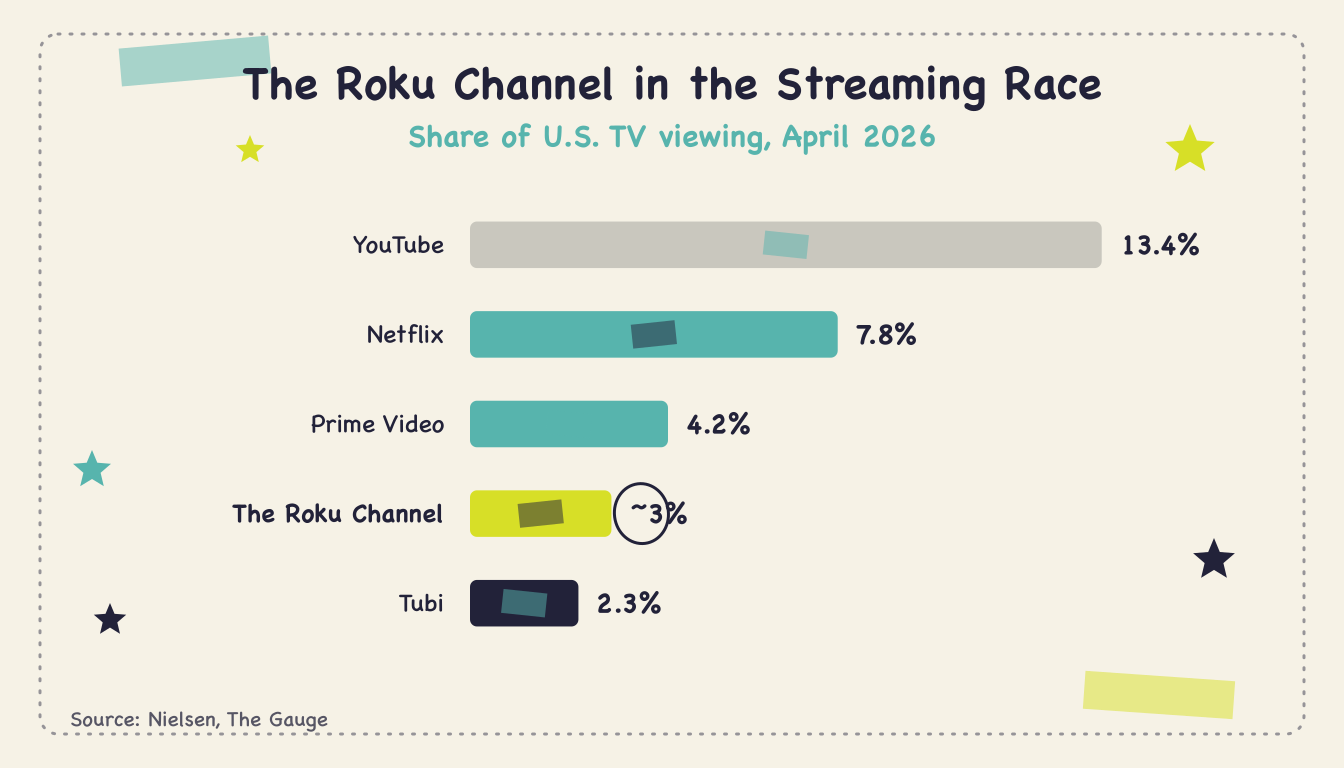
The Roku Channel's share of U.S. TV viewing (April 2026, Nielsen The Gauge)
-
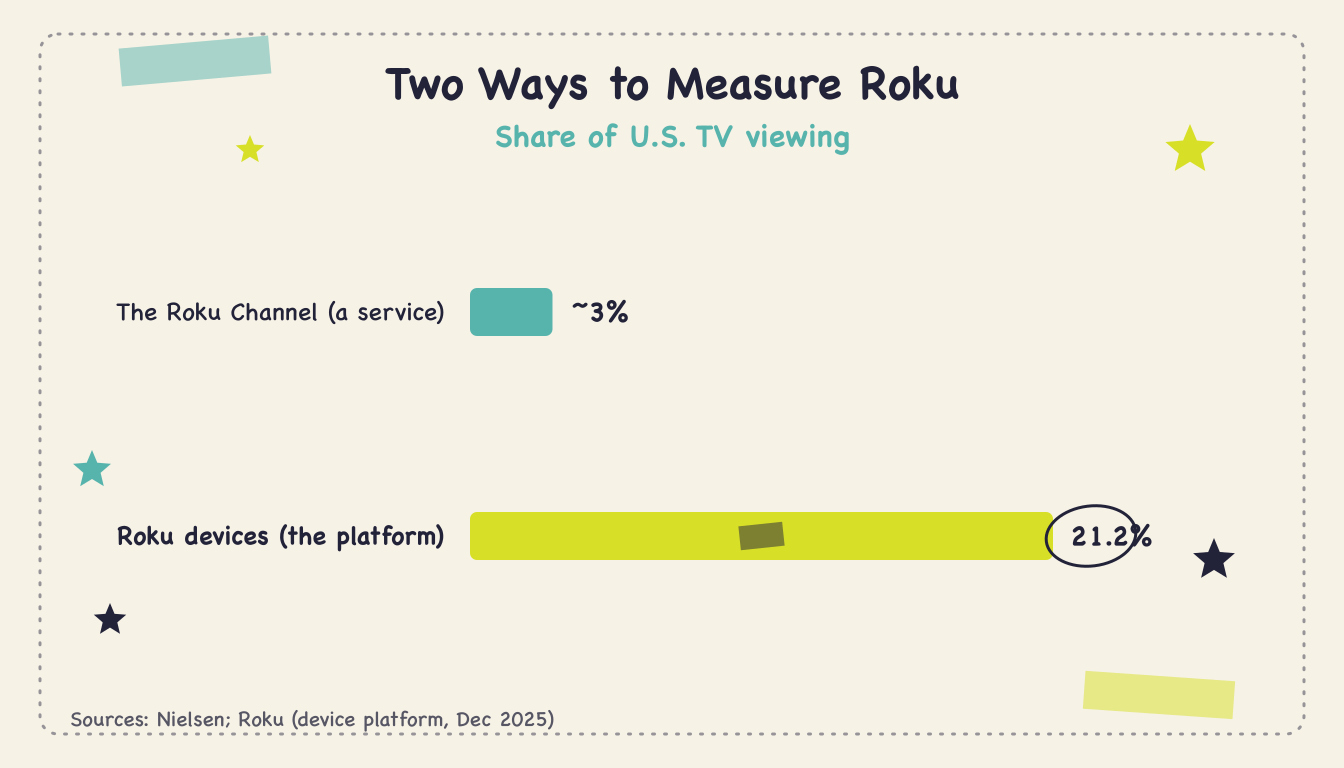
21.2%
Share of all U.S. TV viewing that flows through Roku devices (December 2025)
-
$50
Minimum to start advertising on connected TV with Adwave
Roku means two different things when it comes to TV viewing, and both are big. The Roku Channel, Roku's free ad-supported streaming service, held about 3% of all U.S. TV viewing in April 2026, according to Nielsen's The Gauge, making it a top-five streaming service and one of the largest free services in the country. Separately, Roku the device platform now carries about 21% of all U.S. TV viewing, meaning roughly one in five hours of American television flows through a Roku device.
For a small business, Roku is one of the most accessible names in connected TV, and not by accident. Roku built a self-serve ad platform aimed squarely at growth marketers and smaller advertisers, and its free Roku Channel runs entirely on ads. Roku is where free streaming and small-business advertising meet. Let's break down both Roku numbers for Q2 2026, keep the service and the platform straight, and see what it means for reaching customers.
What the data shows
Before the numbers, one distinction that trips everyone up. "Roku" is both a streaming service and a device platform, and they're measured differently:
The Roku Channel is Roku's free, ad-supported streaming service. It has a share of TV viewing in Nielsen's Gauge, just like Netflix or Tubi.
Roku the platform is the device and operating system, the streaming players and Roku-powered smart TVs that host every app. It has households and hours, and it carries the viewing of all the apps running on it.
With that straight, here's how Roku showed up in the April 2026 Gauge, released June 25, 2026:
The Roku Channel: about 3% of total U.S. TV viewing, a top-five streaming service
Roku the platform: about 21.2% of all U.S. TV viewing flows through Roku devices (December 2025)
For context, total streaming reached a record 47.6% of all TV viewing
The Roku Channel first crossed 3% of total TV viewing in March 2026 and held it in April, and it was one of the fastest-growing services when it did. In Roku's own reporting, the channel reached 6.3% of all U.S. streaming in December 2025, up from 4.6% a year earlier, which is the same audience measured against the streaming pie instead of all TV. Either way, a free service is now one of the most-watched names in streaming. Our free ad-supported streaming share breakdown tracks that FAST growth.
How Nielsen measures this, and why April is the latest number
The Roku Channel's 3% comes from Nielsen's national panel, the same measurement behind its TV ratings, which tracks actual viewing on TV sets. The 21.2% platform figure comes from Roku's reporting of Nielsen data on all viewing that runs through Roku devices. They measure different things, so keep them separate.
A few points help you read the Roku numbers correctly:
Two Roku numbers, two meanings. The roughly 3% is The Roku Channel, a single streaming service. The 21.2% is the device platform carrying every app's viewing. Don't conflate them.
Watch the denominator. The Roku Channel is about 3% of all TV viewing but about 6.3% of streaming-only viewing. Same audience, different base.
April 2026 is the latest confirmed month. Nielsen delayed its March Gauge amid a methodology dispute, and a recalibrated version is expected in the fall, which may shift streaming shares. Every figure here reflects data through April 2026.
The takeaway is that Roku is enormous on both counts: a top-five streaming service and the single largest device gateway to television in America.
Breaking down the numbers
Roku's scale as a platform is the part that surprises people. It isn't just a free channel, it's the connective tissue of streaming for a huge share of U.S. households.
Here's how big the Roku platform is:
100 million-plus streaming households worldwide, a milestone Roku crossed in April 2026
21.2% of all U.S. TV viewing flows through Roku devices, more than any single streaming service
Roku is the number-one selling TV operating system in the U.S., by Roku's account outselling the next competitors, and the top streaming platform by hours streamed in the U.S., Canada, and Mexico
145.6 billion hours streamed across the platform in 2025, up 15% year over year
That platform scale is why Roku matters so much to advertisers. When one in five hours of American TV runs through your devices, you sit at the center of the connected TV ecosystem. Roku sees viewing across every app, powers the home screen everyone passes through, and owns a free channel that runs entirely on ads. Our Roku device ownership page tracks how widespread those devices have become.
Consider what that home-screen position is worth. Every Roku user, tens of millions of households, starts their TV session on a screen Roku controls, before they open Netflix or YouTube. That's premium advertising real estate no individual streaming service can match, because it sits above all of them. It's the connected TV equivalent of owning the front page. Combine that with the viewing data Roku collects across every app on its platform, and you have a company that knows more about how Americans watch television than almost anyone, and can turn that knowledge into ad targeting. For advertisers, Roku isn't just another app to buy, it's infrastructure the whole streaming market runs on.
But the most interesting Roku story for a small business isn't the size. It's the access.
The free-streaming wave behind Roku's rise
The Roku Channel's climb to 3% of all TV viewing is part of a bigger story: the explosion of free ad-supported streaming television, known as FAST. As subscription prices climb, more viewers are turning to services that cost nothing and pay their way with ads, and Roku is one of the biggest beneficiaries.
The FAST trend matters for advertisers in a few concrete ways:
Free means all ad-supported. Unlike subscription services where only some viewers see ads, free services like The Roku Channel run ads for every single viewer. The entire audience is ad-reachable, which makes FAST inventory unusually valuable and abundant.
The audience is huge and growing. The Roku Channel is one of the top free streaming services in the U.S., alongside Tubi and Pluto, and industry forecasts put well over 100 million Americans using free ad-supported streaming. That's a mainstream audience, not a niche.
It skews toward value-conscious viewers. People choosing free, ad-supported streaming are often the same practical, budget-minded consumers many local businesses want to reach, the ones comparing options and responsive to a good local offer.
The Roku Channel expanded aggressively to feed this demand, growing its FAST lineup past 500 channels and adding creator content, sports zones, and event hubs. For advertisers, more free channels means more ad inventory, which tends to keep prices efficient. The rise of FAST is one of the clearest reasons connected TV became affordable for small businesses: a growing share of the most-watched content is now free, ad-supported, and hungry for advertisers of every size.
Why it matters for your business
Most connected TV giants are built for big brands. Roku is unusual in that it deliberately built tools for smaller advertisers, which makes it one of the more accessible names in CTV for a local business.
Here's what makes Roku different for a small advertiser:
A self-serve ad platform. Roku Ads Manager, launched in 2024, is a self-service tool modeled on how you'd buy search or social ads, aimed at growth marketers and smaller businesses. Advertisers using it more than doubled year over year in early 2026.
A low entry point. Trade press has reported Roku Ads Manager campaigns starting around a $500 minimum, far below the tens of thousands that used to gate premium CTV, and a campaign can go live in minutes with approved creative.
Free, ad-supported inventory. The Roku Channel is entirely ad-supported, and Roku's home screen itself carries ad units, so there's deep inventory built for advertising rather than subscriptions.
Roku also extended its reach through a partnership with Amazon's ad platform, announced in 2025, that lets advertisers reach more than 80% of U.S. connected TV households through a single buy. That's the kind of scale that used to require multiple separate deals. Our ad-supported streaming viewers page shows how large the free, ad-supported audience has become.
The bottom line is that Roku pointed its business at accessibility in a way most CTV platforms didn't. For a small business, that philosophy, self-serve tools, lower minimums, ad-supported inventory, is exactly what makes connected TV advertising workable at a local scale.
How to take advantage
Roku's accessibility is real, and you can benefit from the free, ad-supported CTV audience it helped build, whether you buy Roku directly or reach the same viewers across the broader ecosystem. Here's how to think about it.
Reach the audience across services. Roku Channel viewers also watch Tubi, YouTube, Pluto, and more. Running across the whole ecosystem builds the frequency any single service can't.
Match your service area. Set a geographic radius, usually 15 to 25 miles, so every impression reaches a potential customer nearby.
Budget for repetition. Plan enough spend to reach the same households several times over two to three weeks. On connected TV, meaningful frequency costs hundreds of dollars, not thousands.
Let AI make the ad. You don't need a studio. AI tools turn your existing website into a broadcast-quality 30-second ad in about two minutes.
Measure brand lift. Track branded search, direct traffic, and calls during and after a campaign rather than chasing clicks.
The mechanics are simple. With Adwave, ad creation is free, a campaign starts at a $50 minimum, and you can be live across 100+ premium streaming channels in under 10 minutes. You point it at your website, it builds the spot, and you're reaching the free, ad-supported living-room audience that Roku helped make mainstream. For what that budget buys, our guide to the average CTV CPM lays out the costs.
The bigger picture
Roku's two numbers, a 3% channel and a 21% platform, capture a company that turned free streaming and device ubiquity into a major advertising business.
A few forces give the Q2 2026 numbers their weight:
Free streaming is booming. The Roku Channel is one of the top free ad-supported services in the country, and free streaming keeps taking share as subscription prices rise. This is the FAST wave reshaping streaming, and Roku is at the front of it.
Roku's ad business is growing fast. Roku broke out advertising as its own segment for the first time in early 2026, reporting ad revenue of $613 million in the first quarter, up 27% year over year, growing faster than the overall digital ad market.
Accessibility is the strategy. Between Roku Ads Manager, the Amazon partnership, and free ad-supported inventory, Roku is positioning itself to capture small and mid-sized advertising budgets that other CTV platforms overlook. The connected TV advertising market is expanding partly because platforms like Roku opened it to smaller advertisers.
There's a broader lesson in Roku's approach worth sitting with. Most of the connected TV story has been about premium services chasing premium budgets, the Netflixes and Disneys courting national brands. Roku took a different bet: that the bigger long-term opportunity is the enormous, underserved base of small and mid-sized advertisers who never bought TV at all. That's the same bet Adwave makes. As the tools get simpler and the minimums get lower, television stops being a channel reserved for companies with agencies and starts being one any business can use. Roku helped prove that a platform can build a real business serving the long tail, not just the giants.
For small businesses, the throughline is that Roku made the connected TV audience reachable. Whether through Roku's own tools or the broader ecosystem, the free, ad-supported viewers Roku pioneered are exactly the audience a local business can now afford to reach. Roku helped turn television into a channel for everyone.
What experts are saying
Analysts describe Roku as the platform that democratized connected TV advertising. By building a self-serve ad manager, lowering minimums, and leaning into free ad-supported content, Roku positioned itself to capture the long tail of advertisers, the growth marketers and small businesses, that most premium streamers ignore. When Roku broke out advertising as its own reporting segment and posted 27% growth, observers read it as confirmation that the strategy is working.
On the platform side, the consensus is that Roku's device ubiquity is a durable advantage. Being the number-one U.S. TV operating system and carrying more than a fifth of all TV viewing gives Roku a gatekeeper position, sitting on the home screen everyone passes through, that translates directly into ad value. The Amazon partnership, extending combined reach past 80% of U.S. CTV households, reinforced Roku's role as connective infrastructure for the whole ad market. For small businesses specifically, the expert takeaway is that Roku is among the most approachable entry points into connected TV, a rare CTV platform designed with smaller advertisers in mind.
What the numbers don't tell you
Roku's figures come with real nuance, so read them carefully.
The two numbers measure different things. The roughly 3% is The Roku Channel, a single service. The 21.2% is the device platform carrying all apps. Confusing them overstates or understates Roku depending on which you mean.
Denominators matter. The Roku Channel is about 3% of all TV but about 6.3% of streaming only. Always check which base a figure uses.
Some reach stats are dated or self-reported. Roku's claims of being the number-one TV OS and top platform by hours are company figures, and some audience-reach numbers come from older marketing materials. Treat them as directional.
Self-serve still takes work. Roku Ads Manager lowered the barrier, but running an effective CTV campaign still rewards attention and budget. Many small businesses prefer an even simpler path across the whole ecosystem.
Read Roku's numbers as proof of two things at once: a leading free streaming service and the largest device gateway to television, both built with advertising, and increasingly small advertisers, in mind.
Common questions answered
What is Roku's share of TV viewing? It depends which Roku you mean. The Roku Channel, Roku's free ad-supported streaming service, held about 3% of all U.S. TV viewing in April 2026, a top-five streaming service. Separately, about 21.2% of all U.S. TV viewing flows through Roku devices, the largest device platform in streaming.
Is The Roku Channel free? Yes. The Roku Channel is entirely free and ad-supported, with no subscription required. That's a big part of why it has grown so fast, reaching about 6.3% of all U.S. streaming by late 2025, up from 4.6% a year earlier, as viewers gravitate toward free options.
Can a small business advertise on Roku? Yes, and Roku is one of the more accessible CTV platforms for small advertisers. Roku Ads Manager is a self-serve tool with reported minimums around $500. For an even simpler path across the whole streaming ecosystem, Adwave lets you run 30-second ads across 100+ premium channels from a $50 minimum.
How many people use Roku? Roku surpassed 100 million streaming households worldwide in April 2026, and it's the number-one selling TV operating system in the U.S. About 145.6 billion hours were streamed across Roku devices in 2025, up 15% year over year.
How much does streaming TV advertising cost? The average CTV CPM runs roughly $15 to $35, and with Adwave a campaign starts at a $50 minimum with free ad creation. That reaches the free, ad-supported living-room audiences that Roku and the wider streaming shift created, without a national-brand budget.
The numbers at a glance
Key figures behind Roku's Q2 2026 standing, with sources:
~3%: The Roku Channel's share of U.S. TV viewing, a top-five service, April 2026 (Nielsen, The Gauge)
21.2%: share of all U.S. TV viewing flowing through Roku devices, December 2025 (Roku, citing Nielsen)
6.3%: The Roku Channel's share of U.S. streaming, up from 4.6% a year earlier (Roku, citing Nielsen)
100 million+: Roku streaming households worldwide, a milestone crossed April 2026 (Roku)
145.6 billion: hours streamed across Roku devices in 2025, up 15% (Roku)
$613 million: Roku advertising revenue in Q1 2026, up 27% year over year (Roku)
80%+: share of U.S. CTV households reachable through the Roku-Amazon ad partnership (Amazon, Roku)
2024: when Roku launched its self-serve Roku Ads Manager for growth marketers (Roku)
Reach the free-streaming audience, starting at $50
Roku is both a top-five streaming service, through the free Roku Channel at about 3% of U.S. TV viewing, and the largest device platform, carrying 21% of all American TV viewing. It's also one of the most accessible CTV names for small advertisers, which is the whole point.
You don't need a big budget to reach the free, ad-supported streaming audience. See how Adwave works to turn your website into a broadcast-quality 30-second ad in minutes, or check pricing to launch a connected TV campaign from a $50 minimum. The living-room audience is open for business.