-
2x
Higher brand recall from TV vs mobile
-
5x
Brand recall lift with TV + social
-
95%+
CTV ad completion rates
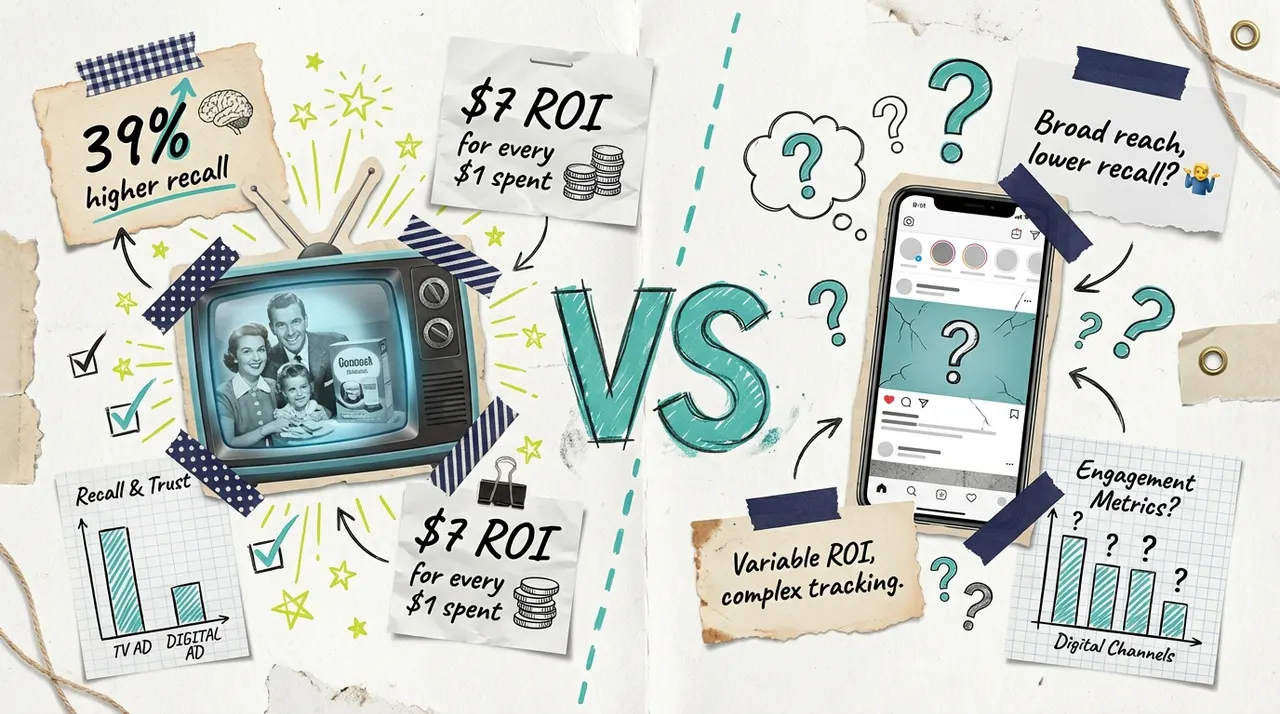
Television advertising delivers brand recall rates 39% higher than other advertising channels, while generating an average return of $7 for every $1 spent, according to research from tvScientific and industry ROI studies. These numbers challenge the common assumption that digital advertising has rendered TV obsolete. In reality, television and digital advertising serve different but complementary roles in building brands and driving business results.
For small businesses evaluating where to invest their advertising budgets, understanding the comparative effectiveness of TV and digital channels is essential. While digital advertising offers precise targeting and immediate measurability, TV advertising delivers unmatched brand-building power, attention quality, and consumer trust. The most effective advertising strategies often combine both channels, with research showing that pairing TV and social media ads produces 2.8 times higher brand recall than social ads alone, according to a 2025 Universal Ads study.
What the data shows
The effectiveness of advertising channels varies significantly depending on what metrics matter most to your business. Television advertising consistently outperforms digital channels on brand-building metrics, while digital advertising often shows stronger performance on direct response metrics. Understanding these differences helps businesses allocate budgets appropriately.
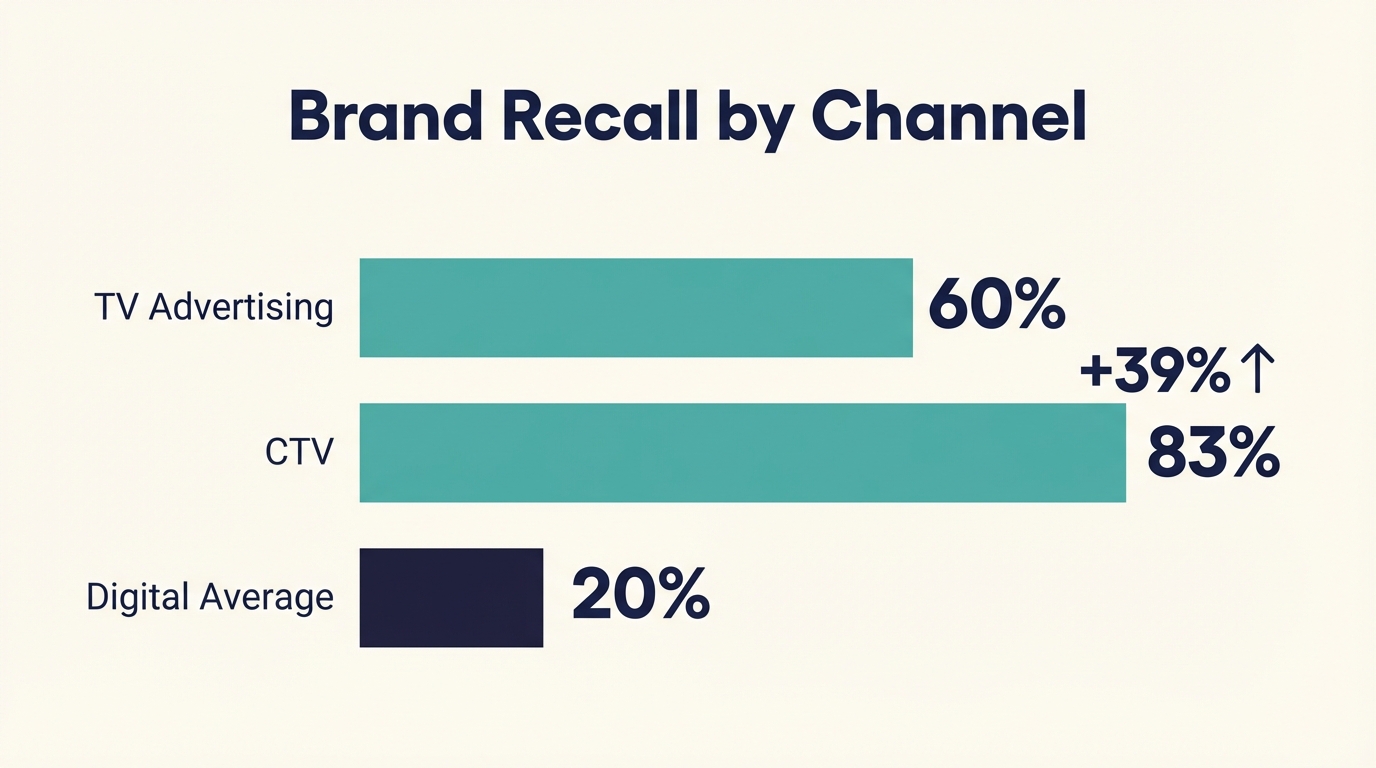
Brand recall represents one of the clearest areas where TV advertising excels. According to a 2024 tvScientific survey, consumers recalled streaming TV ads 39% more often than ads on other channels, including social media. This recall advantage persists across industries and audience segments, which reflects the fundamental differences in how people consume TV versus digital content.
Television advertising achieves an average recall rate of approximately 60% among viewers, according to industry research. This means that six out of ten people who see a TV commercial can later recall seeing it, a substantial figure compared to digital advertising where ad recall often struggles to reach double digits in cluttered, fast-scrolling environments.
Return on investment provides another lens for comparing effectiveness. Television advertising generated an estimated return of $7 for every $1 spent in 2023, according to industry analysis. A separate 2024 study found that TV advertising is responsible for 54.7% of full advertising-generated profit, with an average ROI of £5.61 for every pound spent, per Advanced Television.
Consumer trust represents a significant differentiator for TV advertising. Approximately 55% of viewers find TV advertising more trustworthy than digital ads, according to research data. This trust advantage stems from TV's association with established networks, professional production values, and the implicit quality signal of brands willing to invest in television campaigns.
Purchase intent and behavior show TV's influence on the sales funnel. Research indicates that 65% of consumers report that TV advertisements influence their purchasing decisions. exposure to TV ads drives 44% more sales compared to products without TV advertising support, according to VideoWeek's CTV Advertising Guide.
The coordination between TV and digital advertising produces especially strong results. Research from Universal Ads found that combining streaming TV and social media ads resulted in up to 2.8 times higher unaided brand recall than social media ads alone. This combination also produced a 24% increase in purchase intent, demonstrating how TV advertising amplifies the effectiveness of other channels.
Breaking down the numbers
By advertising objective
Different advertising objectives favor different channels. Understanding which metrics matter most for your specific goals helps determine the optimal channel mix.
For brand awareness objectives, TV advertising demonstrates clear advantages. The combination of sight, sound, motion, and the lean-back viewing environment creates memorable impressions that stick with viewers. TV's ability to reach mass audiences simultaneously builds shared cultural awareness that digital advertising, with its fragmented, personalized delivery, struggles to replicate.
For direct response objectives, digital advertising often shows stronger immediate performance. Google Ads achieved an average conversion rate of 6.96% across all industries in 2024, according to WordStream research. Facebook Ads performed even better, with an average conversion rate of 8.95% across industries, per industry benchmarks.
However, these direct response metrics don't capture the full picture. Many consumers who ultimately convert through digital channels were first influenced by TV advertising. Attribution models that only credit the last click undervalue TV's role in the customer journey. More sophisticated multi-touch attribution reveals TV's contribution to conversions that appear to come from digital channels.
For customer acquisition, the combination of TV and digital typically outperforms either channel alone. TV builds awareness and consideration, while digital captures demand and drives immediate action. Businesses that run TV campaigns often see increased performance in their digital advertising as consumers who've seen TV ads become more likely to click, engage, and convert.
For retention and loyalty, TV advertising maintains brand salience between purchases. Regular TV advertising reminds customers why they chose a brand, reinforcing positive associations and defending against competitive messaging. This maintenance function is especially valuable in categories with long purchase cycles.
By attention quality
Attention metrics reveal significant differences in how consumers engage with advertising across channels. Not all ad impressions deliver equal value; the quality of attention matters as much as the quantity.
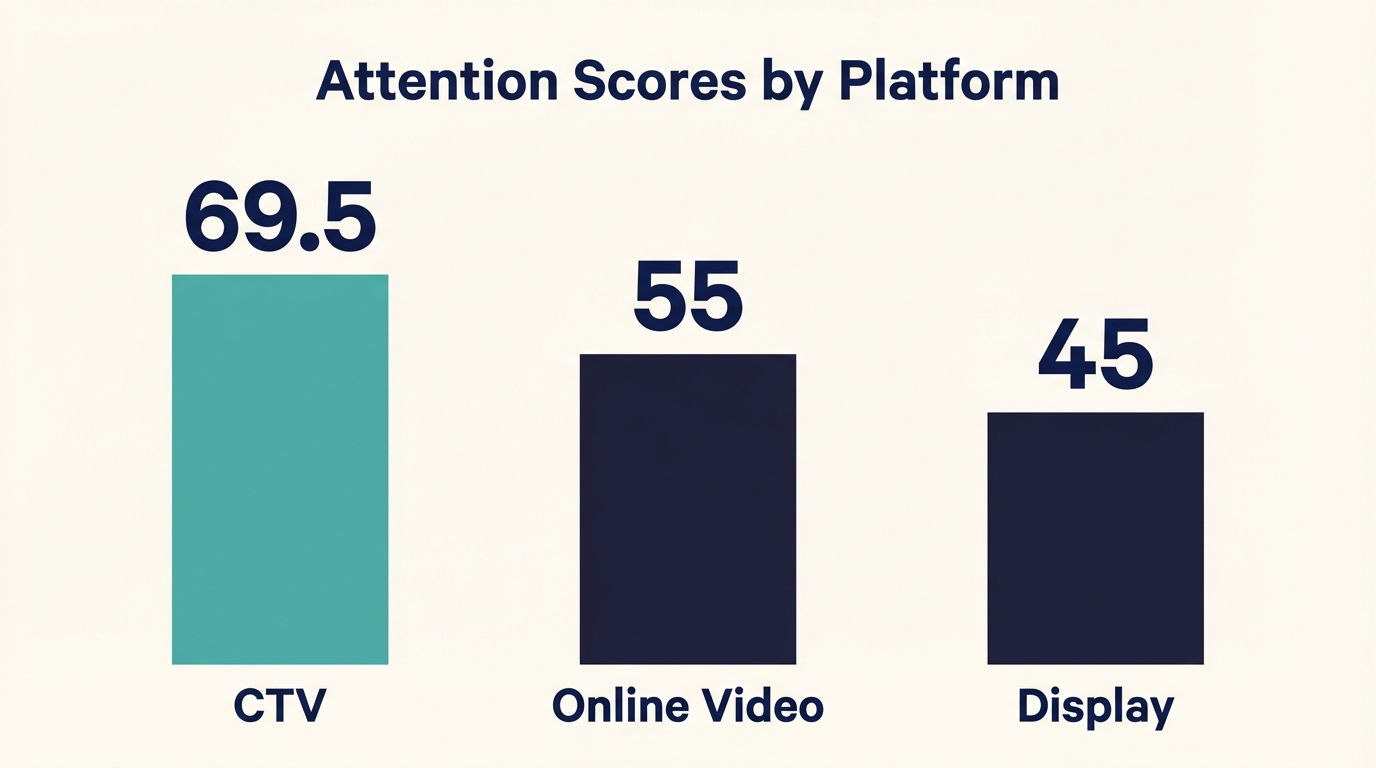
Connected TV advertising attention scores reached 69.53 in Q3 2024, up 21% from 57.55 in Q1 2023, according to MNTN Research. This positions CTV ahead of online video and display advertising in viewer attention.
The viewing environment explains much of TV's attention advantage. When people watch TV, they've made a conscious decision to consume content. They're typically in a relaxed setting, focused on the screen, with fewer competing demands for attention. This contrasts sharply with mobile environments where users scroll quickly through feeds, often while multitasking with other activities. Understanding these attention dynamics helps explain why TV advertising works so effectively for brand building.
Video completion rates further illustrate the attention gap. CTV advertising achieves completion rates above 95%, meaning nearly all viewers watch ads to the end. Mobile video ads achieve completion rates around 80%, and the gap widens further when considering attention quality during viewing. Many mobile viewers technically "complete" ads while their attention is elsewhere.
Research from Lumen Technologies provides detailed attention comparisons. Studies show that CTV ads capture viewer attention for substantially longer than social media ads. Viewers engaged with cinema ads (the gold standard for attention) three times longer than TV and CTV ads, and up to ten times longer than social media ads, according to an NCM study.
The business implications of attention quality are significant. An ad that captures genuine attention for 30 seconds delivers more value than an ad that technically plays while the viewer looks elsewhere. Attention-based metrics increasingly inform media buying decisions as advertisers recognize that impression counts alone don't predict campaign effectiveness.
By audience reach
Reach patterns differ substantially between TV and digital advertising, with each channel offering unique audience access.
Television advertising, especially broadcast and cable, still reaches the broadest audiences in single exposures. Major events like the Super Bowl can reach over 100 million viewers simultaneously, creating mass awareness that digital campaigns struggle to match. Even routine primetime programming reaches millions of households in single airings.
Digital advertising offers precise targeting but fragmented reach. While digital platforms can target specific demographics, interests, and behaviors with remarkable precision, building broad reach requires extensive campaigns across multiple platforms. The personalized nature of digital means that two neighbors might see entirely different ads, limiting shared cultural impact.
Streaming TV advertising combines elements of both approaches. According to Effectv research, 67% of households reached by streaming are incremental to those reached by traditional TV. This means streaming extends reach to audiences that linear TV doesn't capture effectively, especially younger viewers and cord-cutters.
The same research found that streaming impressions are 4.7 times more likely to be delivered within light and no-TV households. For advertisers seeking detailed reach, combining linear TV with streaming captures both traditional TV viewers and those who've shifted to streaming-only consumption.
Understanding your target audience's media consumption patterns helps determine optimal reach strategies. Younger audiences increasingly require streaming and digital strategies, while older demographics remain accessible through traditional TV. Platforms like YouTube on TV have become especially important for reaching younger viewers who consume content on connected devices. Most audiences require multi-channel approaches for detailed reach.
Brand recall: TV delivers 39% higher recall than digital-only campaigns
Return on investment: $7 return per $1 spent on TV advertising (varies by category)
Multi-screen lift: TV + digital combined delivers 60% higher conversion than digital alone
Trust factor: 70% of consumers trust TV ads more than social media advertising
Why it matters for your business
The effectiveness differences between TV and digital advertising have practical implications for businesses making budget allocation decisions. Understanding these differences helps optimize advertising investments for maximum impact.
For businesses building brand awareness, TV advertising delivers efficiency that digital channels struggle to match. The combination of high recall rates, consumer trust, and attention quality means that TV advertising builds brand equity faster and more durably than equivalent digital spending. A business trying to establish awareness in a new market will typically achieve results more efficiently through TV than through digital display or social advertising alone.
For businesses in competitive categories, TV advertising provides differentiation advantages. Consumer trust in TV advertising transfers to the brands that advertise there. Appearing on television signals credibility and establishes brand legitimacy in ways that digital advertising, with its lower barriers to entry, cannot replicate. Small businesses can compete more effectively with larger competitors when they advertise on the same TV screens.
For businesses with digital-heavy strategies, adding TV advertising amplifies existing investments. The research showing 2.8x higher brand recall when combining TV and social demonstrates that TV makes digital advertising work harder. Consumers who've seen TV ads are more likely to notice, engage with, and respond to subsequent digital touchpoints. TV advertising lifts the entire marketing funnel.
Local businesses benefit especially from TV's effectiveness advantages. When a restaurant, dental practice, or home services company advertises on TV, they gain the trust and credibility advantages that national brands have long enjoyed. Geographic targeting capabilities in streaming TV advertising make these benefits accessible at local business budget levels.

For businesses measuring ROI, TV's $7 return per $1 spent represents compelling efficiency. While digital advertising offers more immediate measurability, the longer-term brand effects of TV advertising often deliver superior total returns. Businesses that track awareness and conversion attribution rather than just last-click metrics typically discover that TV's contribution exceeds initial expectations.
How to take advantage of this trend
Businesses can capitalize on TV advertising's effectiveness advantages through strategic approaches that maximize impact while managing costs.
First, consider TV advertising as a brand-building investment rather than a direct response tactic. TV advertising works best when the goal is building awareness, establishing credibility, and influencing purchase consideration. Measure success through brand lift studies, aided and unaided awareness metrics, and overall business growth rather than expecting immediate click-through conversions.
Second, combine TV and digital for maximum effectiveness. The research consistently shows that TV amplifies digital advertising performance. Plan campaigns where TV advertising drives awareness while digital channels capture resulting demand. Coordinate creative messaging across channels to reinforce key brand elements and offers.
Third, invest in quality creative that earns attention. TV's effectiveness advantages depend on creative that holds viewer interest. Professional production, compelling storytelling, and clear messaging maximize the impact of TV advertising investments. With platforms like Adwave, businesses can access AI-generated creative that achieves broadcast quality without traditional production costs.
Fourth, target strategically to maximize efficiency. Streaming TV advertising enables geographic, demographic, and behavioral targeting that traditional TV couldn't offer. Local businesses can focus spending on households in their service areas. National businesses can prioritize high-value customer segments. Smart targeting stretches TV budgets further while maintaining effectiveness.
Fifth, measure detailedly using multi-touch attribution. Simple last-click attribution understates TV's contribution to business results. Implement measurement approaches that credit TV's role in building awareness and consideration before digital channels capture conversions. Brand lift studies, matched market tests, and multi-touch attribution models reveal TV's true effectiveness.
Sixth, test and learn before scaling. Start with modest TV advertising investments to understand how the channel performs for your specific business. Test different creative approaches, targeting strategies, and flight patterns. Once you identify winning combinations, scale investment with confidence.
Build brand first: Use TV for awareness building, layer digital for direct response conversion
Measure holistically: Track brand search lift and overall traffic, not just direct attribution
Allow time for impact: Give TV campaigns 4-6 weeks for effects to materialize fully
Combine channels: Layer TV with digital retargeting for maximum campaign effectiveness
The bigger picture
The convergence of TV and digital
The traditional distinction between TV and digital advertising is becoming less meaningful as the industry converges around connected television. CTV combines TV's effectiveness advantages (attention quality, brand building, consumer trust) with digital's capabilities (targeting precision, measurability, optimization).
This convergence benefits advertisers who previously had to choose between reach and targeting, between brand building and measurability. CTV advertising delivers TV's effectiveness in an addressable, measurable format. Small businesses that couldn't access TV advertising due to high minimums and broad geographic requirements can now run targeted TV campaigns at accessible price points. The growth of streaming makes these opportunities increasingly valuable.
The convergence also changes competitive dynamics. Digital-native brands that built businesses through Facebook and Google advertising are increasingly adopting TV strategies as customer acquisition costs rise on digital platforms. Traditional TV advertisers are embracing streaming to reach audiences that linear TV no longer captures effectively. The result is a more integrated advertising environment where channel distinctions matter less than reaching the right audiences with effective creative.
Rising digital advertising costs
Digital advertising costs have increased substantially, making TV advertising relatively more attractive. Customer acquisition costs on Facebook and Google have risen significantly over the past several years as more advertisers compete for the same inventory. This cost inflation has prompted many businesses to diversify into TV advertising.
The cost dynamics favor TV advertising for brand building specifically. While digital platforms remain efficient for direct response objectives, their cost increases have made them less effective for awareness campaigns. TV advertising's cost efficiency for brand building has improved relative to digital alternatives.
The attention economy
Consumer attention has become the scarcest resource in advertising. The proliferation of content options, the ubiquity of screens, and the competition for engagement have made attention harder to capture and hold. TV advertising's attention advantages become more valuable as attention becomes scarcer.
The lean-back TV viewing environment provides respite from the always-on digital environment. When consumers choose to watch television, they're often seeking relaxation and entertainment, creating mental space for advertising messages. This contrasts with mobile environments where users are task-oriented, hurried, and resistant to interruption.
What experts are saying
Industry analysts and advertising professionals have noted TV advertising's enduring effectiveness even as digital channels dominate advertising discussions.
Media effectiveness researchers emphasize that TV's brand-building capabilities remain unmatched by digital channels. While digital offers targeting and measurability advantages, the fundamental effectiveness of TV advertising for creating memorable brand impressions persists across studies and markets.
Marketing agency professionals increasingly recommend balanced media strategies that include TV advertising. The recognition that digital-only strategies have limitations, especially for brand building and customer acquisition at scale, has renewed interest in TV advertising among businesses that had shifted entirely to digital.
Brand marketers at major companies continue to prioritize TV advertising despite digital's measurability advantages. The understanding that long-term brand equity requires the kind of memorable, emotional impressions that TV delivers better than any other medium shapes budget allocation decisions at sophisticated marketing organizations.
Small business advertising advocates note that streaming TV has democratized access to TV advertising's effectiveness. Businesses that previously couldn't afford TV can now access the same brand-building power that major advertisers have long enjoyed, leveling competitive dynamics in local markets.
Common questions answered
Is TV advertising still effective in 2025?
Yes, TV advertising remains highly effective in 2025. Research shows TV delivers 39% higher brand recall than other channels, generates $7 return for every $1 spent, and maintains consumer trust advantages over digital advertising. While viewing has shifted from linear TV to streaming, the fundamental effectiveness of TV advertising persists. In fact, streaming TV advertising combines TV's brand-building effectiveness with digital targeting and measurability, making TV advertising more accessible and accountable than ever.
Which is more effective, TV or digital advertising?
Each channel excels at different objectives. TV advertising is more effective for brand building, creating memorability, establishing trust, and influencing purchase consideration. Digital advertising is often more effective for direct response, capturing existing demand, and driving immediate conversions. The most effective strategies combine both channels, with research showing 2.8 times higher brand recall when TV and social ads work together. The right balance depends on your specific business objectives, target audience, and budget.
Why is TV advertising more memorable than digital?
TV advertising achieves higher memorability due to several factors. The large screen and immersive viewing environment command attention in ways small screens cannot. Viewers are typically in a relaxed, receptive mindset rather than task-oriented browsing mode. TV ads cannot be scrolled past or skipped as easily as digital ads. The combination of sight, sound, and motion in a controlled environment creates stronger memory encoding. The professional production quality associated with TV advertising signals credibility that enhances brand recall.
How does TV advertising affect digital advertising performance?
TV advertising amplifies digital advertising performance significantly. When consumers see TV ads for a brand, they become more likely to notice, click on, and engage with that brand's digital advertising. Search volume increases, click-through rates improve, and conversion rates rise. Research shows that combining TV and social media advertising produces 2.8 times higher brand recall and 24% higher purchase intent than social advertising alone. TV advertising essentially primes the audience for subsequent digital touchpoints.
Is TV advertising worth it for small businesses?
Yes, TV advertising can be highly effective for small businesses. Streaming TV advertising has made TV accessible at budgets starting as low as $50, eliminating the high minimums that previously excluded small businesses. Local targeting capabilities ensure that small businesses only pay to reach relevant geographic areas. The trust and credibility advantages of TV advertising help small businesses compete more effectively with larger competitors. Many small businesses find that TV advertising delivers strong ROI when implemented strategically.
How do you measure TV advertising effectiveness?
TV advertising effectiveness can be measured through multiple approaches. Brand lift studies measure changes in awareness, consideration, and preference among audiences exposed to TV ads. Multi-touch attribution tracks how TV advertising influences conversions across the customer journey. Matched market tests compare business results in markets with and without TV advertising. Website traffic and search volume analysis reveals TV's impact on digital engagement. Advanced measurement platforms now track household-level exposure and subsequent behavior, providing increasingly precise effectiveness measurement.
Supporting data
Additional context on TV advertising effectiveness compared to digital channels:
Brand recall advantage for streaming TV ads: 39% higher than other channels (tvScientific 2024 Survey)
TV advertising ROI: $7 return per $1 spent (Industry Research)
TV advertising trust: 55% of viewers find TV more trustworthy than digital (Industry Research)
TV influence on purchases: 65% of consumers say TV ads influence purchasing (Industry Research)
TV ad recall rate: 60% average recall among viewers (Industry Research)
TV + social brand recall: 2.8x higher than social alone (Universal Ads 2025 Study)
TV + social purchase intent: 24% increase vs social alone (Universal Ads 2025 Study)
CTV attention score: 69.53 in Q3 2024, up 21% YoY (MNTN Research)
TV sales impact: 44% more sales vs non-advertised products (VideoWeek CTV Guide)
Streaming incremental reach: 67% of streaming households incremental to linear TV (Effectv 2024)
Google Ads conversion rate: 6.96% average across industries (WordStream 2024)
Facebook Ads conversion rate: 8.95% average across industries (Industry Benchmarks)
All sources linked above. Data current as of September 2025.
Get started with TV advertising
Ready to experience TV advertising's effectiveness for your business? Streaming TV advertising combines TV's brand-building power with accessible pricing and precise targeting.
Adwave makes TV advertising accessible for businesses of all sizes. Create professional commercials in minutes using AI, target viewers in your local area, and launch campaigns starting at just $50. Join the brands discovering that TV advertising delivers unmatched effectiveness for building awareness and driving growth.