When someone asks Siri for "a plumber near me" or tells Alexa to "find a pizzeria that's open now," they’re not just searching, they’re starting a direct conversation with a local business. Yours could be the one they find.
Voice search optimization is all about making sure your business is the answer when people ask. It’s less about old-school, rigid keywords and more about being ready for natural, spoken questions. For local businesses, from contractors to cafes, this isn't some far-off trend. It’s the new digital front door, and it's wide open.
Why Voice Search Is Your New Digital Front Door
Think about it. People aren't just typing "dentist Austin" into a search bar anymore. They’re having a real conversation with their phones and smart speakers. The search has evolved into, "Hey Google, who is the best dentist in Austin for teeth whitening?"
If your online presence isn't set up to answer that specific question, you're invisible. For a local business, that's a missed opportunity for foot traffic, phone calls, and new customers. Mastering this channel is quickly becoming essential for growth.
The Data Shows the Urgency
The numbers don't lie. A massive 58% of consumers are already using voice search to find local business information. And for those who own smart speakers, it's a weekly habit, 76% of them perform local searches every single week.
Here's the kicker: Despite nearly half of all voice searches having local intent, a shockingly small 4% of businesses are set up to be found this way.
That gap is your opportunity. Getting this right before your competitors do gives you a serious edge. You can become the default, go-to answer in your area while everyone else is still trying to figure it out.
This simple flowchart breaks down exactly how a customer’s voice command turns into a visit to your shop.
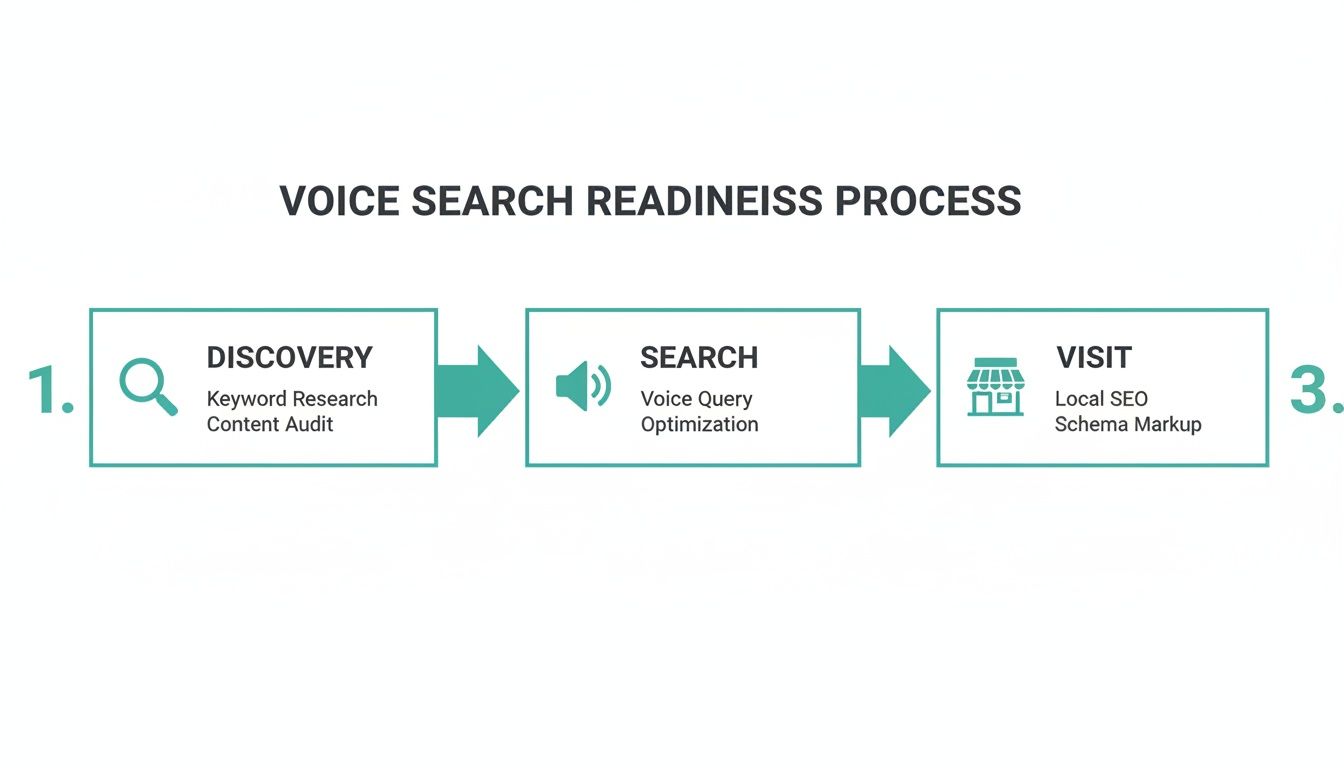
As you can see, if you’re not optimized for the "Discovery" and "Search" phases, you never make it to the "Visit" phase. You're effectively out of the running before the race even starts.
The Pillars of Voice Search Readiness
To win at voice search, you need a solid foundation. This table outlines the core components you need to have in place.
These pillars work together to signal to search engines that you are a trustworthy and relevant answer for a user's spoken query.
Getting these fundamentals right is non-negotiable. It all starts with making sure your core business information (name, address, phone number, and hours) is perfectly consistent everywhere online. From there, your website content must directly address the questions your customers are asking.
But here’s something many people miss: brand recognition. A customer is far more likely to trust a voice assistant’s suggestion if they’ve heard of the business before.
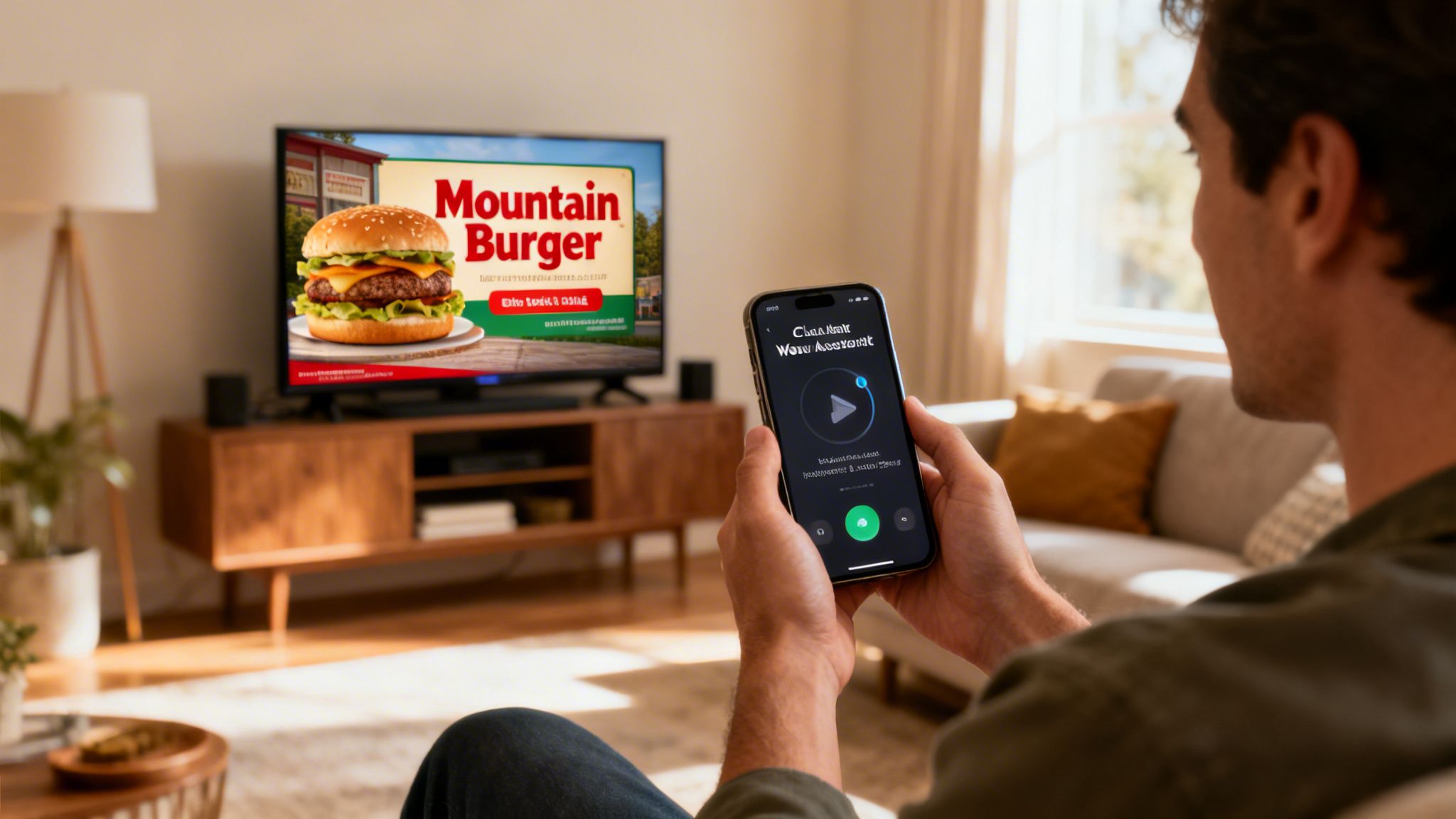
This is where combining your SEO efforts with brand awareness becomes a useful option. Imagine a potential customer sees your ad on a streaming service and then, a few days later, hears Siri recommend your shop. That connection turns a simple search result into a trusted endorsement. It’s a powerful one-two punch that drives real results, and it's precisely what a service like Adwave helps local businesses achieve.
For a deeper look at the foundational elements, our guide on local SEO for the Map Pack is a great place to start.
Finding the Conversational Keywords Customers Use

If you're still optimizing your site for the short, choppy keywords people type, you're missing a huge piece of the voice search puzzle. The biggest pivot local businesses need to make is understanding that people don't talk to their phones the way they type into a search box. It’s a completely different mindset.
Think about it. When you’re at your desk, you might type "plumber Brooklyn." But when your sink is overflowing, you're grabbing your phone and saying, "Hey Siri, who's the best plumber for a leaky faucet near me?" The intent is identical, but the language couldn't be more different. Your job is to show up for that second, more urgent query.
This means you need to target long-tail, question-based keywords that sound like real human speech. We’ve seen time and again that these spoken queries carry much higher purchase intent. A person asking a detailed question isn't just browsing, they have a problem that needs a solution, right now.
Getting Inside Your Customer's Head
To really nail this, you have to think less like a marketer and more like a customer. What exact phrases pop into their heads when they need what you offer?
Let’s run through a few scenarios to make this crystal clear:
A Real Estate Agent: Instead of just "homes for sale Austin," you'll get far more traction by answering questions like, "What are three-bedroom houses for sale in downtown Austin with a yard?"
A Restaurant Owner: "Italian restaurant" is a start, but the real gold is in specific, in-the-moment queries like, "Find a kid-friendly Italian place with outdoor seating that's open now."
A Home Services Business: Forget "HVAC repair." You need to be the answer for urgent questions like, "How much does it cost to fix a broken air conditioner in Phoenix?"
Notice a pattern? Each of these is specific, conversational, and signals an immediate need. That’s the sweet spot for local voice search.
A Practical Workflow for Finding Voice Keywords
So, how do you find these conversational gems without just guessing? Luckily, there are a few fantastic (and free) tools that give you a direct line into what your customers are asking.
My go-to process starts broad and then quickly dials in on the high-intent questions you can build content around.
I always start with Google's "People Also Ask" (PAA) box. Just type a basic term for your business (like "local roof repair") and see what questions Google serves up. It's a goldmine because Google is literally telling you what other related questions people are searching for.
Next, I jump over to AnswerThePublic. This tool is brilliant for brainstorming. Pop in a keyword like "family dentist," and it generates a whole web of questions people ask, neatly organized by "who," "what," "where," "why," and "how."
Don't forget about Google Search Suggestions. As you start typing a question into the search bar ("how often should I..."), pay close attention to the autocomplete options. If it suggests "...get my oil changed" or "...see a chiropractor," you've just found another common concern to address.
By blending these three methods, you can build an authentic list of dozens of long-tail questions. These phrases are the foundation for your website's content, your FAQ pages, and even the Q&A section of your Google Business Profile.
Once you have your list, the next step is creating content that gives the best, most direct answer to each question. This approach doesn't just help you rank in voice search; it also positions you as an expert in your field.
Of course, finding the right keywords is only half the battle. Getting that traffic to convert often comes down to your Google Business Profile. For a deep dive on that, check out our guide on how to optimize your Google Business Profile for more calls.
Here at Adwave, we’ve witnessed the incredible power of combining this sharp SEO work with smart brand awareness. When a voice assistant recommends a business that someone already recognizes from a TV ad, the trust is immediate. That coordination is what turns a simple voice query into a loyal, paying customer.
Alright, you've got your conversational keywords. Now it's time to put them to work.
Implementing Voice Search Content On-Site and Off-Site
This is where we build the digital foundation that makes your business the obvious answer for voice assistants. Getting this right comes down to a two-part strategy: optimizing what you own (your website) and what you control elsewhere (your Google Business Profile and other local listings).
Think of it this way: when someone asks Alexa or Siri for a recommendation, you want your business's information to be so clear and well-organized that you become the easiest, most trustworthy source. It’s all about creating specific content and then getting obsessively detailed about your digital footprint.
Weaving Voice-Ready Content into Your Website
Your website is your home base. The most straightforward way to start capturing voice search traffic is to create content that directly answers those questions you researched. Honestly, an FAQ page is the lowest-hanging fruit here.
A well-built FAQ page is basically a cheat sheet for search engines. By dedicating a page to answering the exact questions people are asking, you're serving up clear, bite-sized content that a voice assistant can grab and read back instantly.
Let's imagine a local coffee shop. Their FAQ could answer questions just like a barista would:
Do you offer dairy-free milk alternatives? "Yes! We have oat, almond, and soy milk for any of our coffee and tea drinks."
Is there free Wi-Fi at your cafe? "Absolutely. We offer free high-speed Wi-Fi for all our customers. Just connect to 'CentralPerkGuest', no password needed."
Are your pastries baked in-house? "You bet. Our croissants, muffins, and scones are all baked fresh in our own kitchen every single morning."
See how each answer is direct, helpful, and sounds natural? That’s the sweet spot for a voice search result. Don't just stop at the FAQ page, either. Sprinkle these question-and-answer formats into blog posts and service pages wherever they make sense.
Making Your Google Business Profile a Powerhouse
While your website is critical, for local voice queries, your Google Business Profile (GBP) is where the real action happens. So many "near me" voice searches pull answers directly from GBP listings, often without the user ever clicking through to a website.
I can't stress this enough: a fully optimized Google Business Profile is the single most important factor for local search. It's not a static digital business card anymore. It’s a dynamic, active tool for talking to customers and feeding search engines real-time info.
"Set it and forget it" is a recipe for getting left behind. To really stand out, you have to actively use GBP's features.
Google Posts: Use these to shout about specials, new products, or events. A post about a "Weekend Pizza Special" gives Google fresh, timely content to serve up for a query like, "find pizza deals near me."
Q&A Feature: Don't wait for customers to ask questions, get in there first. Add the questions you hear all the time and provide your own clear, official answers. This gets ahead of customer needs and gives Google more structured content to work with.
Products and Services: Be specific. If you're a plumber, don't just list "drain cleaning." Detail it out with services like "emergency drain unclogging" or "hydro-jetting services," and add descriptions and pricing if you can.
These features provide the nitty-gritty details voice assistants need to confidently answer more complex questions. The more information you feed Google, the more it trusts you as the right answer.
Getting Your NAP Consistency Perfect
The final, important piece of this puzzle is your Name, Address, and Phone number (NAP). It needs to be 100% identical everywhere online.
Inconsistent information confuses search engines and kills trust. A voice assistant simply won't recommend a business if it finds two different addresses or phone numbers. Your NAP must be exactly the same on your website, your GBP, and on major directories like Yelp, Apple Maps, and Bing Places.
I’m talking about being nit-picky:
Address: Is it "123 Main St." or "123 Main Street"? Be consistent.
Phone: Is it "(555) 123-4567" or "555.123.4567"? Stick to one format.
These tiny details have a huge impact. To get this process under control, we put together a simple guide on local citation building and management over on our blog.
Auditing and fixing your NAP is a high-impact task that solidifies your local authority. For a bird's-eye view of all these moving parts, following an ultimate Local SEO Checklist will ensure you don't miss any of these critical steps.
At Adwave, this is where we see businesses gain serious traction. When your website content, GBP, and NAP are all working together for voice search, adding hyper-local TV advertising on top acts as a powerful multiplier. A customer who hears Siri recommend your business will trust that suggestion so much more if they already recognize your brand from an ad they saw on their favorite streaming app. That’s the coordination that drives real, local growth.
Using Structured Data to Speak Google's Language
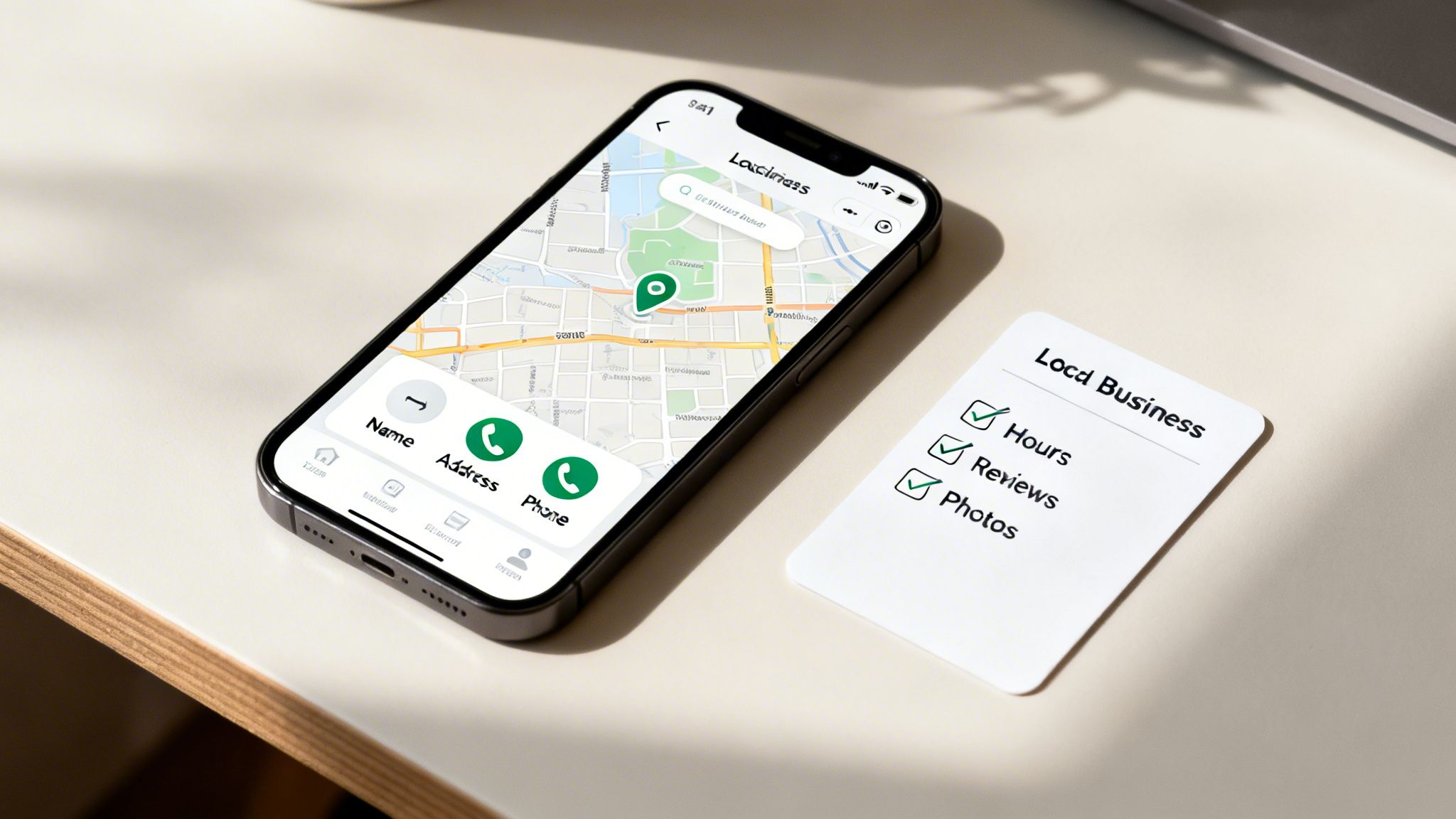
To get found in voice search, you have to make it easy for search engines to understand who you are and what you do. The most direct way to do this is with structured data, also known as schema markup.
Think of it as a special vocabulary you add to your website’s code. It’s like putting little tags on your information that tell Google, "Hey, this is our business address," or "This is our phone number." You're essentially removing all the guesswork.
By giving Google this explicit context, you make it almost effortless for it to grab your business details and present them as a voice search answer. Honestly, it’s one of the most impactful things you can do for voice SEO, and I’m always surprised how many local businesses completely miss it.
And here’s the good news: you don't need to be a coding whiz to get this done.
What Is LocalBusiness Schema?
For any physical business, the gold standard is LocalBusiness schema. This specific markup is built to communicate all the critical details about your brick-and-mortar location.
When someone asks their phone, "Find a shoe store near me that's open until 8 PM," a voice assistant needs to instantly confirm business types, locations, and hours. Good schema hands that information over on a silver platter.
These are the core details LocalBusiness schema helps you define:
Business Name: Your official, branded name.
Address: Your full physical street address.
Phone Number: The primary phone line for customers.
Opening Hours: Your daily hours of operation.
Aggregate Rating: Your average review score and total review count.
Price Range: A general idea of your pricing (e.g., $, $$, $$$).
Tagging these details doesn’t just help with voice search; it also boosts your chances of showing up in those rich, informative results you see in standard text-based local searches.
How to Implement Schema Without Touching Code
The thought of adding code to a website can be intimidating, but several free tools have made this a simple, fill-in-the-blanks process. Google’s own Rich Results Test and generators like Merkle’s Schema Markup Generator do all the heavy lifting.
Let's use a quick example. Say you run a coffee shop called "Oakwood Cafe." You'd open one of the generator tools, enter your information into the form, and it would spit out a block of JSON-LD code. You then just copy that code and paste it into the header of your website.
I’ve seen this give local businesses a noticeable boost. By clearly defining your data, you’re not just hoping Google figures things out; you’re giving it a direct, unambiguous blueprint of who you are, where you are, and what you offer.
Once the code is on your site, pop your page’s URL into Google's Rich Results Test. It will scan the page, show you exactly what structured data it found, and flag any errors. This quick check is important to make sure your work is paying off.
Here at Adwave, we know technical fixes are just one piece of the puzzle. While schema helps search engines find you, great marketing is what makes customers choose you.
Building Brand Authority to Win the Voice Search Game
Getting all the technical SEO right (nailing your schema markup, speeding up your site) is important. It gets your business in the running when someone asks their phone for help. But just being in the running doesn't pay the bills.
To be the one business they choose, you need something more than a technically perfect website. You need to be the name they already know and trust. This is where brand authority stops being a fuzzy marketing concept and becomes your single biggest advantage in voice search.
Think about it from your customer's point of view. They ask Siri for a recommendation, and it spits back two or three names. If one of those names rings a bell (maybe they've seen your van around town or an ad online) their decision is practically made. Familiarity breeds trust, and trust wins business.
Why Brand Recall Is a Voice Search Superpower
The power of a familiar brand name completely changes the dynamic of a voice search result. When a voice assistant suggests a name someone already recognizes, it doesn't feel like a random suggestion. It feels like a confirmation of a good choice.
Voice search isn't just a technical puzzle to solve; it's a branding opportunity. When a customer hears your name and it clicks, the odds of them choosing you over a competitor skyrocket. This is where technical SEO and smart brand building work together to separate the winners from everyone else.
This is exactly why a solution like Adwave can be a useful option for local businesses that want to be the default choice in their area.
Amplifying Your SEO with Strategic Brand Building
Adwave’s AI-driven TV advertising platform is built to create that exact kind of brand recall through hyper-local campaigns. It gives small businesses the power to run polished, memorable ads on the premium streaming services and TV channels their ideal customers are already watching every day.
Here’s how this plays out in the real world:
A homeowner in your city is watching their favorite show on Hulu and sees an ad for your plumbing company. It's professional, it sticks in their mind, and it mentions your 24/7 emergency service.
A week later, a pipe bursts. They scramble for their phone and shout, "Hey Google, find a 24-hour plumber near me."
Google’s assistant reads off a few options, and yours is one of them, the very same company from that TV ad.
Making TV Advertising Accessible and Effective
Not long ago, TV advertising felt completely out of reach for most small businesses. Adwave was created to change that, making it not only affordable but also highly targeted and measurable. You don’t need a Hollywood budget or a full production crew to get your brand in front of thousands of local viewers.
By running campaigns on major platforms like ESPN, NBC, and other popular channels, you build widespread awareness right in your service area. This isn't just about "getting your name out there." It directly supports your voice search optimization for local businesses by making your name the most familiar and trusted option when it really counts.
This combination of building brand authority and executing on technical SEO creates a feedback loop that can drive serious growth. If you want to dive deeper into building a brand that customers remember, check out our guide on how to create brand awareness.
Answering Your Local Voice SEO Questions
Alright, let's tackle some of the big questions that always come up when local businesses start digging into voice search. As we wrap up, I want to address the practical, real-world concerns you’re probably thinking about right now. These are the top questions I hear from business owners, answered without the fluff.
How Long Until I See Voice Search Results?
This is always the first question, and the honest answer is: it’s a process. You’re not flipping a switch. Generally, you can expect to see real, tangible results from your voice search optimization for local businesses within 3 to 6 months.
Some of the foundational work, like cleaning up your Google Business Profile and locking down your business name, address, and phone number (NAP) consistency, can show results much faster. I’ve seen businesses get more calls in just a few weeks from these high-impact fixes alone.
On the other hand, the content-heavy lifting (like building out great FAQ pages or writing blog posts that answer your customers' spoken questions) takes longer. Search engines need time to find, crawl, and understand that new content. It’s like building a reputation in your neighborhood; it doesn't happen overnight, but the trust you build delivers compounding returns for years.
Do I Need a Smart Speaker for This?
Definitely not. You don’t need an Amazon Echo in your office or a Google Home on your counter to get this right. Your job isn't to own the devices; it's to optimize your own digital presence, your website, your Google profile, and your directory listings.
Think about how your information gets used. The goal is to structure your business info so that any voice assistant can find and serve it up, no matter the device.
A driver asking for directions through their car’s Apple CarPlay.
A tourist walking down the street, asking their phone for "restaurants near me."
Someone at home asking a smart speaker for a local plumber they can call right now.
You're optimizing for the customer's query, not the specific gadget they're using. Your work ensures you’re the best, most relevant answer, period.
Can I Do Voice Search SEO Without a Website?
Yes, you can absolutely make progress, though I'll always argue that a website is your best long-term asset. If you don't have one, your single most critical tool for voice search is a perfectly tuned Google Business Profile (GBP).
So many voice assistants pull data like hours, phone numbers, and reviews directly from GBP for those "near me" searches. This makes your profile a non-negotiable starting point. You can answer customer questions, post updates, and gather reviews all in one place. It’s a powerful standalone tool for snagging immediate, local voice traffic.
That said, a website is where you turn that initial discovery into a real customer relationship by offering more depth and information.
How Does TV Advertising Like Adwave Fit into Voice Search?
This is where things get really interesting. A hyper-local TV advertising platform like Adwave acts as a massive amplifier for all your voice SEO work by building brand salience. In simple terms, it makes your business name familiar and trusted before someone even asks their device for a recommendation.
Think about it. When a voice assistant offers a few options ("I found three plumbers nearby: A, B, and C") which one do you think the customer will pick? They'll choose the one they recognize.
By putting your brand on major channels in front of local viewers, Adwave makes your business familiar. When Siri or Alexa then mentions you, it’s not a cold suggestion from a stranger; it's a recommendation for a familiar, credible business. That coordination creates instant trust and dramatically increases the odds of a user calling you over an unknown competitor.