Down-ballot campaigns hear the same advice from every direction: be on TV for credibility, run social for frequency, buy search for the name-lookups, text for turnout. All true, and all useless as a list, because a county commission campaign doesn't have a media department to run four channels. What it has is a candidate, a manager, a few thousand dollars, and twelve weeks.
Down-ballot races hold an integration advantage no statewide campaign can match: the voter universe is small enough that every channel can cover the same people. That single fact, used deliberately, turns four modest channels into one compounding system. This guide is the architecture: who does what, how the channels stay synchronized, and what the budget split looks like at three sizes. For the case that TV belongs in local races at all, start with our down-ballot advertising guide; this is the build that follows.
The shared-universe principle
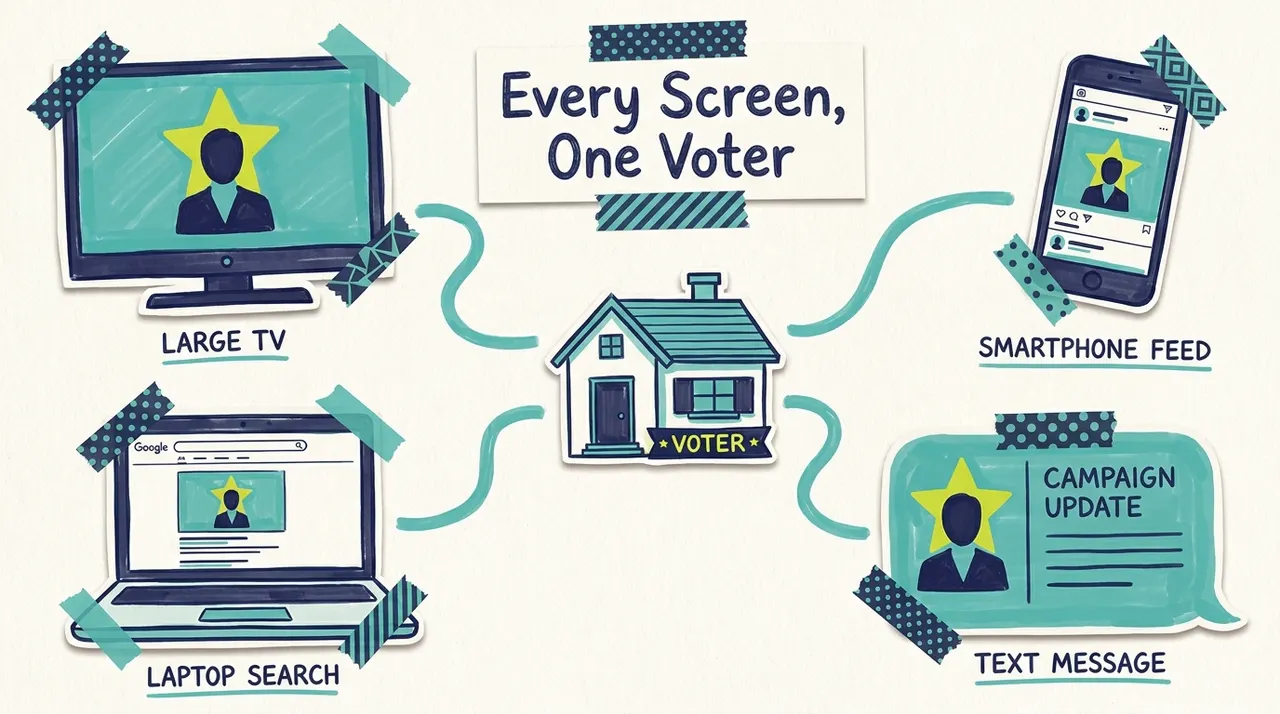
A statewide campaign's channels each reach different slices of a huge electorate; overlap is accidental. A down-ballot campaign targeting 15,000 likely voters can put CTV, social, search, and SMS against that same 15,000. Overlap isn't waste at this scale; it's the strategy. The same voter sees the candidate on the living-room TV Tuesday, in the feed Thursday, and atop the search results when curiosity strikes, and each exposure compounds the others because it's recognizably the same campaign.
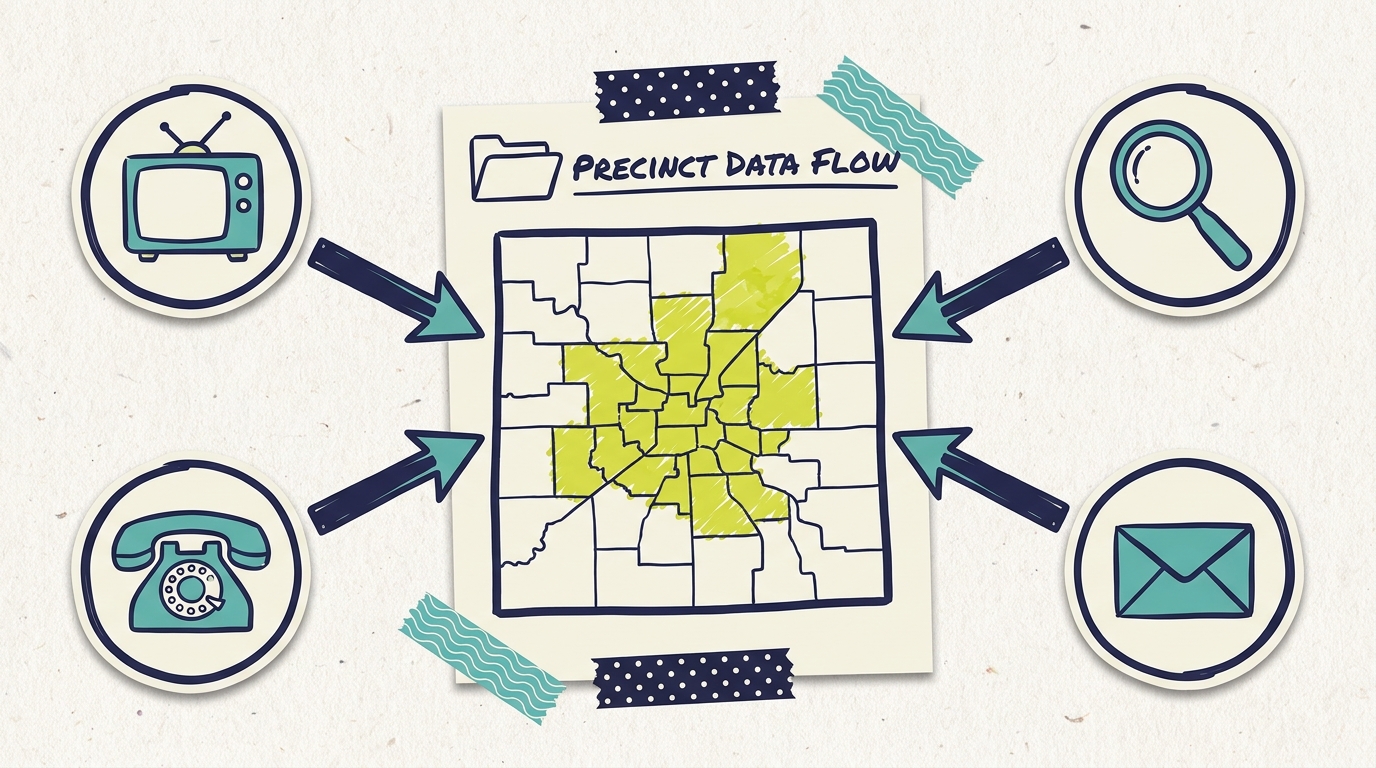
The mechanics start with one decision made once: define the universe in one document (the precincts and zips that decide the race, weighted by turnout propensity), and force every channel to use it. CTV gets the zip list. Social gets the same geography. Search runs geo-fenced to it. The canvass walks it. When a channel can't match the definition exactly, it approximates from the same document rather than inventing its own audience.
Campaigns skip this because it feels bureaucratic, and pay for it in silent dispersion: TV in one geography, social set by a volunteer to another, search nationwide because nobody checked. The thirty-minute universe memo is the highest-value half hour in down-ballot media planning.
What each channel is for
CTV: the credibility engine. Television does the two things a down-ballot campaign needs most and can least afford historically: name recognition and instant seriousness. "I saw their TV ad" makes a county candidate real in a way no impression elsewhere matches, and at $15-35 CPMs against a small universe, sustained frequency costs hundreds, not thousands, per month. TV leads; the rest of the system echoes.
Social: the frequency multiplier and energy channel. Feed ads carry the same creative (stills and lines from the spot) at low CPMs, adding touches between TV exposures. Social also does what TV can't: volunteer recruitment, event promotion, shareable moments that supporters carry into their own networks.
Search: the name catcher. TV creates lookups; the campaign must own them. Branded search on the candidate's name (and common misspellings) is trivially cheap at local volume and prevents the dispiriting outcome of TV-driven curiosity landing on an opponent's ad or a stale news result. The mechanics are the same TV-to-conversion loop every advertiser runs, with votes as the conversion.
SMS and email: the closer. Owned lists handle the deadlines: ballot drops, early-vote windows, election day. Their power scales with the warmth of the audience, which is precisely what the TV-social-search layers spent twelve weeks building. A GOTV text from a campaign the voter has seen on television all fall reads as a reminder from a known quantity, not spam from a stranger.
The synchronization rules
Integration lives or dies on recognition, and recognition has three requirements:
Same face. The candidate's actual face, same photo treatment, every channel. Down-ballot voters are deciding among strangers; the face is the brand.
Same three words. Whatever the campaign's core message compresses to ("schools, safety, spending"), it appears verbatim in the TV close, the feed ad, the search copy, and the mailer. Variation is for altitude, not vocabulary.
Same week. Channel pushes move together. When the TV flight shifts from introduction to persuasion creative, social shifts the same Monday; when the closing argument starts, every channel starts it together. A simple shared calendar (one row per week, one column per channel) is the whole tool.
The test for every asset: would a voter who half-remembers the TV ad recognize this as the same campaign in under a second? If not, it's spending recognition rather than building it.
Budget splits at three sizes
The shape holds across sizes: TV takes the largest share because it's doing the heaviest lift (credibility and recognition), social scales with it as the echo, search stays cheap because local branded volume is small, and the reserve exists because every race produces one week that demands a response; the debate-window playbook is the usual claimant.
At the $5K end, the discipline is concentration: a tighter universe rather than thinner coverage. The $2,500 of CTV against 8,000 high-propensity households sustains real frequency for the final eight weeks; spread against the whole county it evaporates.
Sequencing: three phases, one handoff
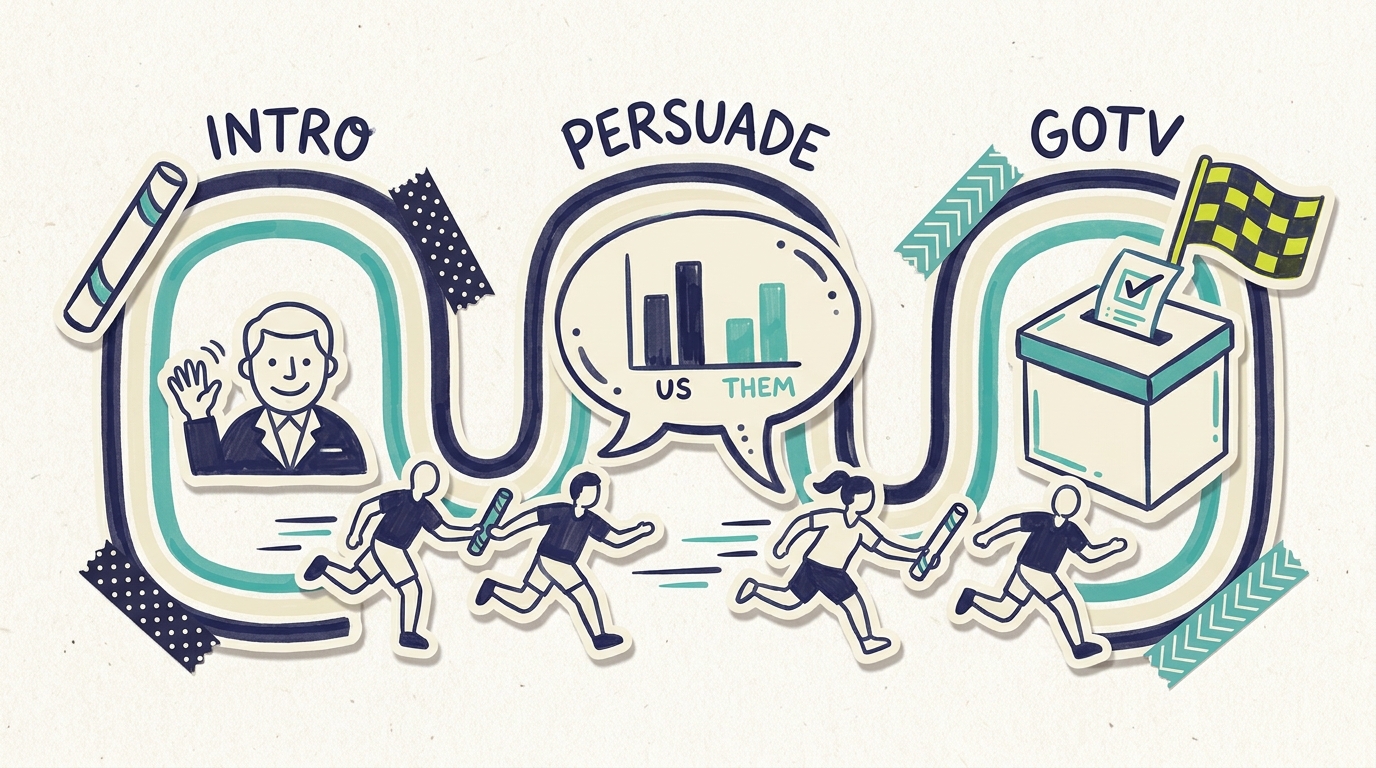
Weeks 12-7: Introduction. TV carries biography creative at steady frequency; social runs the same introduction plus volunteer asks; search goes live (it stays live forever). The goal is recognition in the universe before persuasion begins, the same logic as the primary-season build.
Weeks 6-3: Persuasion. Creative shifts to the three-word message and the contrast with the opponent's record (factual, professional). The retargeting pool social has gathered gets the heavier persuasion frequency; TV stays broad within the universe.
Final 2 weeks: GOTV handoff. TV and social pivot to vote-mechanics creative (dates, methods, polling info) while SMS and email take the lead on direct turnout contact. The paid channels' final job is making the GOTV texts land warm, the cross-screen close that integrated campaigns execute and siloed ones fumble.
Measuring on a county budget
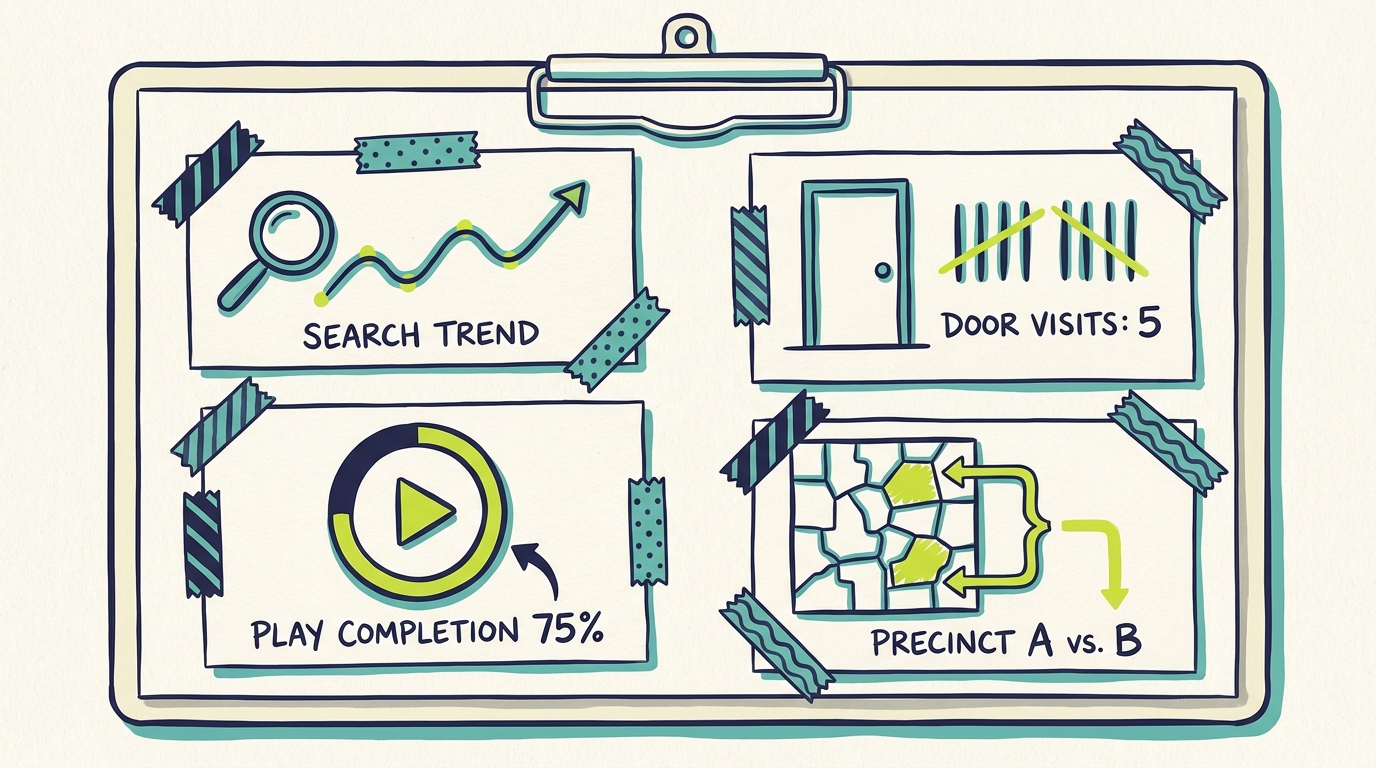
No polling budget required; four free signals referee the system:
Branded search trend in the universe geography: the recognition scoreboard, week over week.
Completion rates by creative: which message holds attention, read straight from the CTV dashboard.
Door and phone anecdata, logged: canvassers tally "knew the candidate" versus "who?" by precinct. Crude, weekly, and surprisingly aligned with the paid-media map.
The precinct autopsy: after election day, performance in heavy-frequency precincts versus matched lighter ones. It's the cheapest media-mix study in politics, and it writes the next campaign's plan.
Common questions answered
What budget does a down-ballot campaign need to run TV plus digital?
An integrated program starts working around $5,000 total for the final twelve weeks: roughly half to CTV against a tightly defined universe, the rest split across social echo, branded search, and GOTV texting. The architecture matters more than the amount; the same split scales smoothly to $15,000 and $40,000 races.
Should a local campaign run TV or social first?
Together, by design. TV builds the credibility and name recognition that make every social impression land as a reminder rather than an introduction, while social adds the cheap frequency TV's budget can't sustain alone. The mistake is sequencing them as separate experiments; the compounding only happens when the same voters see synchronized creative in the same weeks.
How does a small campaign keep four channels synchronized?
One universe document, one message compressed to three words, one shared weekly calendar. Every channel uses the same geography, the same candidate photo, and the same vocabulary, and shifts phases on the same Monday. The coordination overhead is an hour a week once the rules are set, which is the point: integration is rules, not staff.
Is CTV targeting precise enough for a single county or district race?
Yes; zip-code-level targeting maps cleanly onto county and municipal geographies, and most legislative districts assemble well from zip clusters. The residual spill into neighboring areas is small, and at down-ballot CPMs, far cheaper than the broadcast alternative of buying an entire media market to reach one county.
What's the most common integration mistake in local campaigns?
Letting each channel define its own audience. The TV targets the district, a volunteer sets social to a 25-mile radius, search runs unfenced, and the campaign quietly pays to advertise to three different electorates. The fix costs thirty minutes: write the universe down once, and make every channel inherit it.
One voter, every screen, twelve weeks
The TV layer takes the least time to stand up. See how Adwave works: generate the introduction spot in about two minutes, load the universe zips, and have the credibility engine running this week.