You publish a post, share it once, maybe twice, and then it disappears. A week later, you're back at the blank page trying to come up with the next idea. For a small business owner, that cycle gets expensive fast. It eats time, drains attention, and rarely builds anything that keeps working after the launch week.
Evergreen content changes that equation. Instead of treating content like a stream of short-lived updates, you build resources that stay useful long after publication. A strong guide, glossary, FAQ, or how-to article can keep answering customer questions, earning search traffic, and supporting sales conversations without needing daily attention.
That shift matters because most small businesses don't need more content for content's sake. They need fewer pieces that do more work. Done well, evergreen content becomes part of your marketing infrastructure. It helps prospects find you, trust you, and move closer to buying, even when you're busy running the business.
Moving Beyond the Content Hamster Wheel
A small business publishes three posts in a month, sees a brief bump in traffic, then watches the numbers fall back to baseline. The team still spent the time. They still paid for the writing, design, or approvals. What they do not have is an asset that keeps working after the campaign ends.
That pattern is the content hamster wheel. It keeps the calendar full, but it does not build much that compounds.
Short-form and timely content still have a place. They help with launches, announcements, seasonal offers, and industry updates. The problem comes when that becomes the whole plan. If every piece is tied to a moment, performance resets every time the moment passes.
Evergreen content changes the math for a resource-strapped business because one useful piece can support search, sales conversations, email nurturing, and social distribution for months or years with light maintenance. That is a better fit for a team that cannot afford to create from scratch every week. A simple three-month content calendar template also makes it easier to protect time for these longer-life assets instead of filling every slot with reactive posts.
What evergreen content is
Evergreen content covers a problem, question, or decision your audience will keep dealing with over time. It is built to stay relevant beyond a launch window or news cycle.
In practice, that usually includes:
How-to guides that solve recurring problems
Beginner explainers that answer foundational questions
Service pages with real educational depth that address buying concerns
Glossaries and FAQs that reduce friction before a prospect reaches out
A simple test helps. If a customer is still likely to ask the same question next year, the topic has evergreen potential.
Why this works better for small businesses
Small businesses need output that earns more than one result.
A well-built evergreen article can bring in search traffic, give the sales team something useful to send prospects, answer support questions before they become emails, and give you material to reuse in newsletters or short social posts. That is the advantage. The same piece does several jobs.
Depth helps too, but only when it serves the reader. Backlinko found that long-form content tends to earn more backlinks than shorter posts in its analysis of search results and content performance, which supports a practical point for small teams: thorough answers have more chances to get cited, saved, and shared than thin posts built to hit a publishing quota. The original study is here: Backlinko's analysis of content length and backlinks.
That does not mean every post should be 2,000 words. Some topics need 700 clear words and a strong example. Others need 2,500 words, screenshots, and an FAQ. The goal is not length. The goal is usefulness that holds up over time.
What does not age well
Some content is supposed to be temporary. That is fine. The mistake is treating temporary content like a long-term asset.
The trade-off is straightforward. Timely content can create short bursts of attention. Evergreen content builds a base you can keep using and improving without burning out your team. A healthy strategy usually needs both, but the long-term value comes from the pieces that still help six months from now.
How to Find Your Pillar Content Ideas
Most businesses don't have a topic problem. They have a filtering problem. Good evergreen ideas are usually sitting in inboxes, sales notes, and support threads, but nobody has turned them into a structured content plan.
Start with the questions customers already ask before they buy, while they compare options, and after they run into problems. Those are your raw materials.
Mine real conversations first
Before you open any SEO tool, collect language from the business itself.
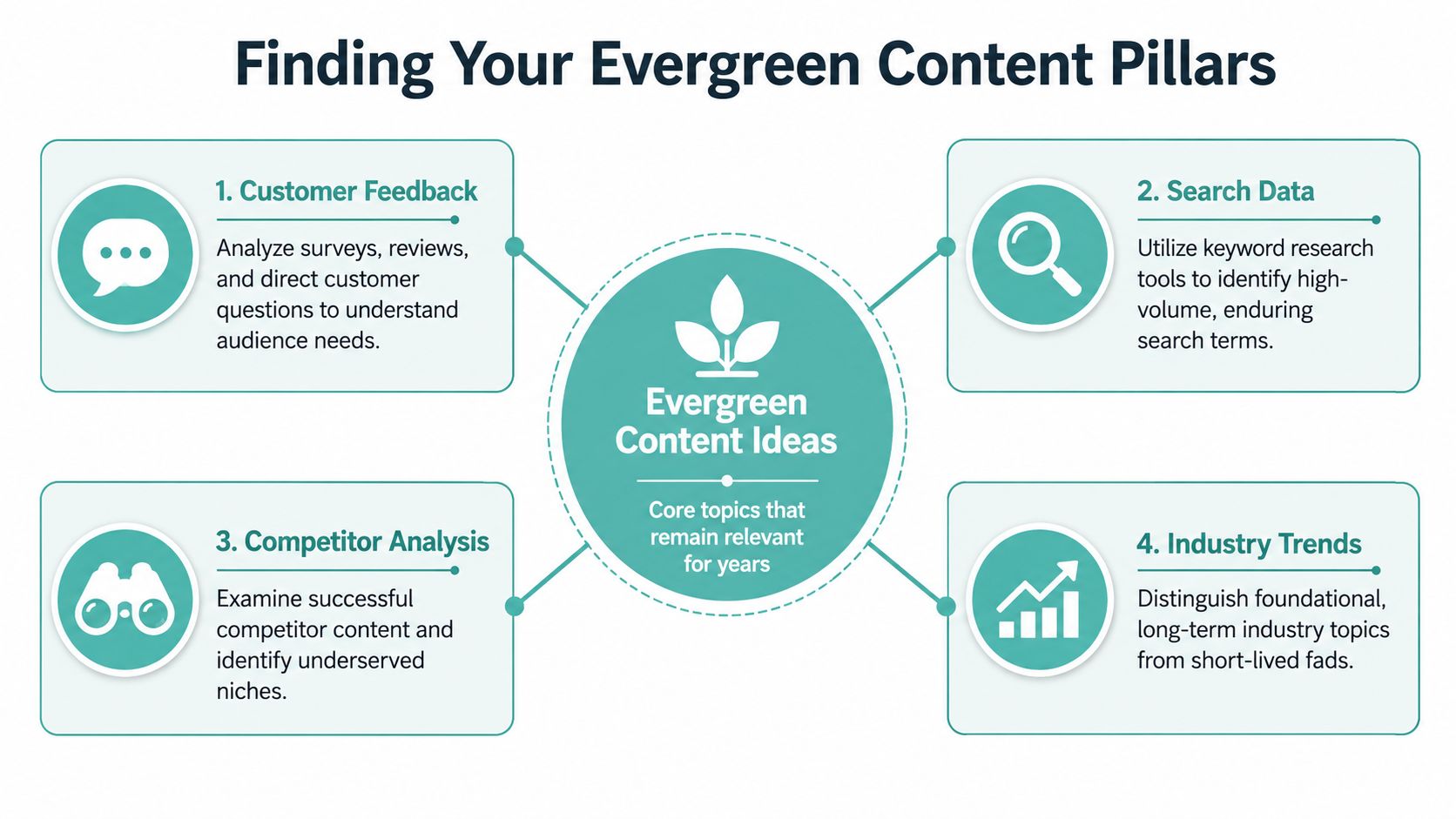
Look in places like:
Customer service email for repeated confusion and recurring setup questions
Sales call notes for objections, comparison questions, and buying criteria
Support tickets for issues customers struggle to solve on their own
Review language for outcomes customers care about most
If five different people ask some version of the same question, that's usually a stronger content signal than an idea pulled from a keyword list.
A local service business might hear, "How long does this take?" A financial advisor may keep getting asked, "What's the difference between these account types?" A home services company may notice that customers don't understand the installation process. None of those are trendy. That's the point.
Validate with search behavior
Keyword tools matter, but they should validate demand, not create the idea from scratch. You're checking whether a customer question also has durable search interest.
Northstar Inbound recommends monitoring topics for at least 6 months, with 12 months being better, to identify subjects that consistently drive organic traffic. It also suggests building central pages for statistics-style topics that can include historical data in a trend chart, as explained in Northstar Inbound's evergreen content guidance. That mindset is useful even if you never publish an industry stats page. You're looking for stability, not novelty.
Use free or low-cost tools to sanity-check:
Google Search Console to see queries already bringing impressions
Google Trends to spot whether interest is steady or purely seasonal
Autocomplete and People Also Ask to see how searchers phrase the need
Broad enough to stay relevant, specific enough to satisfy the full search intent. That's the target.
Choose pillar topics, not isolated blog ideas
A pillar topic can support multiple related articles. That's what gives it staying power.
A few strong formats work especially well:
Foundational guide such as a buyer's guide, process overview, or industry primer
Glossary page for terms prospects need before they feel confident enough to buy
FAQ hub that groups related questions instead of scattering answers across short posts
Step-by-step tutorial that walks through a stable process from start to finish
Once you identify the pillar, map a few supporting subtopics around it. If you need a simple planning framework, this three-month content calendar template from Adwave is a practical way to turn scattered ideas into a manageable schedule.
Writing and Structuring Posts for Lasting Value
An evergreen topic can still fail if the page is thin, vague, or written like a dated announcement. Structure matters because readers need quick clarity first, then depth.
The goal isn't to hit a word count. The goal is to build the page a customer wishes they had found earlier.

Use a repeatable article template
For most small businesses, a simple structure beats clever writing. A durable post often follows this pattern:
Lead with the problem Confirm what the reader is trying to solve. Skip the broad scene-setting.
Give the short answer early If someone needs a definition, process, or recommendation framework, deliver it near the top.
Break the topic into clear sub-questions Use H2s and H3s that mirror the way customers think.
Add examples, scenarios, or decision criteria Adding examples, scenarios, or decision criteria makes the post more useful than a surface-level competitor page.
Close with the next logical action That might be contacting your team, comparing options, or reading a related guide.
The strongest evergreen posts are usually easy to scan. Readers should be able to jump to the section they need without digging through long intros.
Write in a time-agnostic style
A lot of content ages because the writing announces its age. Phrases like "this year," "recently," or "prevailing market conditions" go stale faster than the topic itself.
Instead:
State principles clearly rather than tying every point to a date
Explain processes that remain useful even if examples change
Use examples carefully so they illustrate the point without anchoring the article to one moment
Avoid unnecessary trend framing unless freshness is essential to understanding
If removing the publication date makes the article feel timeless, you're probably on the right track.
Build one pillar page and support it properly
A technically sound evergreen workflow is to build a pillar page around a stable, high-intent topic, support it with internally linked subposts, and refresh it every few months with new data, examples, or insights. That structure is specifically recommended in Perfect Afternoon's evergreen strategy guide because it helps build topical authority over time and sustain visibility as rankings, backlinks, and traffic compound.
That means one main page might target the broad question, while supporting posts handle narrower angles such as pricing factors, common mistakes, comparisons, or preparation steps. Each supporting article links back to the pillar, and the pillar routes readers to the right detail page.
For a practical writing reference, this guide to writing a blog post that ranks on Google is useful when you're shaping headings, intent, and on-page structure.
Promoting and Amplifying Your Evergreen Assets
A small business owner publishes a strong guide, sees a short traffic bump, then watches it flatten out. The problem usually is not the article. The problem is distribution ended on publish day.
Evergreen content pays off over time, but only if the same asset keeps working in more than one channel. For a resource-strapped team, that means two things. Give the article a real launch window, then build a simple repurposing habit you can sustain without turning content into a full-time job.
Treat the launch like a planned rollout
A new evergreen piece needs early visibility so it can start collecting clicks, replies, and sales conversations. That does not require a complex campaign. It requires using the channels you already control.
Start with the places closest to revenue:
Email newsletters for subscribers who already trust your business
Sales follow-up emails when the article answers a recurring objection
Social posts built around one useful point from the article
Customer success or support replies when the guide helps explain a process
Internal sharing so your team uses the piece in real conversations
A guide on choosing the right home security system should not live only on your blog. It can support lead nurturing, reduce repetitive sales explanations, and help prospects compare options without booking a call too early.
That is the key advantage. One article starts doing work across marketing, sales, and customer education.
Repurpose the core idea for different buying moments
Reposting the same link every few weeks rarely changes reach. Pull out the strongest idea, objection, or decision point and reshape it for the channel.
One evergreen article can turn into:
A short video script answering the question prospects ask before they buy
A carousel post that walks through the decision criteria
A lead magnet excerpt for readers who want a printable version
A sales one-pager for prospects still comparing vendors
A FAQ response bank your team can reuse in email and chat
For a practical model, this guide on repurposing one article into multiple content assets shows how to break a single post into smaller pieces without rewriting everything from scratch.
The trade-off is focus. Not every article deserves this treatment. Put extra effort behind the pieces that already address a high-value customer question, attract qualified traffic, or help move buyers toward a decision.
Extend reach beyond search when the message proves itself
SEO is only one distribution path. A strong evergreen article can also feed email, social, sales enablement, partnerships, and paid channels.
That broader use matters for small businesses because it lowers the pressure to publish constantly. Instead of chasing more topics, you get more mileage from the content that already reflects your positioning and answers a real customer need.
Adwave can turn a business's website into a broadcast-ready TV ad and place it across premium channels. For some businesses, that creates a practical way to carry a proven message beyond search and social. The right time to test something like that is after the content has already shown that it resonates.
Amplify the few assets that keep proving their value. That is how evergreen content becomes a long-term business asset instead of another post in the archive.
The Low-Effort System for Maintenance and Measurement
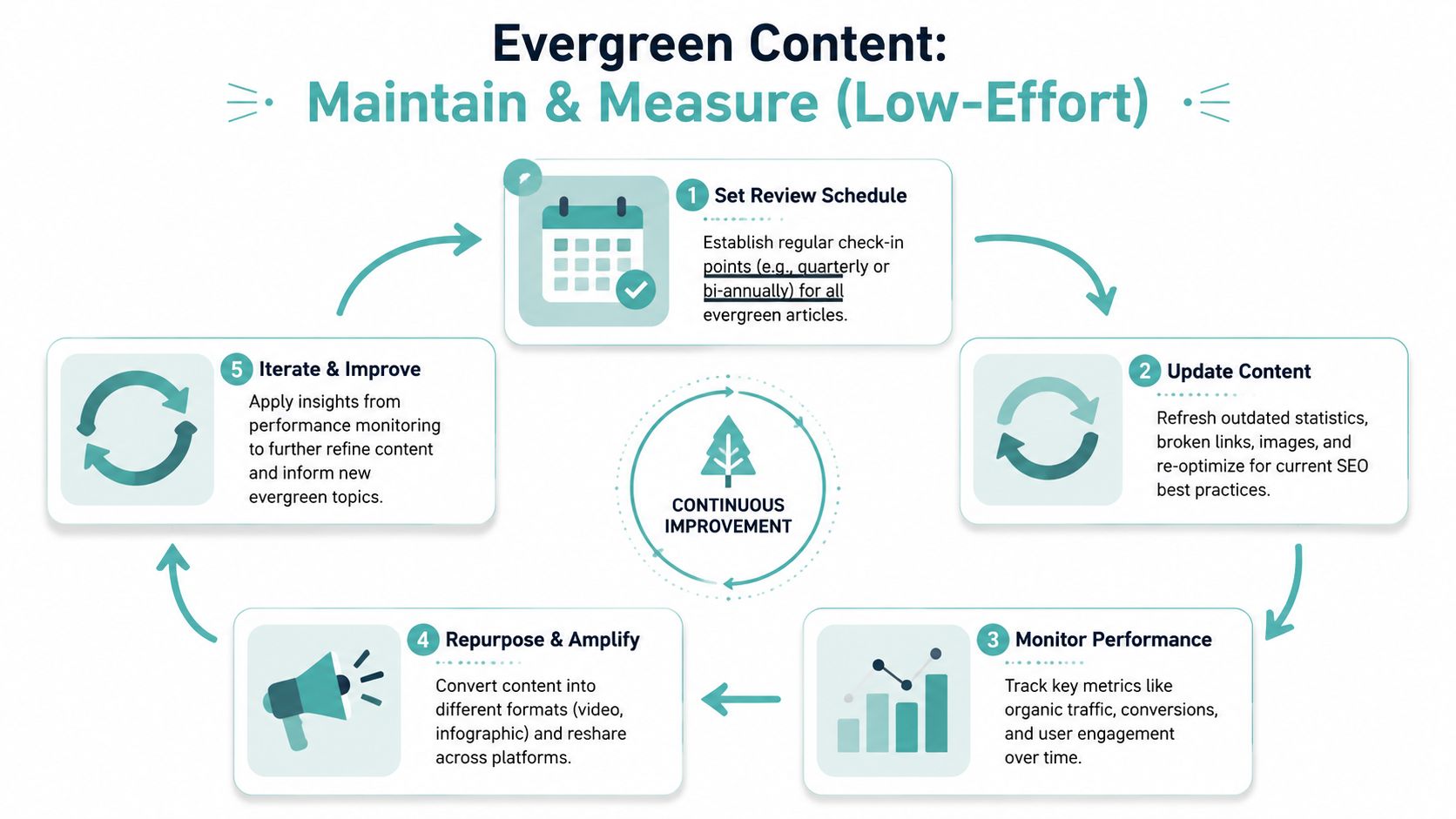
Evergreen doesn't mean untouched. It means the page has a long useful life if you maintain it with intention.
Most businesses either ignore old content completely or create a maintenance routine so ambitious that nobody follows it. The better system is lighter. Review fewer pages, more consistently.
Review the pages that matter most
Start with Google Analytics and Google Search Console. Pull a shortlist of pages that already attract organic traffic, assist conversions, or rank for terms close to purchase intent.
Then run a simple review checklist:
Check links and replace anything broken or redirected poorly
Update examples if they no longer reflect how the service or market works
Improve weak sections where the page feels thin compared with current competitors
Add new questions that sales or support teams keep hearing
Refresh calls to action so the next step is still relevant
This is usually enough to keep a good page useful without rewriting it from scratch.
Match update cadence to SERP pressure
Generic advice says to refresh content regularly. That's incomplete. The smarter question is how often a specific query demands freshness.
Ahrefs notes that the right refresh cadence depends on how often competing pages are updated. For some queries, the average top-20 result may be updated every 3 months, while others allow much longer runway, as explained in Ahrefs' evergreen content article. That's the operational detail many guides skip.
Here's a practical perspective:
Stable topic doesn't always mean stable search results. Watch the results page, not just your own calendar.
If measurement feels messy, keep it simple. Track whether the page keeps attracting the right traffic, supports inquiries, and remains aligned with what prospects need. This marketing ROI resource from Adwave can help you connect content activity to business outcomes without turning reporting into a full-time task.
Turning Your Content Into a Business Asset
The shift isn't editorial. It's operational. When you approach evergreen content seriously, you stop publishing disposable posts and start building assets.
That changes how you choose topics, how you write, and how you measure success. A good evergreen article isn't there to fill this month's calendar. It's there to answer a durable question better than the alternatives, support the buyer journey, and keep doing useful work after the publish date is forgotten.
For a resource-strapped business, that's a better fit than chasing endless novelty. One strong pillar post can anchor supporting content, feed your email marketing, inform sales conversations, and create material you can reuse across channels. You don't need a giant team. You need a system that respects limited time and compounds effort.
The businesses that get the most from evergreen content usually do a few simple things well. They listen for recurring customer questions. They build around topics that stay relevant. They structure pages clearly. They revisit high-value assets before they decay. And they treat promotion as an ongoing process, not a one-day task.
If you want a practical starting point, don't build a giant content library all at once. Pick one recurring question with clear buying intent. Turn it into the best page on your site for that topic. Link related pieces to it. Promote it. Review it on a sustainable schedule.
That's how evergreen content starts to drive traffic for years. Not through volume, and not through hacks. Through useful work that keeps earning attention.
If you want to extend the reach of your strongest content beyond your website, Adwave gives small businesses a straightforward way to turn proven messaging into TV advertising and measure performance without a heavy production process.