
Most advice on long-form vs short-form content starts with the wrong assumption. It treats content length like a winner-take-all decision, as if one format always drives more traffic than the other.
That isn't how buyers behave, and it isn't how channels work.
A Google search, an Instagram Reel, a YouTube Short, and a branded search after seeing a TV ad all represent different kinds of attention. One person wants a quick answer. Another is comparing vendors. Another doesn't know your business exists yet. If you measure all of that as one bucket called “traffic,” you'll make bad content decisions and wonder why your analytics look busy but your pipeline doesn't.
For most SMBs, the better question is simpler: which format fits the goal, the channel, and the buyer's level of intent?
Here's the short version before we go deeper:
The Wrong Question to Ask About Content
“Which drives more traffic?” sounds practical. In reality, it hides the strategic issue.
Traffic from a short social post often behaves very differently from traffic landing on an in-depth guide from search. Social traffic tends to be impulsive and feed-driven. Search traffic is usually problem-driven. One visitor is grazing. The other is trying to solve something.
Traffic quality matters more than raw volume
A local business owner doesn't benefit from pageviews alone. You need visitors who match the task at hand. If someone watches a short video and remembers your brand later, that matters. If someone lands on a deep service guide and books a call, that matters differently.
Practical rule: Don't ask which format gets more traffic in general. Ask which format gets the right traffic from the right surface.
The long-form versus short-form debate gets distorted. People hear that long-form ranks better and assume everything should become a giant guide. Or they hear that short video gets attention and start cutting every message into fragments. Both mistakes come from ignoring intent.
Channel changes the answer
A short post can work well when the user wants speed, novelty, or a lightweight introduction. A longer article works when the user wants context, comparison, or confidence before taking action.
That's why content strategy should start with three questions:
What is the user trying to do? Learn, compare, buy, or notice you.
Where are they finding you? Search results, social feeds, direct traffic, branded search, or referral.
What happens next? Subscribe, call, read more, visit a product page, or remember your name.
If you skip those questions, “more traffic” becomes a vanity metric. If you answer them first, content length becomes a tool, not a belief system.
The Data on SEO and Organic Traffic Performance
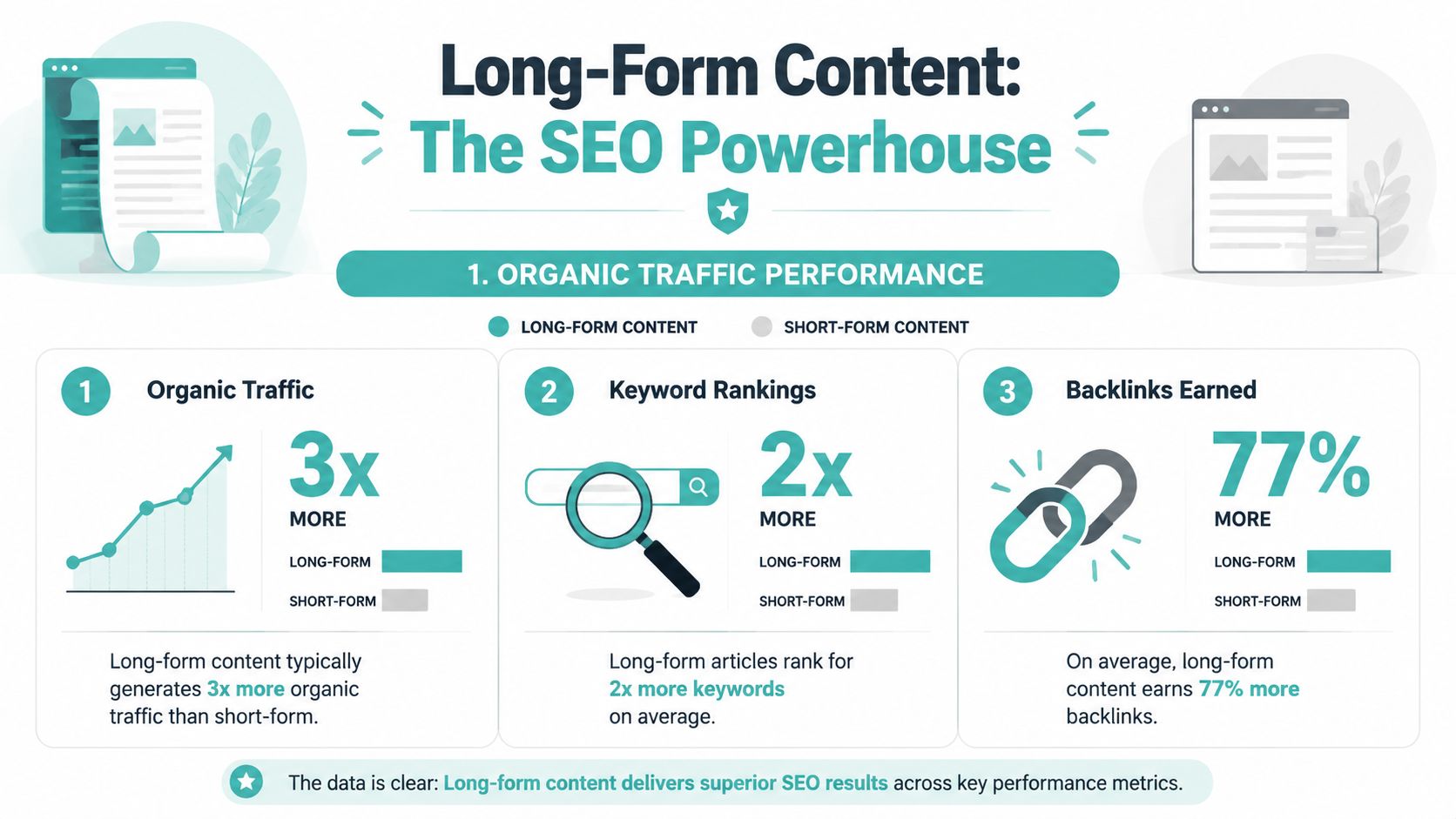
If your main goal is organic search traffic, long-form content has the stronger evidence base.
The clearest benchmark comes from Semrush reporting cited by Impact. Articles of 3,000+ words generated 21% more traffic, 24% more shares, and 75% more backlinks than average-length articles of 901 to 1,200 words, according to this breakdown of Semrush content marketing findings. For an SMB, that matters because backlinks, discovery, and shareability reinforce each other over time.
Why long-form tends to win in search
Longer pages usually give you more room to do the things search rewards:
Answer related questions: A single page can cover the main query and the sub-questions a buyer asks next.
Earn links naturally: People link to resources that feel complete, not partial.
Support internal linking: A strong guide becomes a hub that can connect service pages, FAQs, and supporting posts.
Create extractable structure: Clear headings, concise sections, and direct answers make a page easier to scan and easier for search systems to understand.
Depth alone doesn't create rankings. Useful depth does.
A bloated article won't outperform a concise one just because it has more words. But when a topic requires explanation, examples, comparisons, and objections, a short post often runs out of room before it becomes persuasive.
What this means for SMBs
For local and regional businesses, long-form content often works best on topics tied to active research. Think service comparisons, cost considerations, process explanations, mistake-avoidance content, and “what to expect” pages. Those are the searches that benefit from depth.
Search doesn't reward length for its own sake. It rewards pages that solve the full problem.
That's why a short blog post can attract a few visits and then disappear, while a strong long-form page can keep earning traffic, links, and branded trust over time. If your team is building a search library, each long-form piece should act like an asset, not a post you publish and forget.
A good working standard is simple: write short when the answer is short. Write long when the user would feel underserved by a quick summary. If you need help structuring pages that can compete in search, Adwave's guide on how to write a blog post that ranks on Google is a useful operational reference.
Short Form Content for Social Media and Attention
Short-form content wins a different contest. It wins attention in motion.
In social environments, people aren't sitting down to study your expertise. They're scrolling, pausing, reacting, and moving on. The format that works there has to earn interest almost immediately. That's why short-form content fits feeds so well. It respects the user's context.
What short-form does better
Short-form content is built for quick consumption and low commitment. That makes it effective for:
Introducing the brand: A fast tip, product angle, or local proof point can create first contact.
Staying visible: Frequent, lightweight publishing helps you remain familiar.
Driving curiosity: The best short content creates enough tension to earn the click to something deeper.
Supporting mobile behavior: Small screens and fragmented attention favor compressed communication.
A short post also forces clarity. If your team can't explain the value proposition in a few lines or a brief video, the issue usually isn't format. It's positioning.
Where SMBs often go wrong
Many businesses expect short-form content to do a long-form job. They publish a quick clip, get decent engagement, and assume that means they've educated the buyer. Usually they haven't. They've earned a moment, not a decision.
That's why short-form should usually point somewhere. It can point to a service page, a buying guide, a demo, a consultation, or a longer educational resource. Without that next step, attention leaks away.
Short-form content is best treated as a door opener. It starts the interaction. It rarely finishes it.
This is especially true on video-first platforms, where the hook matters as much as the message. The opening line, visual movement, and immediate relevance do most of the work. Once you understand that, short-form becomes less about compression and more about precision.
If you're building a short video workflow, Adwave's resource on YouTube Shorts for small business getting started is a practical place to tighten execution.
Matching Content Format to the Customer Journey
The most useful way to answer “Long-Form vs Short-Form Content: Which Drives More Traffic?” is to stop treating traffic as a single outcome.
The better lens is the customer journey.
A user at the awareness stage behaves differently from a user at the decision stage. That sounds obvious, but many content calendars ignore it. Teams mix educational content, social snippets, service pages, and offers without assigning each one a job.
A more grounded principle comes from Devenup's framing of the issue. The actual question isn't which format wins. It's which format matches the user's search intent and discovery surface, with short-form working for simpler queries and long-form proving stronger when searchers need depth, as summarized in this discussion of intent-based content choice.
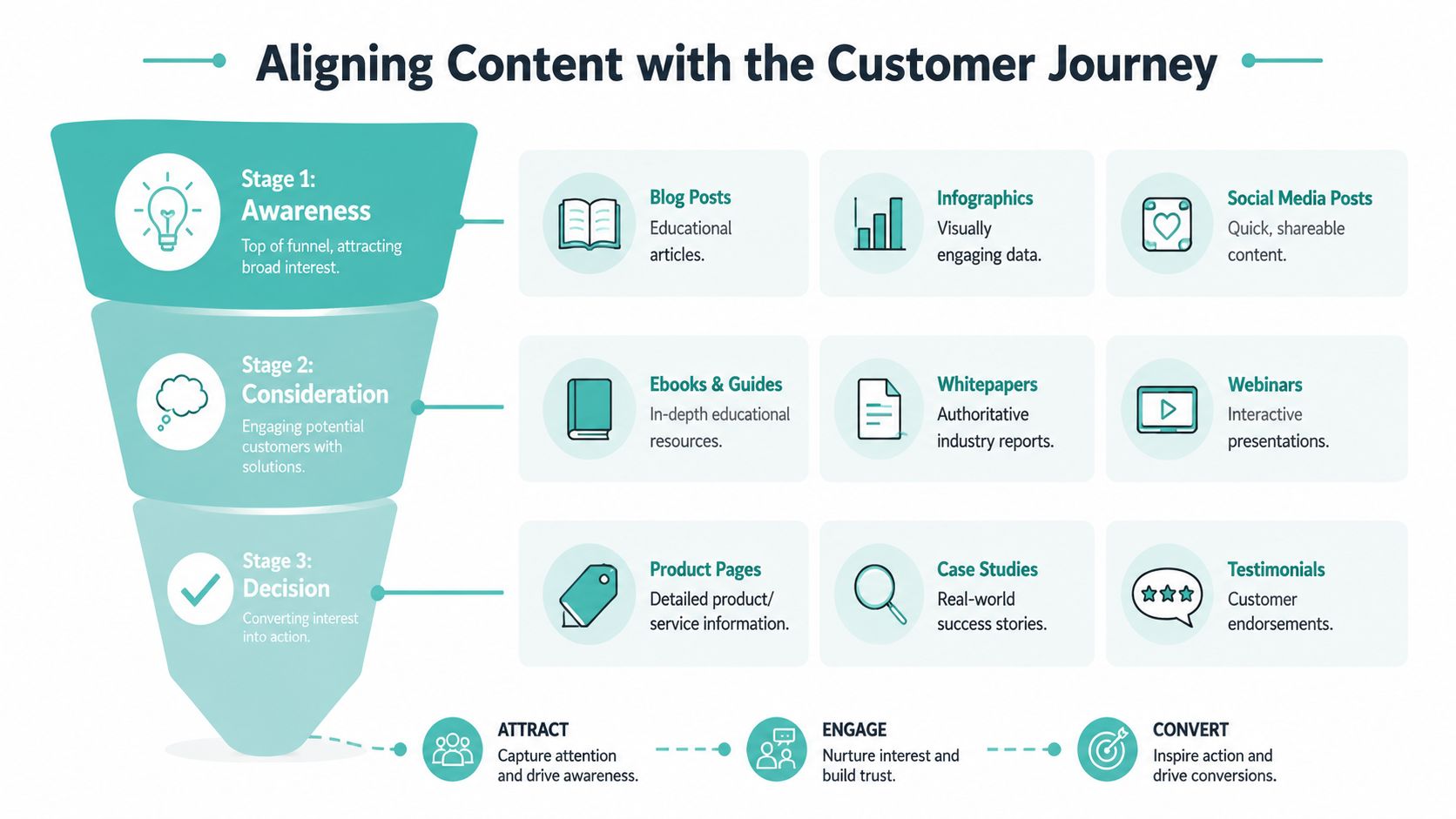
A practical funnel view
Here's how the split usually works in real businesses:
The strategic implication
This changes how you judge performance.
A short social post might succeed because it creates branded search later, even if the click-through rate looks modest. A long-form guide might succeed because it closes uncertainty for someone already in research mode, even if total sessions are lower than your top social asset.
That's why “traffic” should be measured by stage, not just volume.
Use questions like these instead:
Awareness content: Did more people discover the brand or engage for the first time?
Consideration content: Did visitors stay, explore related pages, or move toward a service page?
Decision content: Did qualified prospects convert, contact, or return directly later?
What this means in practice
A local law firm, dental office, real estate team, or home service company usually needs both forms, but not in equal proportion across every channel. Social and lightweight formats create familiarity. Search-focused long-form content captures active intent. Decision-stage pages turn that intent into action.
When businesses force one format across every stage, they usually create either a lot of noise or a lot of invisible depth. Neither is enough by itself.
Creating Awareness to Fuel Your Content Engine
There's a blind spot in most content discussions. People talk about ranking, repurposing, and conversion paths, but they ignore the first problem: someone has to know you exist before they seek you out.
That matters more for SMBs than for established national brands. A long-form guide can be excellent and still underperform if there's little existing awareness around your name, your category, or your local offer.
Content needs demand, not just quality
Search content captures intent. It doesn't always create it.
If you're a local business, some of your future site traffic won't start with a generic search. It will start when someone sees your brand in another channel, remembers it, and later searches for you directly. That's why awareness channels matter so much. They increase the pool of people who are likely to click, search, and return.
Broadcast and streaming TV can play that role well because they build recognition at scale in a local market. For a small business, that's often the missing top-of-funnel layer behind content performance.
Where Adwave fits
One practical option is Adwave's content repurposing guide, which is useful because it reflects the broader operating model SMBs need. Adwave itself is an AI-powered TV advertising platform that lets businesses create, launch, and measure broadcast-ready ads, then use that awareness to support the rest of the content funnel.
The key point isn't that TV replaces content. It doesn't. The point is that awareness channels can prime the market so your content works harder.
A prospect who has already heard your name is more likely to click your result, watch your short video, and trust your longer guide.
That creates a more realistic flywheel. Awareness generates curiosity. Short-form captures that attention in fast-moving channels. Long-form content gives the interested buyer somewhere substantial to go next.
For many SMBs, that sequence is more effective than waiting for blog posts alone to create demand from scratch.
A Strategic Framework for Choosing Your Format
Most content decisions get made backward. A team starts with the asset they know how to produce, then looks for a place to publish it.
A better method starts with four filters: goal, channel, audience stage, and topic complexity. If you run every content idea through those filters, the format becomes clearer fast.
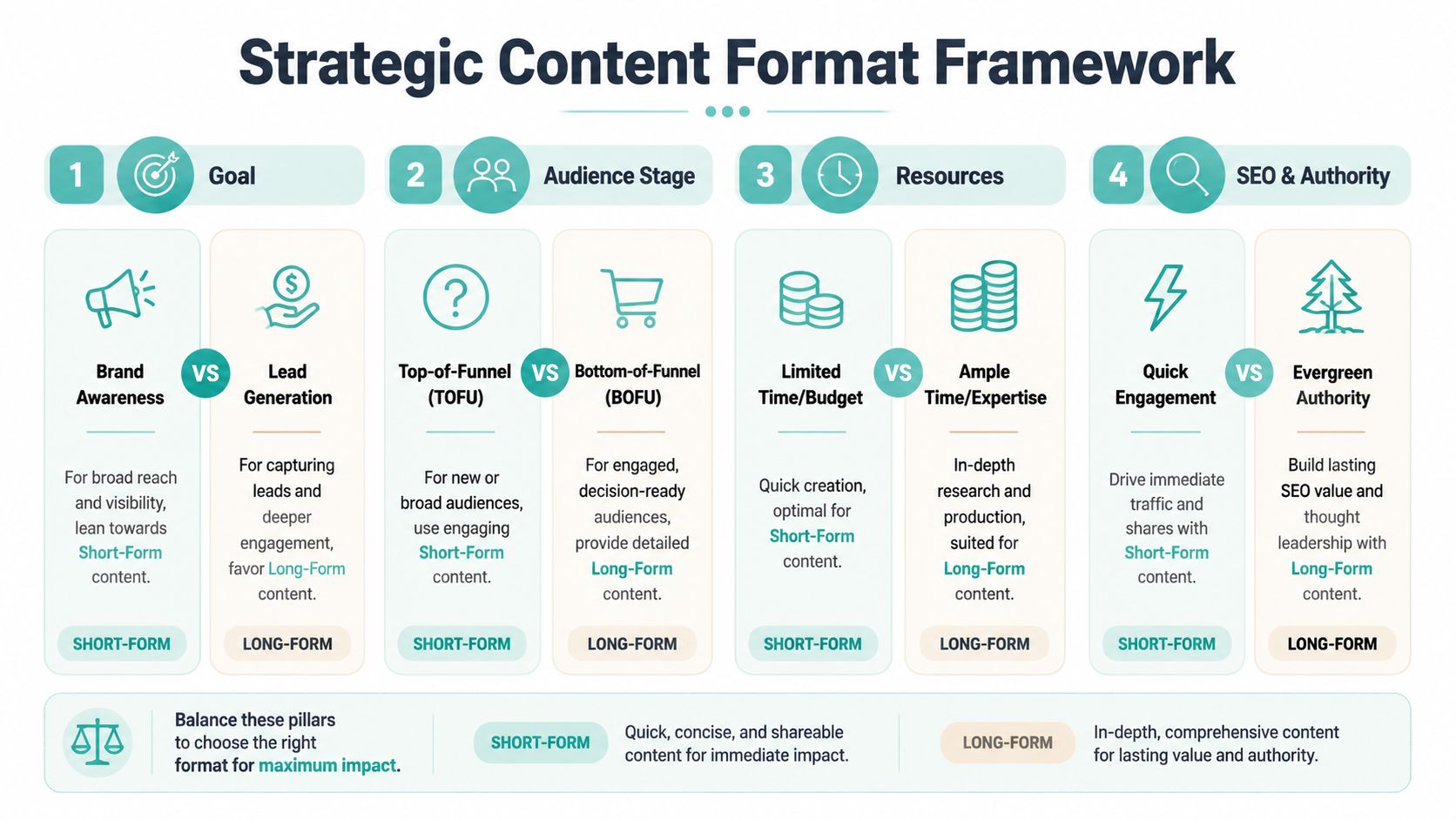
Use these four filters
Goal
If the job is visibility, recall, or frequent touchpoints, short-form usually makes more sense. If the job is educating a prospect, supporting a sale, or ranking for a research-heavy query, long-form usually earns the investment.
A promotion, announcement, or quick tip often doesn't need a full guide. A “how to choose the right provider” article usually does.
Channel
Some channels reward brevity by design. Social feeds, short video platforms, and many mobile-first placements favor quick communication. Search results reward completeness when the query demands it.
Don't force social behavior onto search pages, and don't post mini whitepapers into scrolling feeds.
Audience stage
A new audience needs a low-friction entry point. A warm prospect needs specifics. That distinction saves a lot of wasted production.
Decision shortcut: If the audience barely knows you, shorten the ask. If they're evaluating options, deepen the answer.
Topic complexity
Some questions can be answered in a paragraph. Others require definitions, tradeoffs, examples, and objections. The complexity of the topic should dictate the length, not your publishing template.
A simple planning grid
What SMB owners should do next
If your team is small, don't try to produce every format at once. Start with one core long-form asset tied to a high-intent topic. Then carve that asset into short-form posts, clips, quotes, FAQs, and follow-up angles.
That approach keeps the message aligned. It also prevents the common SMB problem of publishing disconnected short pieces that never build toward authority.
Measuring Success and Building a Hybrid Strategy
A strong strategy doesn't pit formats against each other. It assigns each format a job and measures success accordingly.
Short-form content should usually be judged on signs of attention and movement. Did it stop the scroll, generate engagement, create clicks, or increase branded interest? Long-form content should be judged on deeper behaviors. Did visitors stay, consume the material, move to a service page, or convert?
Match KPIs to the content's job
Use a simple split:
For short-form: watch engagement, view quality, clicks, saves, shares, and assisted visits.
For long-form: watch time on page, scroll depth, internal pathing, lead actions, and conversion support.
If you evaluate both formats with the same metric, one of them will look weaker than it really is.
Build the flywheel, not isolated assets
The strongest model for an SMB usually looks like this:
Awareness channels create recognition.
Short-form content captures light interest and keeps the brand visible.
Long-form content answers the serious questions that appear once a buyer starts researching.
Decision assets turn that trust into calls, forms, bookings, or purchases.
This matters more over time because the gap favoring depth appears to be widening in industry reporting. A 2026 Semrush Authority Report cited in industry coverage said long-form content averaging 2,500 words generated 63% more backlinks than content under 1,000 words, up from 56% the prior year, according to this summary of the report's findings. Read carefully, that's less a mandate to make everything longer and more a warning not to neglect depth where buyers need it.
For teams trying to make the hybrid model measurable, Adwave's resource on social media analytics and the metrics that actually matter can help separate signal from noise.
Long-form versus short-form isn't an argument to settle. It's a system to design. Short-form gets you noticed. Long-form gets you chosen. The businesses that grow steadily tend to build both, then connect them deliberately.
If you want to create the awareness layer that makes your content work harder, Adwave gives SMBs a way to launch broadcast-ready TV ads, build local brand recognition, and feed more demand into the rest of the content funnel.


