
You're probably in one of two spots right now.
Either you've been thinking about starting a podcast for months and haven't hit record because it feels like one more thing to manage, or you've watched other businesses do it and you're not sure whether it would help your company or just eat your time.
That hesitation is reasonable. A small-business podcast only works when it supports the business you already run. If it turns into a side hobby with no connection to local demand, referrals, or sales conversations, it becomes expensive content therapy.
Why Your Small Business Should Consider a Podcast Now
Most small businesses don't have a visibility problem because they lack expertise. They have a visibility problem because prospects don't get enough chances to hear that expertise in a format that feels personal.
A podcast solves that in a way short posts usually can't. It lets people hear how you think, how you explain problems, and how you talk to real customers. For a local business, that matters. Trust often forms before the first call, visit, or estimate request.
Podcasting also isn't niche anymore. Edison Research reported that 135 million people in the U.S. listened to a podcast monthly in 2024, up from 47 million in 2015, and 47% of Americans ages 12+ had listened to a podcast in the last month according to this summary of the data. That changes the decision. You're not betting on an experimental channel. You're deciding whether your business should show up in a mainstream one.
The mistake I see most often is treating the podcast itself as the goal. It isn't. The goal is stronger familiarity, better-qualified conversations, and more reasons for local buyers to remember your name. That's the same logic behind building brand awareness in marketing. Repeated exposure matters, especially when your buyer may not need you today but will need you later.
Practical rule: Start a podcast only if you can answer one sentence clearly: “This show will help my business get known for ___ among ___.”
If you can answer that, starting a podcast for your small business becomes much simpler. You're no longer chasing downloads. You're building a repeatable trust asset.
Laying the Strategic Foundation for Your Podcast
A podcast gets easier once you stop asking, “What should we talk about?” and start asking, “What business job should this show do?”
That shift is where most small-business podcasts either become useful or drift into generic content. Broad advice about consistency is fine, but it skips the harder issue. A major unanswered question is how to use a podcast when the primary goal is local or niche customer acquisition. Most beginner content recommends consistency and broad promotion, but it does not clearly address whether a small business should prioritize guest-led networking, local SEO, or direct-response CTAs. This is an emerging gap because podcasting remains crowded and the best-performing shows increasingly depend on distribution beyond the feed, as noted in ICSC's small-business podcasting guide.
Use this as your planning model:
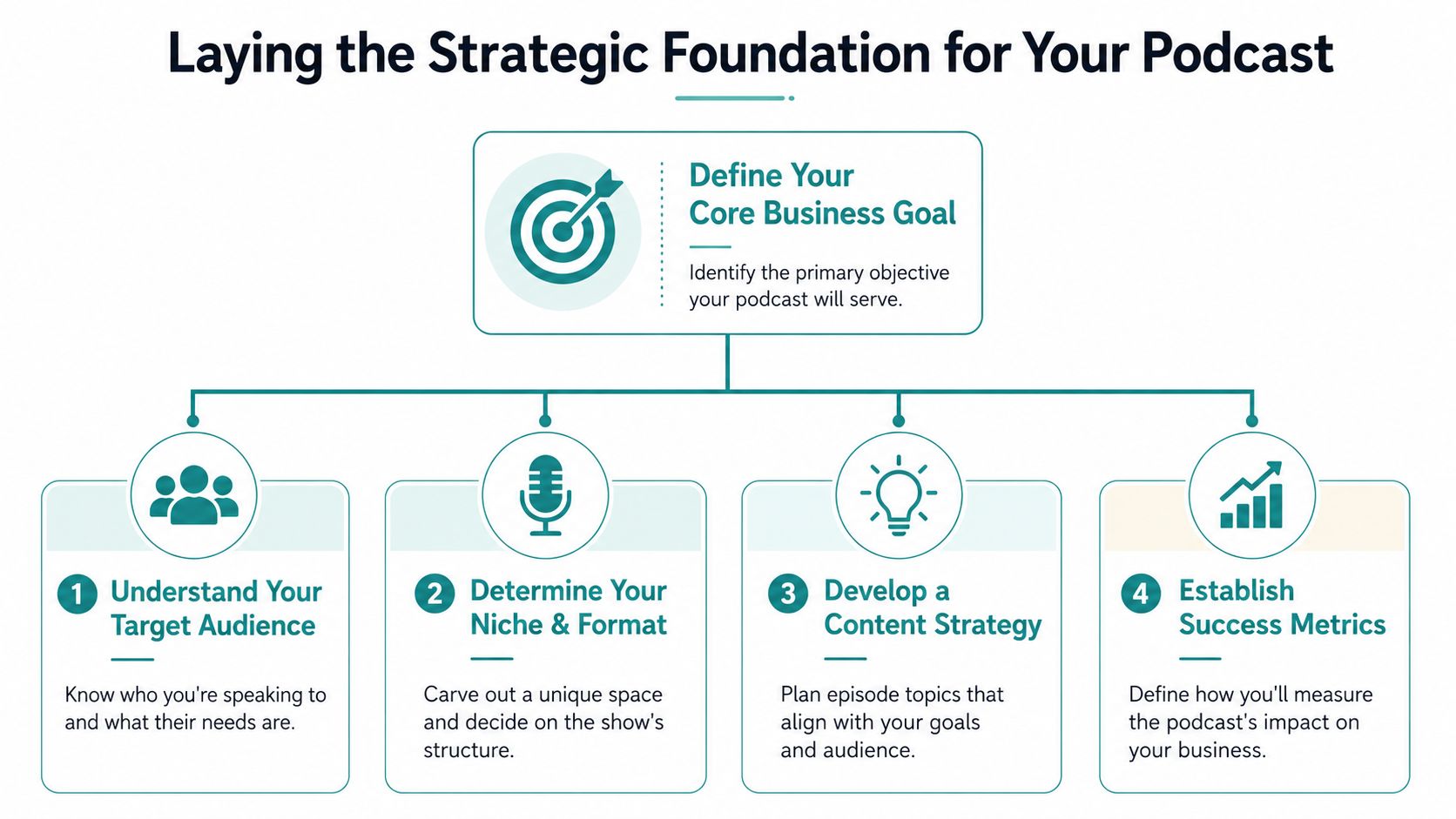
Pick the business outcome first
If you run a local service business, your show probably shouldn't try to compete with national entertainment podcasts. It should support a commercial outcome.
Common outcomes look like this:
Become the trusted local educator: Good for dentists, attorneys, financial advisors, contractors, and health practices.
Build referral relationships: Strong fit for real estate, home services, B2B local firms, and agencies.
Pre-handle objections: Useful when prospects ask the same questions before buying.
Stay familiar: Important in businesses with long consideration cycles.
A weak goal sounds like “grow an audience.” A strong goal sounds like “make local homeowners more likely to request an estimate because they already trust how we explain the job.”
Narrow the listener until the show becomes useful
Most owners define the audience too broadly. “Small business owners” is too wide. “First-time homebuyers in our county” is usable. “Parents choosing pediatric dental care nearby” is usable. “People opening a second retail location” is usable.
That's also where audience segmentation becomes practical instead of theoretical. Your podcast should speak to a clear buyer group with a repeatable set of concerns, not to everyone who could possibly buy someday.
A simple audience filter helps:
Choose a format you can keep producing
A great format on paper can still fail in practice. The best format is the one your team can produce without turning every episode into a scheduling crisis.
Three formats usually work for small businesses:
Solo teaching episodes Best when the owner has strong expertise and limited time. Fast to record, easy to batch, and good for authority.
Customer question episodes Best when sales calls repeat the same objections. These episodes align closely with revenue because they answer real buyer concerns.
Guest interviews with local partners Best when your growth depends on relationships. Interviewing builders, brokers, physicians, vendors, or neighborhood business owners can double as networking.
Don't copy a format just because it sounds polished. Copy the workload first. If the process is too heavy, the show won't last.
Build a simple one-page strategy
Before you buy gear, write down:
Show promise: What practical result does the listener get?
Primary listener: One clear audience segment.
Business purpose: Leads, referrals, authority, retention, or local awareness.
Format: Solo, Q&A, interview, or hybrid.
Call to action: What should listeners do next?
Distribution plan: Website, email, local partners, clips, social.
That one page will save you from the most common waste in podcasting: publishing episodes that sound fine but don't move the business.
Your Affordable Podcast Production Toolkit
Podcast gear is where owners often overspend early and underthink the basics. You don't need a studio. You need a setup that sounds clean, starts quickly, and doesn't create technical friction every time you record.
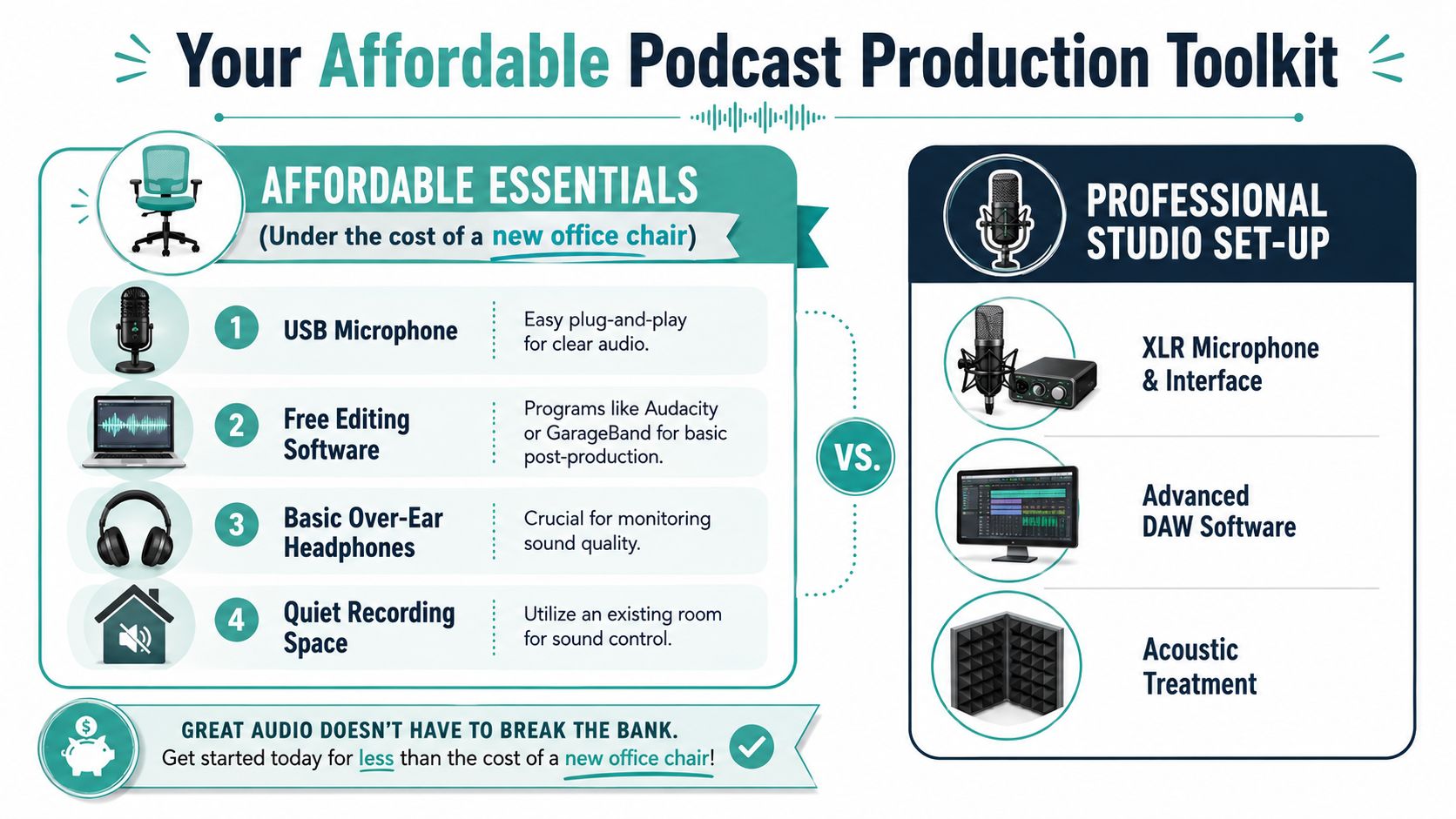
This comparison keeps the decision grounded:
Buy for consistency, not prestige
For most small businesses, the affordable toolkit is enough:
USB microphone: Plug-and-play is the point. A USB mic removes setup complexity and gets you recording fast.
Basic headphones: You need to hear echo, room noise, and plosives before publishing.
Recording software: Audacity and GarageBand cover the basics for many owners. Descript is useful if you want a more text-based editing workflow.
Quiet room: The room matters more than many people think. A soft, quiet office usually beats an expensive mic in a reflective room.
Here's the trade-off in plain terms:
If you're starting a podcast for your small business, convenience wins early. A system you'll use every week beats a more advanced system that stays in a box.
Spend attention on sound habits
Better audio usually comes from behavior, not shopping.
Use these rules:
Keep the mic close: Distance creates room noise and thin sound.
Face soft surfaces when possible: Hard walls bounce sound back into the mic.
Turn off obvious noise sources: HVAC hum, desktop fans, and notifications all show up.
Wear headphones during tests: Problems are easier to catch before recording than after.
A quiet room with a decent USB microphone will outperform a fancy setup used badly.
Think past the podcast feed
The smartest equipment decision is choosing tools that make repurposing easy. If you can turn one recording into clips, email content, and short promotional assets, the podcast becomes more valuable.
That's why it's worth thinking about light video from the beginning, even if your show is audio-first. A simple camera angle or recorded remote interview can produce usable visuals later. Teams that already create clips often borrow ideas from video marketing workflows because the repurposing logic is the same. One strong source asset should fuel multiple channels.
A practical starter kit is boring by design. That's what you want. Podcast production should feel routine, not precious.
Recording and Editing Your First Episodes
Your first few episodes don't need polish in the abstract. They need a repeatable process.
The most practical workflow I've seen for small businesses is simple and proven: validate the concept with at least 10 episode ideas, define a niche audience, choose a sustainable format, then test recording positions and audio settings before publishing. This sequence includes using a short test recording to check volume and background noise, then editing by removing mistakes, balancing levels, and distributing through a hosting platform, based on Buzzsprout's launch guidance.
Record in batches
Batching changes the whole experience. If you record one episode at a time, the show can feel like a recurring interruption. If you record several in one block, it becomes a scheduled content task.
A simple batch day might include:
Review outlines for multiple episodes.
Record a short sound check before the first full take.
Keep a notepad nearby to mark mistakes instead of restarting every time.
Finish all recordings before switching into editing mode.
That separation matters. Recording and editing use different kinds of attention. Mixing them in the same hour slows everything down.
Use a pre-recording checklist
Before you hit record, check the room and setup. This prevents most beginner problems.
Silence the room: Phones, alerts, office chatter, and browser tabs.
Check mic placement: Slightly off-center works better than speaking straight into the capsule.
Run a short test file: Listen for hum, echo, or clipping.
Open your outline: Don't rely on memory for key points and CTAs.
A podcast episode doesn't need to sound scripted. It does need structure. Rambling is the fastest way to create editing work.
Edit for clarity, not perfection
Early on, owners often over-edit. They remove every breath, every pause, and every natural turn of phrase. That usually makes the episode sound stiff.
Focus on these essentials:
A useful editing rule is this: if the listener notices the problem, fix it. If only you notice it because you recorded it, it may not matter.
Your first episodes should sound clear, organized, and human. That's enough.
Build a small content buffer
Don't launch the same week you record episode one. Record ahead. A buffer protects the show from illness, travel, and busy weeks.
That also gives you room to hone your skills. By the time episode one goes live, you may already have recorded enough to fix recurring issues in later episodes without missing your release schedule.
Consistency comes from process, not motivation. Once the workflow is stable, podcasting stops feeling like a creative gamble and starts acting like an asset.
Publishing and Distributing Your Show
Publishing feels technical until you understand the parts.
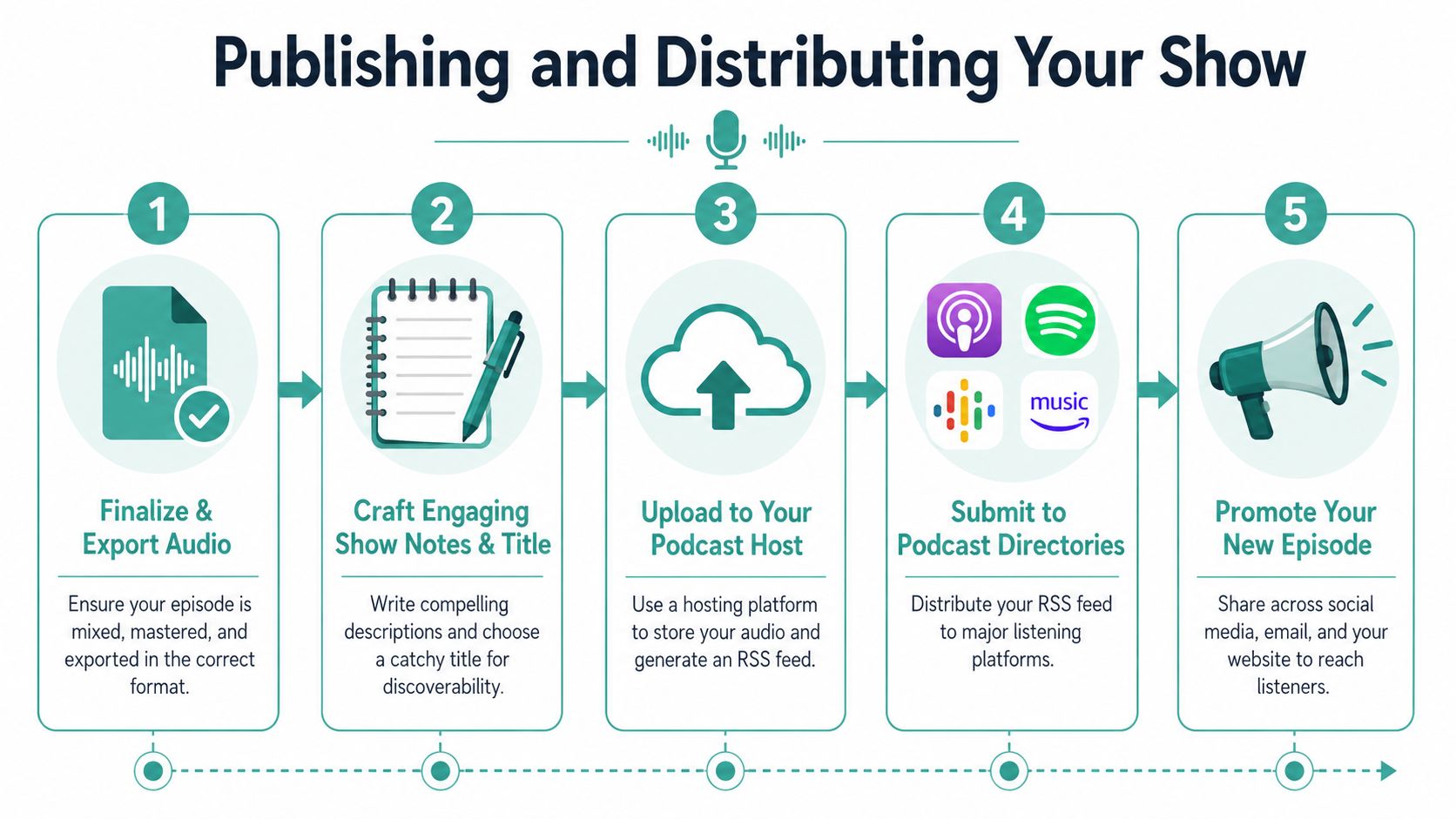
Your podcast host stores the audio file. Your RSS feed is the connection that sends your show information to listening platforms. Apple Podcasts, Spotify, and other directories read that feed and display your episodes. Once it's set up properly, the process becomes routine.
This is the publishing flow to keep in mind:
Treat hosting like infrastructure
Choose a podcast host based on ease of use, reliability, and how simple it is to publish notes, titles, and episode details. This isn't the place to get clever. You want a stable platform with clean submission tools.
Once your host generates the feed, you submit it to major directories one time. After approval, new uploads typically flow through automatically.
That's why this part is easier than people expect. It's mostly administrative, not creative.
Write metadata that helps the right listener click
A lot of business podcasts publish episodes with vague titles like “Episode 12” or “A Great Conversation With Sarah.” Those titles waste discovery opportunities.
A better title tells the listener what they'll get. Strong episode packaging usually includes:
A clear topic: State the problem or result.
A useful angle: Why this episode is worth time.
A recognizable context: Local issue, buyer question, or niche challenge.
Show notes matter too. They don't need to be long. They need to help a listener decide quickly whether the episode is relevant.
A good structure is simple:
One paragraph on the episode's main takeaway.
A short bullet list of topics covered.
Any guest context.
Your business call to action.
Use your own channels first
Directories matter, but your owned channels matter more for a small business.
Publish each episode where your customers already pay attention:
Your website: Add an episode page or blog post.
Your email list: Introduce the episode with a plain-language reason to listen.
Your sales process: Share relevant episodes with leads who ask recurring questions.
Your team: Give staff an easy way to send episodes to customers and referral partners.
Many local podcasts underperform because the episode gets uploaded and then left alone. Distribution should support the places where prospects already interact with your business, not rely only on feed discovery.
Build a simple publishing routine
Use the same checklist every time:
Once you've done this a few times, publishing stops being a technical hurdle and becomes a repeatable admin task.
Promoting Your Podcast and Measuring What Matters
A podcast rarely grows because it exists. It grows because the business treats each episode as a source asset and pushes it into other channels.
That's also where the true ROI conversation begins. A major underserved angle is whether a small-business podcast is worth the ongoing operational cost when most guidance only covers setup. Existing “how to start” guides rarely answer the harder question of ROI: how many episodes, downloads, or listener actions a small business should expect before treating the show as a business asset rather than a branding experiment, as discussed in Moneris' guide to small-business podcasting.
The answer, in practice, is that downloads alone won't tell you enough. Small businesses need to watch for business signals.
Here's one useful way to think about amplification beyond the feed:
Promote the episode in layers
Most episodes can produce several assets if you plan for it:
Email feature: A short intro with one reason the episode matters now.
Short clips: Good for social, landing pages, and retargeting creative.
Blog adaptation: Especially helpful if the episode answers a common buyer question.
Sales enablement asset: A rep can send a relevant episode after a consult or inquiry.
Offline tie-ins: Event handouts, in-store signage, or even ideas from guides on buying custom promotional items in bulk if you want to turn the show into something people remember at local events.
For local businesses, guest episodes can also become co-promotion opportunities. If you interview another business owner, nonprofit leader, broker, physician, or community partner, you create a reason for both sides to share the episode.
Repurpose your strongest moments into ads
A podcast can become more than a feed-based content project.
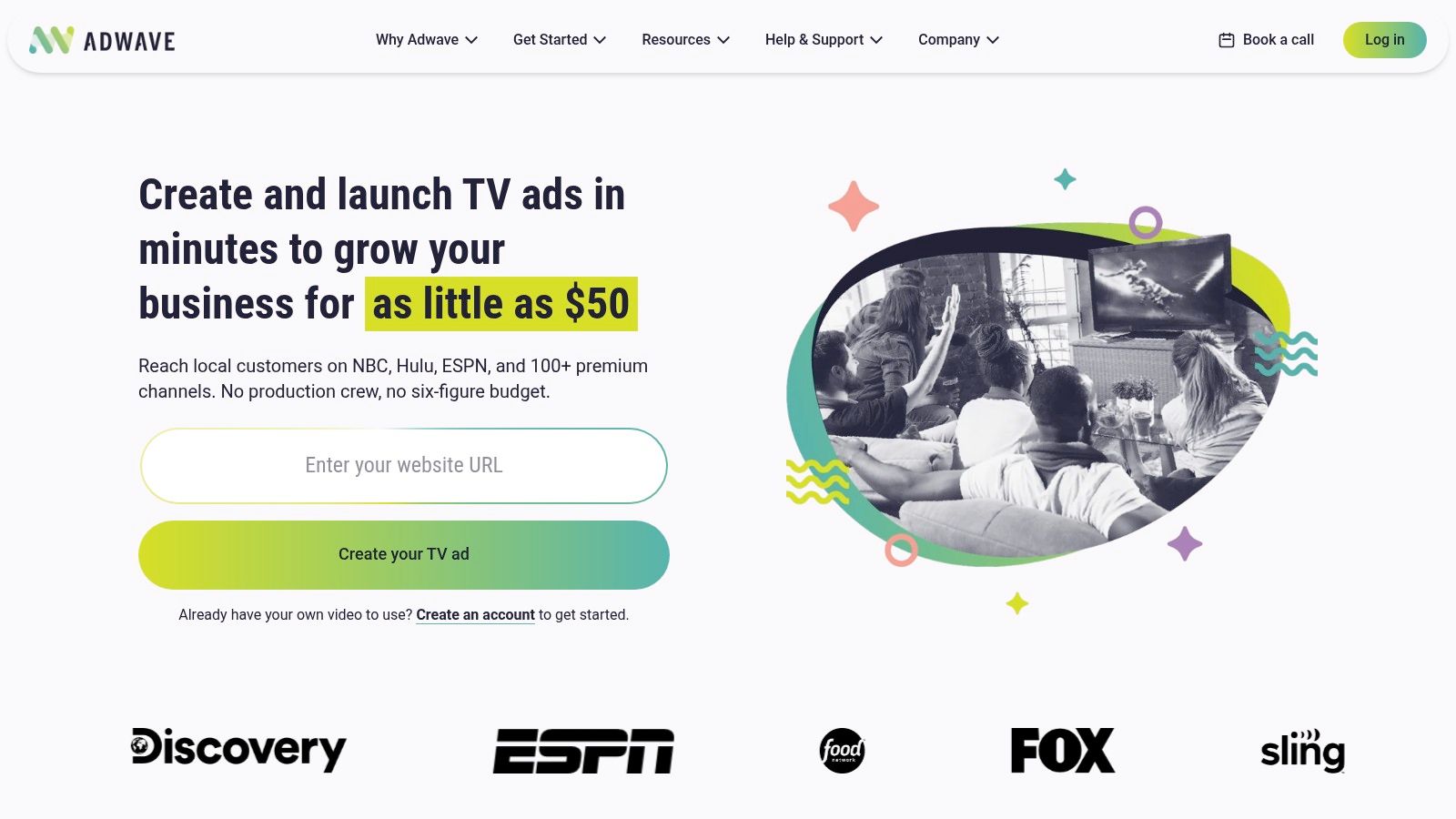
A strong clip from an episode can work as a promotional ad, especially when it captures a useful teaching point, a local insight, or a memorable customer problem you solve. In the article body, one practical option is Adwave, which lets businesses create, launch, and measure broadcast-ready TV ads using AI, including campaigns built from existing marketing assets and targeted to local viewers across premium channels. For a small business, that means your podcast doesn't have to stay in audio form. A sharp segment can become part of a broader local awareness campaign.
That approach works best when the clip does one clear job. It should introduce the business, show expertise, and give viewers a reason to remember the name. Not every episode deserves ad spend. The ones that answer high-intent buyer questions often do.
If you already did the hard work of saying something useful on mic, use it more than once.
Track inquiries, sales, and customer feedback
Downloads matter, but they're incomplete. The better question is whether the podcast changes buyer behavior.
Watch for:
This is also the point where a clear ROI process matters. If you need a framework for that, measuring marketing ROI should include both direct response and assisted impact. A podcast often helps the sale before it gets credit for the sale.
Small-business owners usually know when this is working. Prospects sound warmer. Calls get shorter because buyers are already educated. Guests become partners. People mention an episode in meetings. Those signs matter.
A podcast becomes a business asset when it repeatedly supports trust, demand, and local visibility. If it's only producing files, change the strategy. If it's producing conversations and better leads, keep going.
If you want to turn your podcast clips, business expertise, or existing site content into local TV campaigns without a complicated production process, take a look at Adwave. It's a practical way to extend the reach of the content you're already creating and put it in front of the right local viewers.


