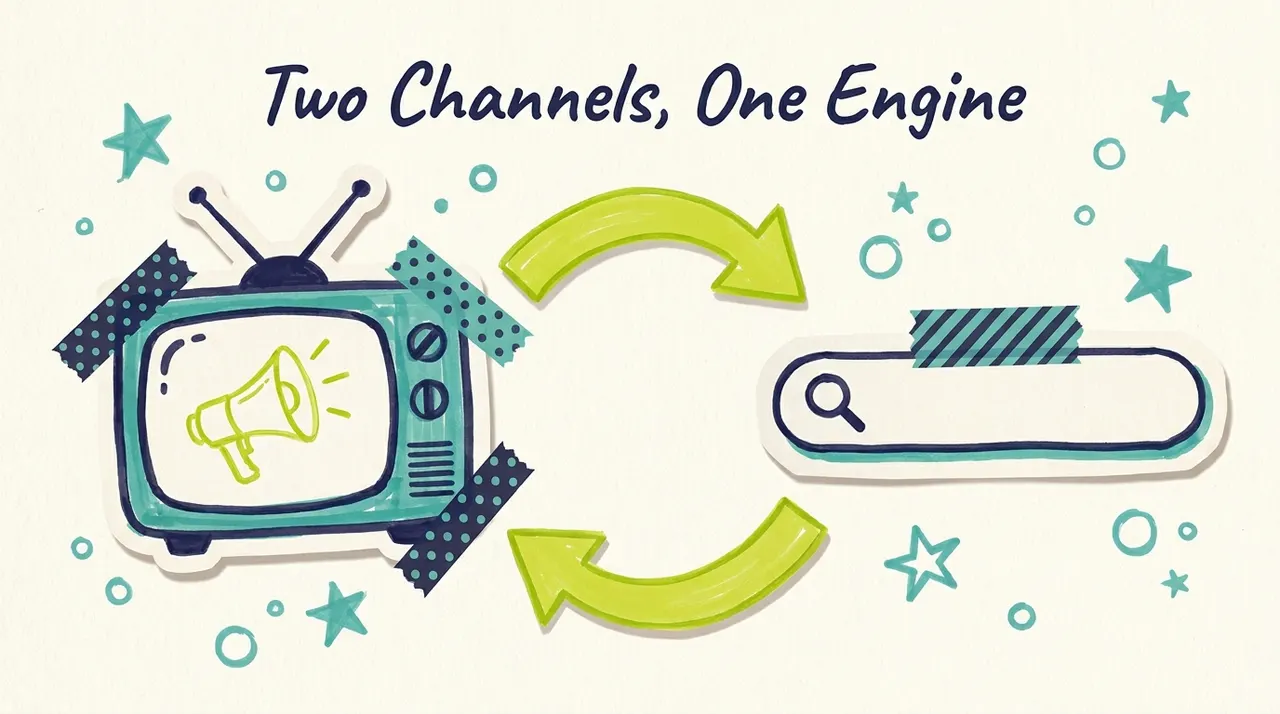
In most small business budget meetings, TV advertising and SEO sit on opposite sides of a ledger, competing for the same dollars. One is paid, one is "free." One is awareness, one is intent. The framing feels natural, and it quietly costs businesses the biggest compounding effect available to them: the two channels feed each other, and the businesses that run both see each one perform better than it would alone.
This guide explains the mechanism, the four specific ways a TV campaign shows up in your organic search performance, and how to coordinate the two so the compounding happens. One scope note up front: this isn't an SEO tactics guide. It's about what happens to your existing organic presence when television starts creating demand for your brand.
Demand creation versus demand capture
Here's the cleanest way to think about the relationship:
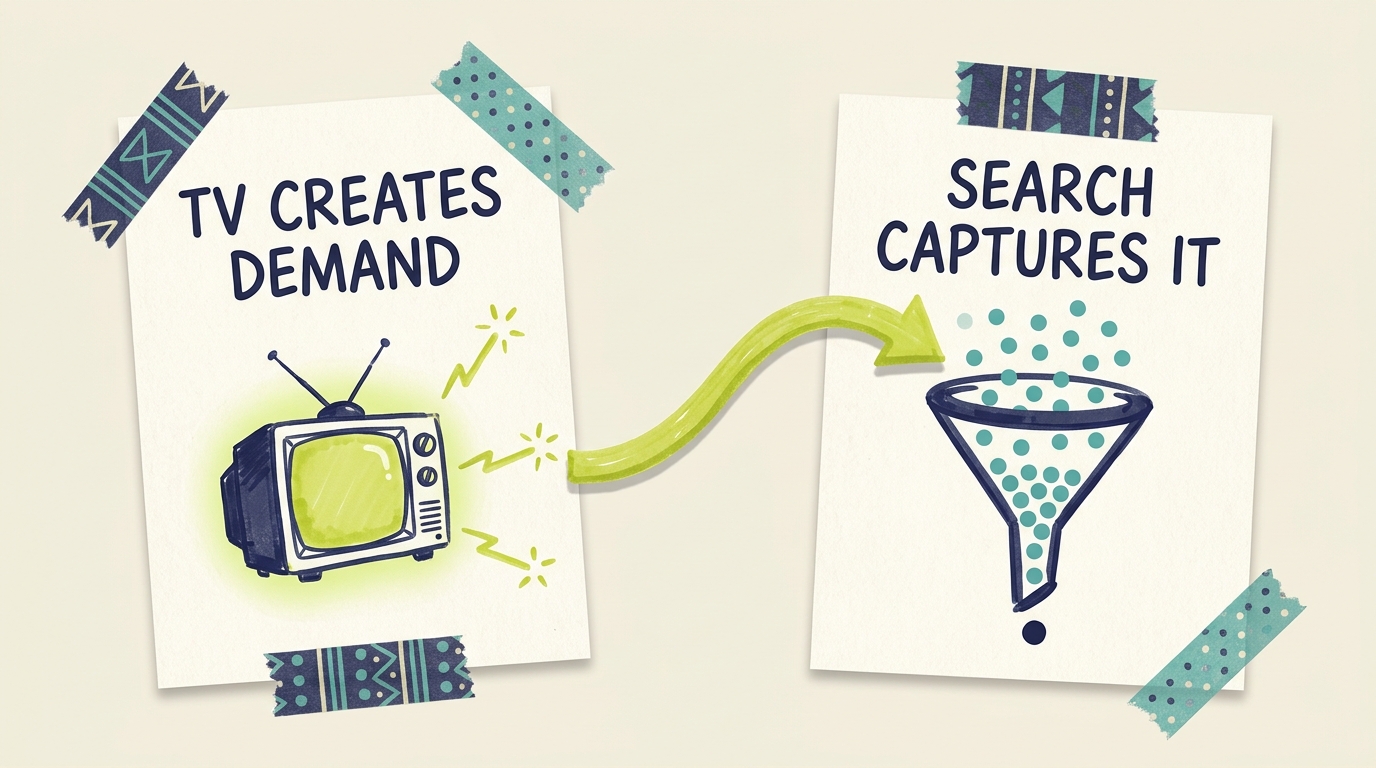
Search captures demand that already exists. When someone types "plumber near me" or your business name into Google, the demand is formed; search (organic or paid) determines who captures it. SEO is a contest for a fixed pool of existing intent.
TV creates demand that didn't exist yet. A homeowner watching streaming TV isn't searching for a plumber. But when their water heater fails next month, the brand they've seen twelve times on the household screen is the one they search for by name, and the one they recognize in the results.
The strategic consequence: SEO without demand creation fights harder and harder for the same searches, while TV without search presence creates demand that leaks to whoever ranks. Run together, TV expands the pool while search captures your share of it. That's the awareness and conversion logic in miniature, and it's why the channel-versus-channel budget debate misframes the decision; our guide to choosing advertising channels makes the broader version of this argument.
Effect 1: Branded search lift
The most direct, most measurable effect of a TV campaign on your search performance is branded search volume: more people typing your business name into Google.
This matters more than it first appears. Branded searches convert at the highest rate of any traffic you'll ever receive (the searcher already chose you; they're just finding the door), and you rank #1 for your own name essentially for free. Every increment of branded search volume a TV campaign generates is high-intent organic traffic that no amount of conventional SEO work could have produced, because the demand didn't exist until the ad created it.
Branded search lift is also your cleanest TV measurement tool. Pull up Search Console, mark the campaign start date, and watch the branded query trend over the following quarter. Campaigns at healthy frequency levels produce a visible, sustained climb in the zips they target; it's the recognition layer of measurement, and it doubles as proof to yourself that the compounding is happening.
Effect 2: Familiar brands win the click
The subtler effect operates on searches that have nothing to do with your name. When your business appears in results for a non-branded query ("dentist in [city]", "best HVAC company near me"), the searcher scans a list of strangers, with one exception: the brand they've seen on TV.
Familiarity changes click behavior. Searchers click names they recognize at meaningfully higher rates than names they don't, and the trust that television confers makes your listing the recognized one. You hold the same ranking position; you capture more of its traffic. The same recognition follows the click: visitors who arrive already trusting you bounce less, browse more, and convert more often, which is the user behavior every search engine is in the business of rewarding.
None of this requires the searcher to consciously remember your ad. Recognition works below recall; "I've seen this name somewhere" is enough to tilt the click.
Effect 3: Direct traffic and the attribution shadow
TV campaigns produce a population of people who skip search entirely: they type your URL directly, or they scan the QR code from the ad's end card. That's direct traffic, and it's the channel attribution forgets.
The practical consequence is an attribution shadow: when TV is working, your analytics show organic and direct channels "mysteriously" improving, and the credit lands everywhere except the campaign that caused it. Businesses misread this constantly, sometimes concluding the TV campaign did nothing while simultaneously celebrating their best organic quarter ever.
The fix is structural, not forensic. Evaluate TV at the quarter level against three signals together: branded search trend, direct traffic trend, and your intake question ("how did you hear about us?"). For viewers you want to re-engage digitally after the TV impression, retargeting strategies that bridge TV and digital close the loop the attribution tools can't see.
Effect 4: The downstream signal engine
The last effect arrives on a delay. TV campaigns produce customers, and customers produce the raw material organic visibility runs on: reviews, repeat visits, word-of-mouth mentions, people asking for you by name. A business with a growing review count and rising branded demand presents exactly the profile of a business that deserves to be found, to algorithms and to humans reading the results page.
This is a cycle, not a hack: more customers, more reviews and mentions, more visibility, more demand for the next TV flight to amplify. It's slow, it compounds, and it's the reason the TV-plus-search combination gets stronger every quarter it runs instead of plateauing.
Coordinating the two channels
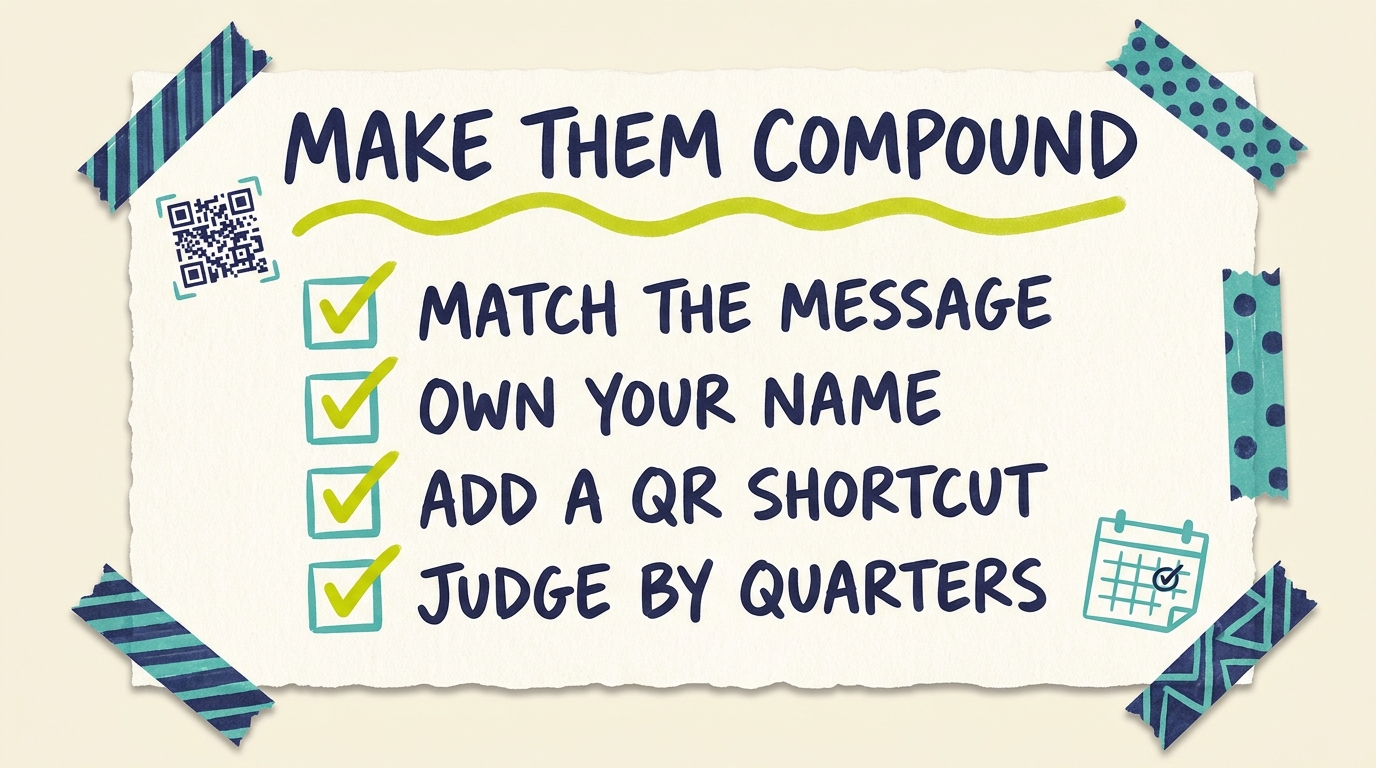
The compounding happens by default, but four practices amplify it:
Match the message. The promise in your TV ad should be the promise on your website. A viewer who searches you after seeing the ad and lands on a page that says something different loses the recognition thread. Same offer, same tone, same key phrase.
Be findable for your own name. Before the campaign starts, search your business name and make sure you own the results: your site first, your Google Business Profile accurate, your reviews visible. TV will send people to that search; check what they'll find.
Give the impatient a shortcut. The QR code on your end card serves the viewers who act immediately; clean URLs serve the ones who type. Both reduce the demand that leaks to a generic search where competitors wait.
Read the right metrics on the right clock. TV's search effects build over weeks and months, not days. Set the baseline before launch (branded query volume, direct sessions, review velocity), then review monthly and judge quarterly.
Where TV shows up in your organic metrics
The mistakes that break the compounding
Four failure patterns undo most TV-plus-search efforts, and all four are avoidable:
Judging TV by last-click attribution. If your analytics dashboard is the only scoreboard, TV will always look like it's losing, because its conversions arrive wearing organic and direct badges. Businesses that insist on per-click accounting cancel working campaigns at exactly the moment the branded search curve starts bending.
Launching TV onto a broken search presence. A campaign that drives thousands of branded searches to a results page with an unclaimed business profile, a three-year-old phone number, or a competitor's ad sitting above your listing is paying to generate demand and then donating it. Thirty minutes of cleanup before launch protects the entire investment.
Mismatched messaging. The TV ad promises same-day service; the website leads with your company history. The viewer who searched you came for the promise, doesn't find it, and leaves. Recognition is a thread; every handoff either continues it or cuts it.
Stopping at the first plateau. The search effects build in the second and third quarter of a steady campaign, after the novelty bump fades and before the review cycle matures. The businesses that pause "to evaluate" at month three reset the recognition clock and then evaluate a campaign they interrupted.
The common root is impatience with a compounding system. TV-plus-search is a quarters game, and every shortcut back to a weekly scoreboard breaks it.
A realistic six-month timeline
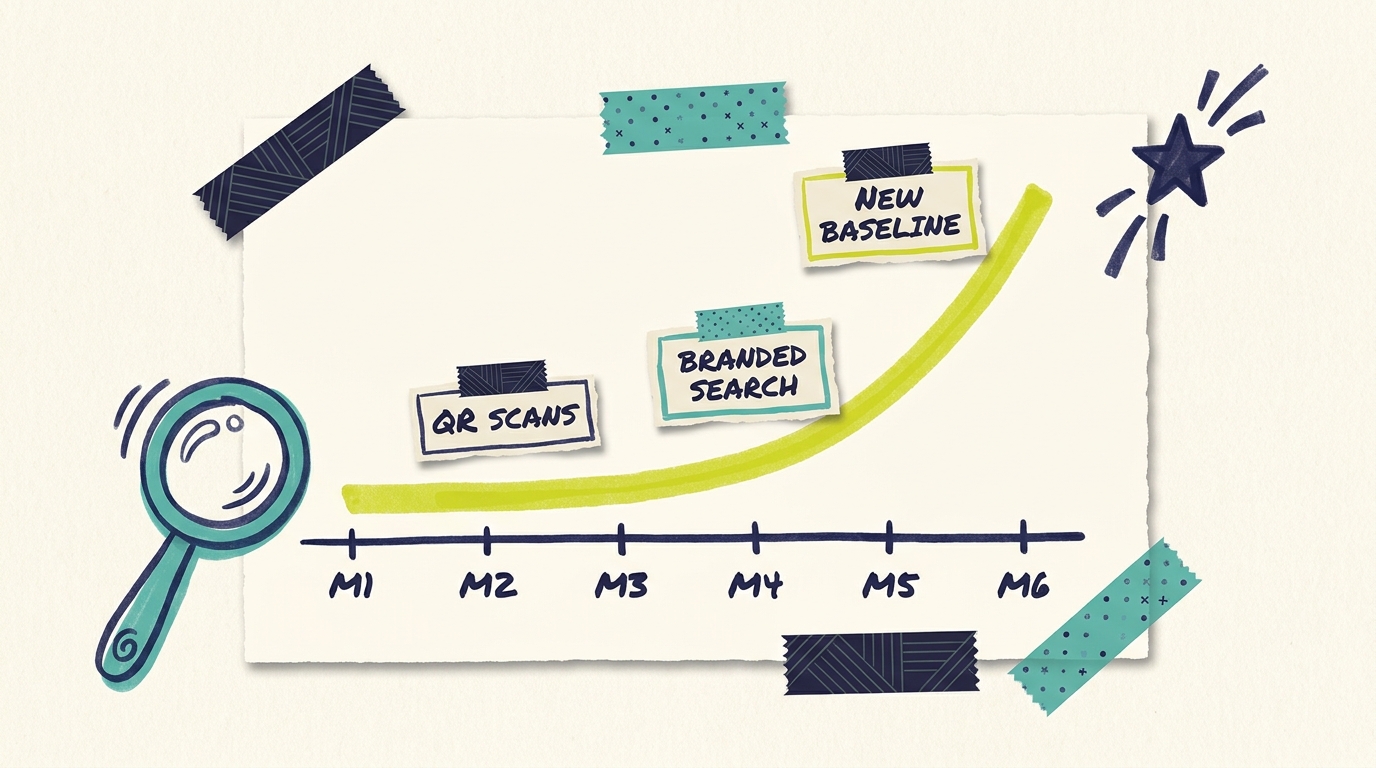
What a steady local TV campaign typically does to organic metrics, assuming healthy frequency in a tight geography:
Month 1: QR scans and a small direct-traffic bump from immediate actors. Branded search flat to slightly up. Nothing dramatic; recognition is still loading.
Months 2-3: Branded queries visibly above baseline in targeted zips. Click-through on existing rankings ticks up. The intake question starts returning "saw you on TV."
Months 4-6: Branded search establishes a new, higher baseline. Direct traffic holds its gain. Review velocity rises with customer volume, and the organic channel posts its best quarter, which is the moment to remember where the demand came from.
The pattern's speed varies with budget, market, and category, but the order rarely changes: direct response first, branded search second, behavioral and downstream effects third.
Common questions answered
Does TV advertising help SEO rankings?
Indirectly but genuinely. TV doesn't change anything on your website, but it changes how searchers behave around your brand: more branded searches, higher click-through on the rankings you already hold, better engagement after the click, and faster review accumulation. Those behavioral and reputation signals are the currency of organic visibility, and television generates them at scale.
Should a small business invest in TV advertising or SEO first?
If you're invisible for your own name, fix that first; TV sends people to a search you need to win. Beyond that, the question is less either-or than sequence: search captures existing demand, TV creates new demand, and the combination outperforms either alone. Many businesses run lean on both rather than maxing one, because the channels compound.
How do I measure TV's effect on my organic traffic?
Set baselines before launch: branded query volume in Search Console, direct sessions in analytics, and review velocity. Then compare quarterly trends in your targeted geography. The signature of a working TV campaign is branded search and direct traffic climbing together, confirmed by customers answering "saw you on TV" at intake.
Why did my organic traffic improve during my TV campaign?
That's the attribution shadow: TV-created demand arrives through search and direct channels, so analytics credits the arrival channel rather than the cause. It's one of the most common ways businesses underestimate a working TV campaign. Judge the campaign by the trend change after launch, not by the channel labels in your analytics.
How much does a TV campaign that supports search need to cost?
The same as any effective local CTV campaign: enough budget to sustain 3-6 monthly exposures per household across your core zips, which for most local businesses means a few hundred to a couple thousand dollars monthly at typical $15-35 CPMs. On Adwave, ad creation is free, generation takes about two minutes, and campaigns start from $50, so the search-lift experiment is cheap to run.
One engine, two intakes
The TV half takes minutes to start. See how Adwave works: generate your ad from your website, target the zips your customers live in, and watch your own name start trending up.