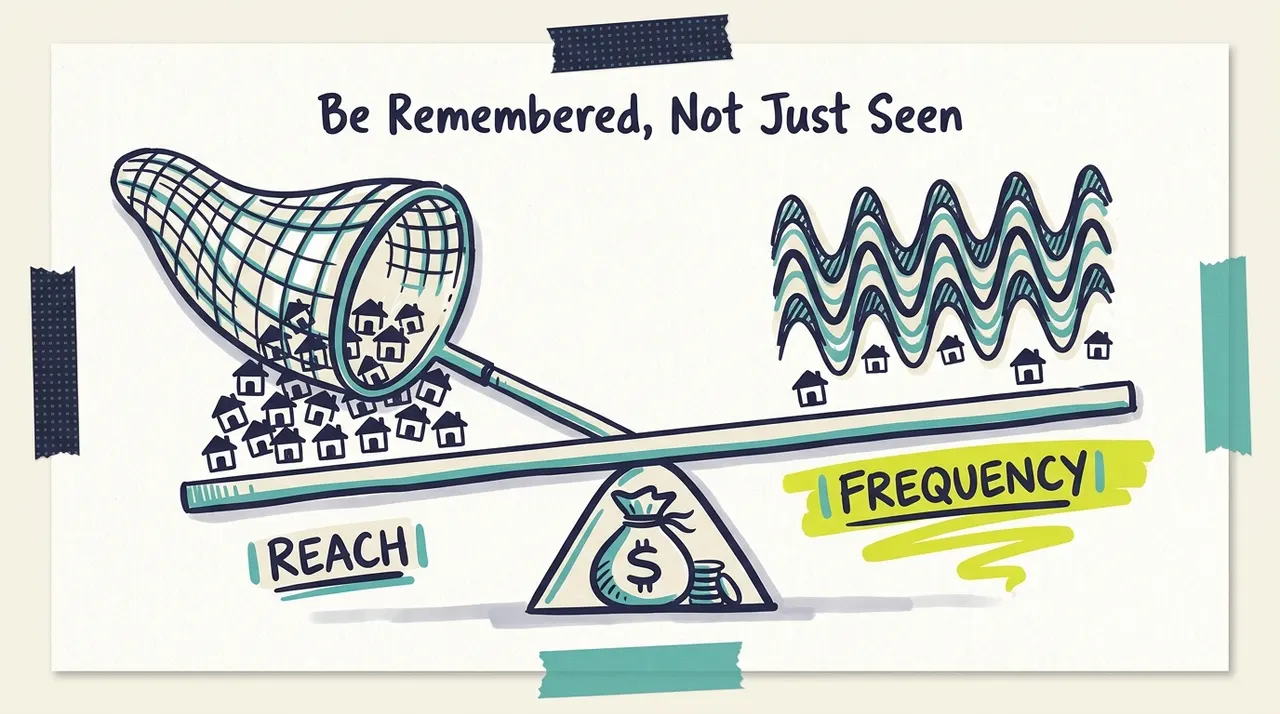
Every TV campaign, from a dentist's first $500 flight to a national brand's eight-figure quarter, is governed by the same unforgiving equation: your budget buys a fixed number of impressions, and you choose how to spend them. Spread them across many households (reach) or concentrate them on fewer households repeatedly (frequency). You can't maximize both. The campaigns that fail usually didn't pick; the campaigns that work picked deliberately.
This guide covers the tradeoff itself: when frequency should win, when reach should, the planning math with real numbers, and how to read your dashboard once the campaign is live. If you're looking for the narrower question of the ideal exposure count per viewer, our guide on how many times viewers should see your ad goes deep on that number; here we're deciding how to split the budget.
The iron equation
Strip away the jargon and TV planning is one line of arithmetic:
Budget = Households reached × Average frequency × Cost per impression
At a $25 CPM (the middle of CTV's typical $15-35 range, explained in our CPM guide), $1,000 buys 40,000 impressions. The choice is how to arrange them:
40,000 households, once each
10,000 households, four times each
4,000 households, ten times each
Same spend, radically different campaigns. The first is a whisper to a city; the last is a steady voice in a neighborhood. Neither is automatically right, but one of them is right for your situation, and the equation forces the honesty that wishful planning avoids: every household you add dilutes the repetition every other household gets.
Why frequency usually wins for small budgets
Advertising works through memory, and memory is built by repetition. A single exposure to an unfamiliar local business produces almost nothing durable: recognition research has shown for decades that meaningful recall starts around the third exposure and strengthens through several more. One impression is a rounding error in a viewer's day; seven impressions over a month is a familiar name.
That's why the default for small budgets is frequency-first: define the smallest audience that can sustain your business goal, and fund repetition against it before adding anyone else. A med spa that needs 30 new clients a quarter doesn't need 400,000 households to know it exists; it needs 15,000 of the right households to remember it. The classic small-budget failure runs the other way: targeting the whole metro "for efficiency," delivering 1.2 impressions per household, and concluding TV doesn't work. The budget wasn't too small; the audience was too big. Our minimum TV budget guide builds on exactly this logic.
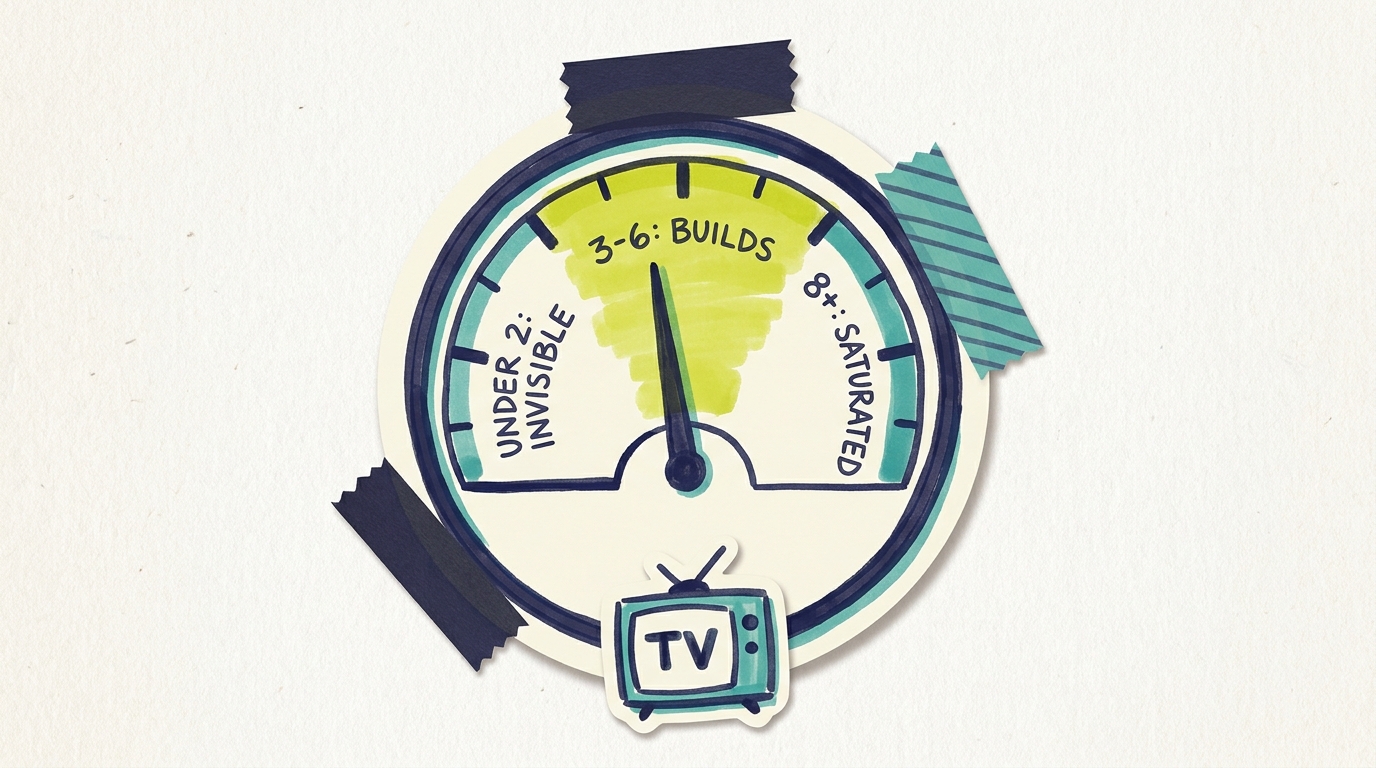
The frequency floor: plan for at least 3-4 exposures per household per month, and treat anything under 2 as a planning error to fix immediately, by shrinking geography, narrowing audience, or extending the flight.
The frequency ceiling: past roughly 8-10 monthly exposures, additional repetition buys little and can irritate. CTV platforms cap household frequency precisely so the equation's overflow goes to new households instead of the same living room's fifteenth impression.
When reach wins
Frequency-first is the default, not the law. Reach takes priority when time is short or the message is shallow:
Deadline events. A grand opening, a weekend sale, a festival: there's no "next month" for repetition to compound into. Reach everyone plausible once or twice before the date.
Already-famous advertisers. If your market already knows you (the 30-year furniture store, the dominant local franchise), each first impression to a new household is worth more than a seventh to a familiar one. Mature local brands drift reach-ward over time.
Simple, urgent messages. "We're hiring," "new location open," "school enrollment closes Friday" don't need memory-building; they need distribution.
Political close-windows. The final two weeks before an election are a reach race among voters who are finally paying attention; the frequency was for the months before.
The test: does the message need to be remembered later, or acted on now? Remembered-later is frequency. Acted-on-now is reach.
The planning math: three worked scenarios
The middle row is the most common real-world plan, and it's the one the dashboard exposes within weeks: lots of households "reached," nothing remembered, no calls. Run the division before you launch, not after.
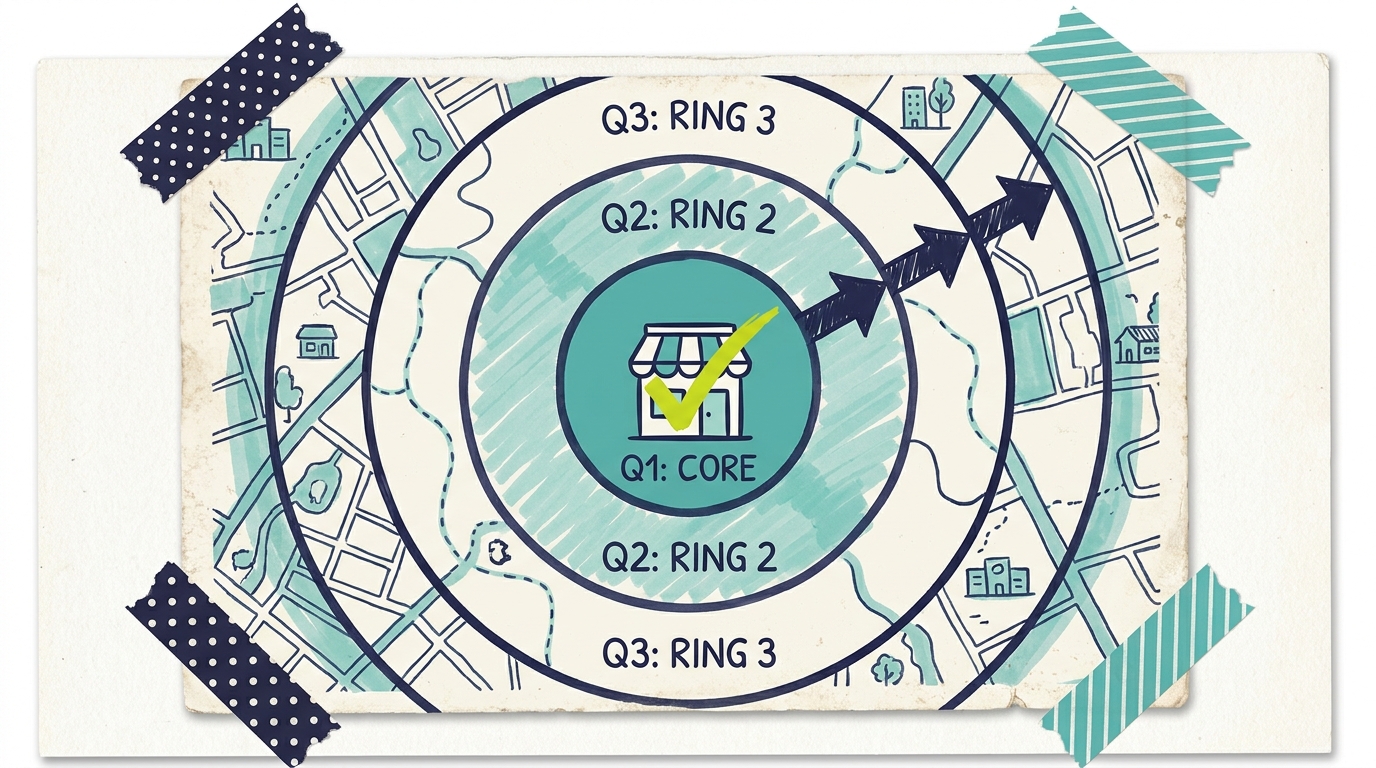
Sequencing: frequency first, then rings of reach
The tradeoff isn't permanent; it's a sequence. The proven pattern for growing local advertisers:
Quarter one: own a core. Smallest viable geography, frequency 4-6x, until branded search and "I've seen your ad" signals confirm the core knows you.
Quarter two onward: add a ring. Expand to adjacent zips while protecting the core's frequency. Your budget growth funds new reach; your original audience never drops below the floor.
Repeat. Each ring graduates from building to maintenance frequency (2-3x) as recognition stabilizes, freeing budget for the next ring.
This is how a $750/month campaign becomes a $3,000/month campaign that feels different in market, instead of the same thin layer painted over a bigger map. The expansion decision points are the same signals covered in our guide to TV campaign metrics worth tracking.
Plan your own split in five steps
Run this before any flight; it takes ten minutes:
Count your universe. How many households are in the geography that can realistically buy from you? Zip-code household counts are public; your platform shows them at setup. Write the number down.
Set your frequency target. Building recognition: 4-6 monthly. Maintaining it: 2-3. Deadline event: 1-2 across the event window.
Multiply. Universe × frequency = impressions needed. At your CPM, that's a dollar figure.
Compare to budget. If the budget covers it, launch. If it doesn't, you have exactly two honest options: shrink the universe (cut zips, tighten audience) or lengthen the timeline. Lowering the frequency target below the floor is the dishonest third option that feels like a compromise and performs like a cancellation.
Recheck monthly. Universe drift (added zips, broadened settings) is the silent frequency killer; thirty seconds with the dashboard math keeps the plan true.
A worked pass: a pool-service company wants 12,000 households at 5x monthly. That's 60,000 impressions, or $1,500 at a $25 CPM. Their budget is $1,000, so they cut the two farthest zips, drop the universe to 8,000 households, and fund 5x against the core, $1,000 on the nose. The two outer zips go on the expansion list for the quarter the budget grows. That's the whole discipline.
Flighting vs. always-on: the third dial
Time is the quiet third variable in the equation. The same monthly budget can run continuously or in concentrated bursts (flights), and the choice interacts with frequency:
Always-on suits businesses whose customers decide year-round (dentists, HVAC, restaurants). Steady moderate frequency keeps the memory warm so you're present whenever the need arrives. This is the default for most local services.
Flighting concentrates the same dollars into heavier frequency for shorter windows: four weeks on, four off. The bursts hit the recognition threshold faster; memory decays during the gaps but doesn't vanish. Flighting fits seasonal pushes, promotion windows, and budgets that can't sustain the frequency floor continuously, since it's better to be above the floor half the time than below it always.
Pulsing blends the two: a low continuous baseline with bursts layered onto demand peaks. Mature local campaigns usually evolve toward pulsing once the baseline recognition exists.
The error to avoid is unplanned flighting: stopping and starting based on monthly nerve instead of design. Every unplanned dark month spends some of the recognition you bought, and the restart repurchases it.
How CTV changed this tradeoff
Broadcast forced the reach-heavy shape: you bought the whole market whether you wanted it or not, and frequency against your actual prospects was a statistical accident. Three CTV mechanics turned the tradeoff into a controllable dial:
Geographic precision. Zip-level targeting means "smallest viable audience" is an actual setting, not a fantasy. The dentist can literally buy three zip codes.
Household frequency management. Delivery systems spread impressions across the target universe and cap per-household repetition, so your plan's average frequency is engineered rather than hoped for.
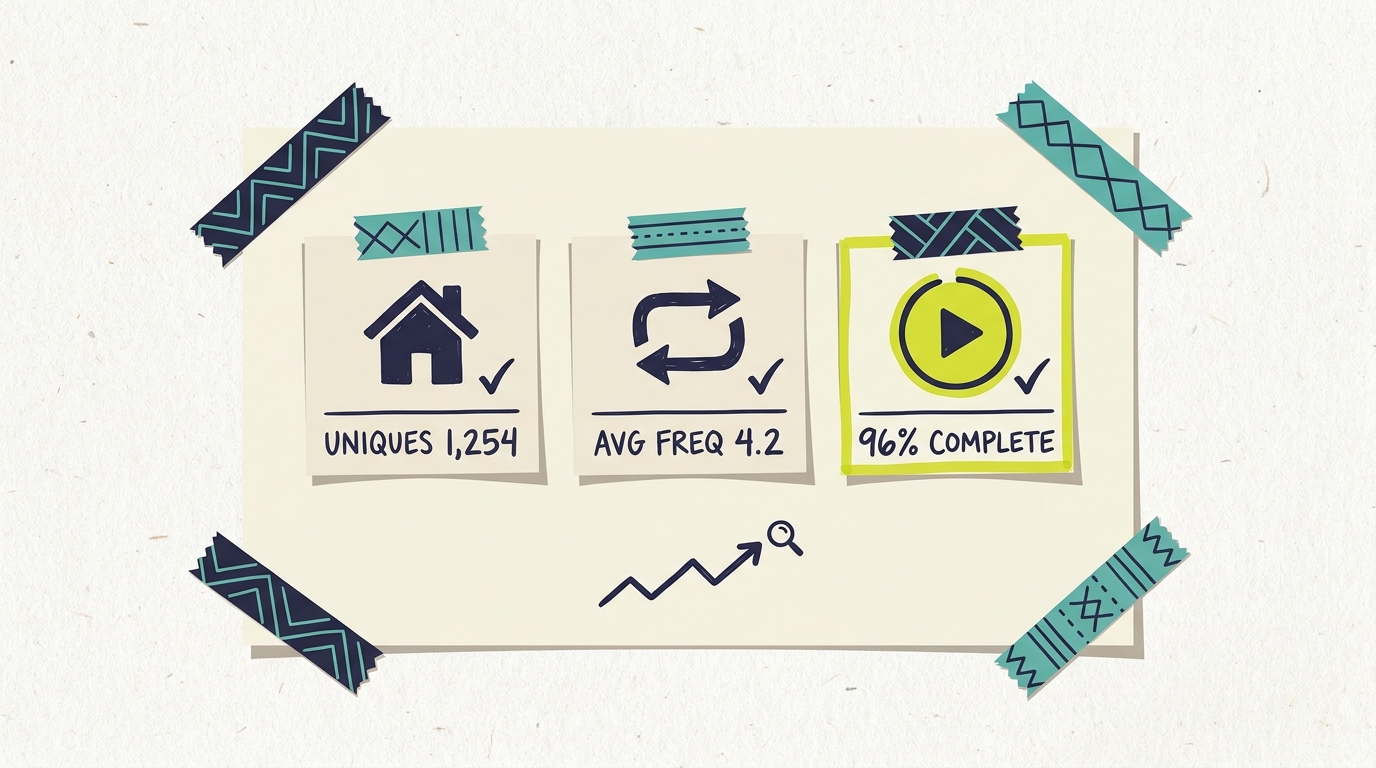
Real measurement. Unique households, average frequency, and completion rate are dashboard numbers, not panel estimates. The equation's variables are visible weekly, which makes correction cheap. The broader effectiveness picture is covered in how TV advertising effectiveness works.
The practical upshot: small advertisers can now run the textbook strategy (concentrated frequency, deliberate expansion) that only sophisticated media shops could execute in the broadcast era.
Reading the dashboard
Three numbers tell you whether your reach-frequency plan is working:
Unique households vs. plan. If uniques are far above plan, your targeting is leaking and frequency is starving. Tighten geography.
Average frequency vs. The floor. Below 3 monthly: shrink the audience or extend the flight. Above 8-10: you've saturated; widen a ring or bank the budget.
Completion rate as the quality check. High frequency with strong completion (90%+) means the creative is wearing well. Frequency with sagging completion means fatigue: swap creative before cutting frequency, since regeneration takes about two minutes on Adwave and fresh creative resets the wear-out clock.
Branded search and direct traffic remain the external confirmation: when the core audience's frequency crosses the recognition threshold, name searches in those zips rise. That's the signal to start planning the next ring.
Common questions answered
What's more important in TV advertising, reach or frequency?
For most small and growing advertisers, frequency, because an unfamiliar name needs repetition before any impression converts to memory. Reach takes priority only when the clock is short (events, sales, deadlines) or the brand is already widely known. The practical rule: be memorable somewhere before being visible everywhere.
What frequency should a TV campaign target?
Plan for 3-6 exposures per household per month while building recognition, with 3 as the working floor and 8-10 as the ceiling where returns flatten. Established brands can maintain on 2-3. The number matters less than the discipline of checking it: divide your monthly impressions by your targeted households before launch and fix any plan that lands under 2.
How do I increase frequency without more budget?
Shrink something else in the equation: fewer zip codes, a tighter audience definition, or a longer flight against the same total spend. Concentration is free. The reverse (more reach without budget) always costs frequency, which is why audience expansion should wait until the current core is demonstrably recognizing you.
Does the same ad get worn out at high frequency?
Yes, eventually; the signal is completion rate declining while frequency holds. The modern fix is cheap: rotate two or three creative variations so the household sees the brand repeatedly but not the identical spot, and replace the weakest variation monthly. With free, two-minute AI generation, creative rotation costs attention rather than money.
How do reach and frequency apply to a multi-location business?
Run the equation per location, not per brand. Each location's trade area is its own core needing floor-level frequency; pooling locations into one broad buy recreates the invisible-everywhere problem at chain scale. Shared creative with location tags keeps production trivial while the delivery stays concentrated where each store draws from.
Pick your households, then show up
See how Adwave works: set your zips, let household-level delivery manage the frequency, and watch the uniques and repetition numbers live from day one.