
You're probably in a familiar spot. A customer already trusts your business, they're ready to buy, and you can see an obvious next step that would help them get a better result. But the moment you bring up an add-on, an upgrade, or a related service, you worry you'll sound like every pushy salesperson people try to avoid.
That tension is real, especially for service-based SMBs. A dentist suggesting whitening after a cleaning, an auto shop recommending premium oil, a real estate agent offering staging support, or a local retailer bundling setup services all face the same problem. The offer may be useful, but if it lands wrong, it feels self-serving.
Learning how to upsell and cross-sell without feeling pushy comes down to one principle. Make the offer feel like guidance, not pressure. That means relevance, timing, clarity, and respect for the customer's control.
The Art of Helping Not Hard Selling
The businesses that do this well don't treat upselling as “getting more money out of the same customer.” They treat it as finishing the job properly. If a customer buys the base option but still misses the outcome they wanted, the sale wasn't complete.
That's why the best upsells and cross-sells often sound boring in the moment. They're calm. They're specific. They answer a need the customer already exposed in the conversation.
Solve the next problem, not your revenue problem
A pushy offer starts with your margin. A helpful offer starts with the customer's next obstacle.
If someone hires your landscaping company for a yard cleanup, the logical cross-sell isn't “what else can we sell?” It's “what will keep this yard from looking neglected again in six weeks?” That might be mulch refresh, irrigation checks, or a maintenance plan. Same customer, same relationship, better result.
Practical rule: If the add-on doesn't clearly improve the result of the original purchase, don't offer it.
This mindset also matters if you care about boosting customer lifetime value. Long-term value usually comes from repeat trust, not from squeezing one transaction as hard as possible.
Why customers reject good offers
Customers rarely reject upsells because they hate spending. They reject them because the offer creates one of four reactions:
Bad timing: They're still trying to decide on the main purchase.
Extra thinking: You added complexity when they wanted certainty.
Suspicion: The offer sounds like something you say to everyone.
Loss of control: They feel cornered instead of advised.
That last point gets ignored. People don't mind hearing a recommendation. They mind feeling trapped inside someone else's sales process.
A strong trust layer before any offer helps. Social proof, testimonials, and a clear buying experience lower resistance because the recommendation feels more credible. Businesses that want to tighten that trust signal can study examples of testimonial pages that build trust and drive sales, especially if their service requires a higher-commitment decision.
The better frame
Use this mental switch: “I'm not asking them to spend more. I'm helping them avoid an incomplete result.”
That frame changes your language. You stop saying, “Would you like to add this?” and start saying, “Most customers in your situation ask about this because it helps with X.”
That isn't hype. It's service.
Master the Psychology of a Good Offer
Most advice on upselling was built for carts, shelves, and checkout pop-ups. Service businesses work differently. The customer isn't buying a product alone. They're buying an outcome, relief, convenience, or confidence.
That changes the psychology. Price still matters, but context matters more.
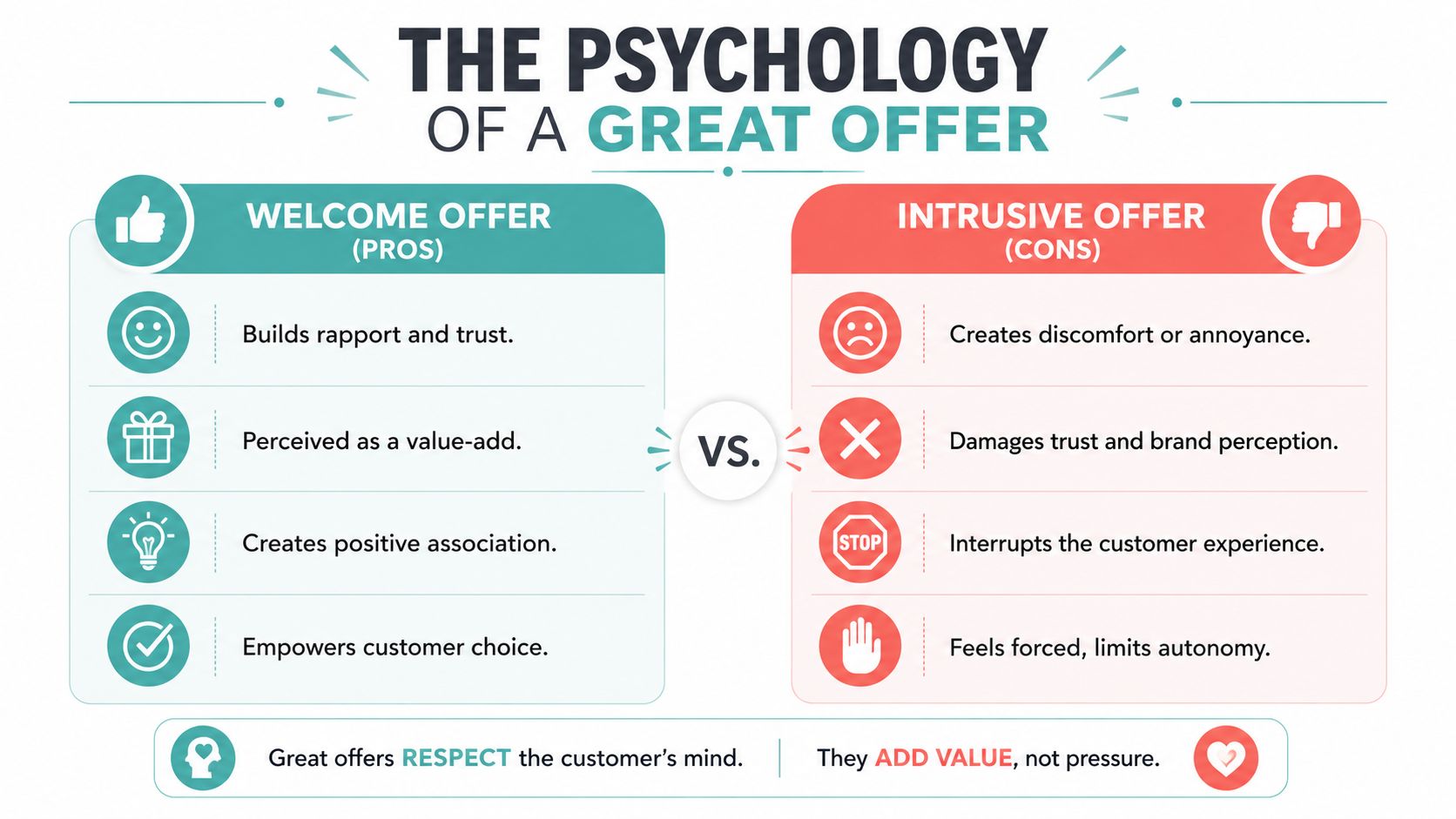
What makes an offer feel welcome
A welcome offer gives the customer a sense that you noticed something important. An intrusive offer feels automated, generic, or badly timed.
Here's the simplest comparison:
The difference often comes down to choice architecture. Give the customer an easy yes, but also an easy no. Don't hide the decline path. Don't bury the lower-cost option. Don't force them through a gauntlet of upgrades.
The cleanest upsell is one the customer can decline without friction and still feel respected.
Explain when an additional product would be useful. For example: “This may help when you start taking larger orders.”
Why the 25 percent rule often breaks in services
Retail advice often leans on the 25% rule, the idea that the upsell should stay close to the original spend. That can be sensible when customers compare similar items with visible prices.
It often fails in service businesses.
A 2025 Gartner study on B2B service expansion found that 68% of SMBs accept cross-sells exceeding 50% of the original spend when the offer is framed as solving a visible problem ( business.com coverage). That matters for real estate, legal, health, home services, and local advertising. If the add-on fixes a real risk, missed opportunity, or weak result, customers often judge it by usefulness rather than by a neat percentage threshold.
So don't ask, “Is this add-on too expensive relative to the first purchase?” Ask, “Does the customer clearly understand the problem this solves?”
Better framing for service-based SMBs
A service upsell works when it follows this sequence:
Name the problem already visible.
Tie the add-on to that problem.
Explain the practical outcome.
Leave room to decline.
Examples:
Weak framing: “Do you want our premium package?”
Better framing: “You mentioned you want faster turnaround. This add-on is the part that usually helps with that.”
Weak framing: “Can I upgrade you?”
Better framing: “If you want fewer revisions and clearer handoff, this option tends to fit better.”
Businesses that sell online services can sharpen that logic by looking at how to write product descriptions that sell. The same principle applies in speech and on service pages. Don't describe the feature first. Describe the problem it removes.
Perfect Your Timing and Technique
Even a useful offer fails when it shows up at the wrong moment. Customers need different things at different points in the buying process. If you push too early, you create resistance. If you wait too long, the opportunity passes.
The cadence matters as much as the message.
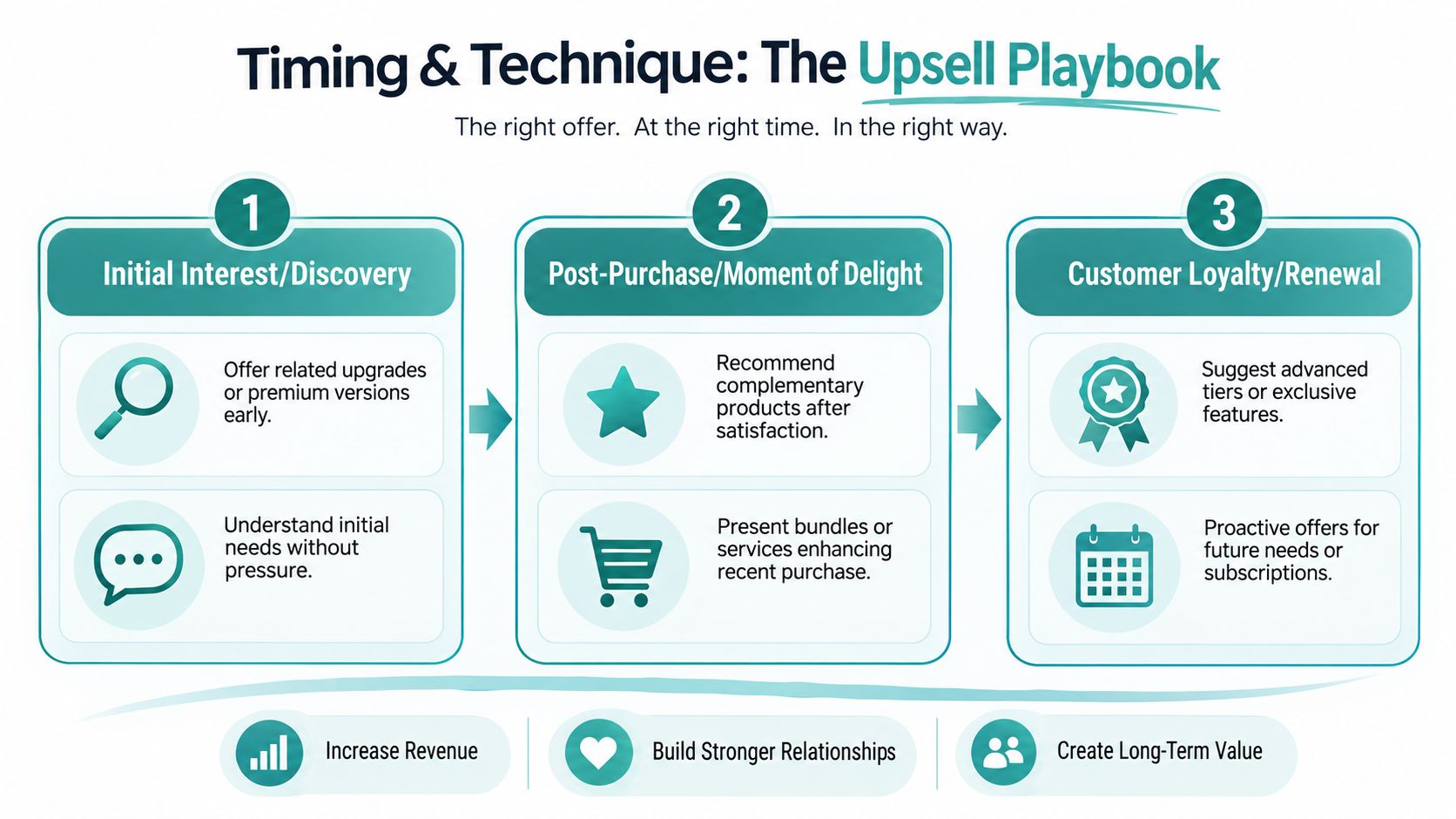
The three moments that work best
The strongest offers tend to appear in one of these windows:
Before purchase This works when the customer is still comparing options and trying to choose the right level of service. A version upgrade belongs here. So does a clearer package.
At commitment This is the point right before payment, signature, or booking. Complementary add-ons work here if they are simple and clearly connected to the main decision.
After purchase This is often the least pushy moment because the core decision is already complete. The customer can evaluate the add-on without feeling that their original purchase is at risk.
A useful benchmark comes from commerce data. The average upsell conversion rate in 2026 is substantively between 15% and 30%, and showing two or three highly relevant product suggestions instead of a cluttered list can increase revenue by up to 20% and profits by 30% ( Salesgenie). The lesson for SMBs is simple. Fewer, sharper suggestions beat a buffet of options.
Use techniques that reduce effort
Not every tactic fits every business. These usually travel well from one local SMB to another:
The complete package Bundle what the customer would likely need anyway. This works for home services, salons, wellness clinics, and B2B services.
The protective add-on Offer something that protects the value of the main purchase. Think warranty support, maintenance, setup, or monitoring.
The better result upgrade Present a higher tier when it clearly improves speed, durability, visibility, convenience, or outcomes.
Use this test: If the customer asks, “Why would I need that?” and your answer is fuzzy, the offer isn't ready.
Copy you can use
You don't need clever sales scripts. You need language that sounds grounded.
Try these starters:
Before purchase: “Based on what you said you want, this option is often chosen when speed and fewer follow-up issues are important.”
At commitment: “There's one add-on that pairs well with this because it handles the part customers usually forget.”
After purchase: “Now that you've got the main piece in place, the next thing that helps is this. If you'd rather keep it simple, no problem.”
For online sellers, post-purchase and recovery sequences can do a lot of this work without pressure. Tactically, some of the same thinking behind abandoned cart emails for recovering lost revenue also applies to service follow-ups. Be timely, specific, and low-drama.
Upselling in the Real World Examples for Your SMB
Theory gets clearer when you can hear the offer out loud. In local businesses, the right script often sounds less like selling and more like a professional noticing what's missing.
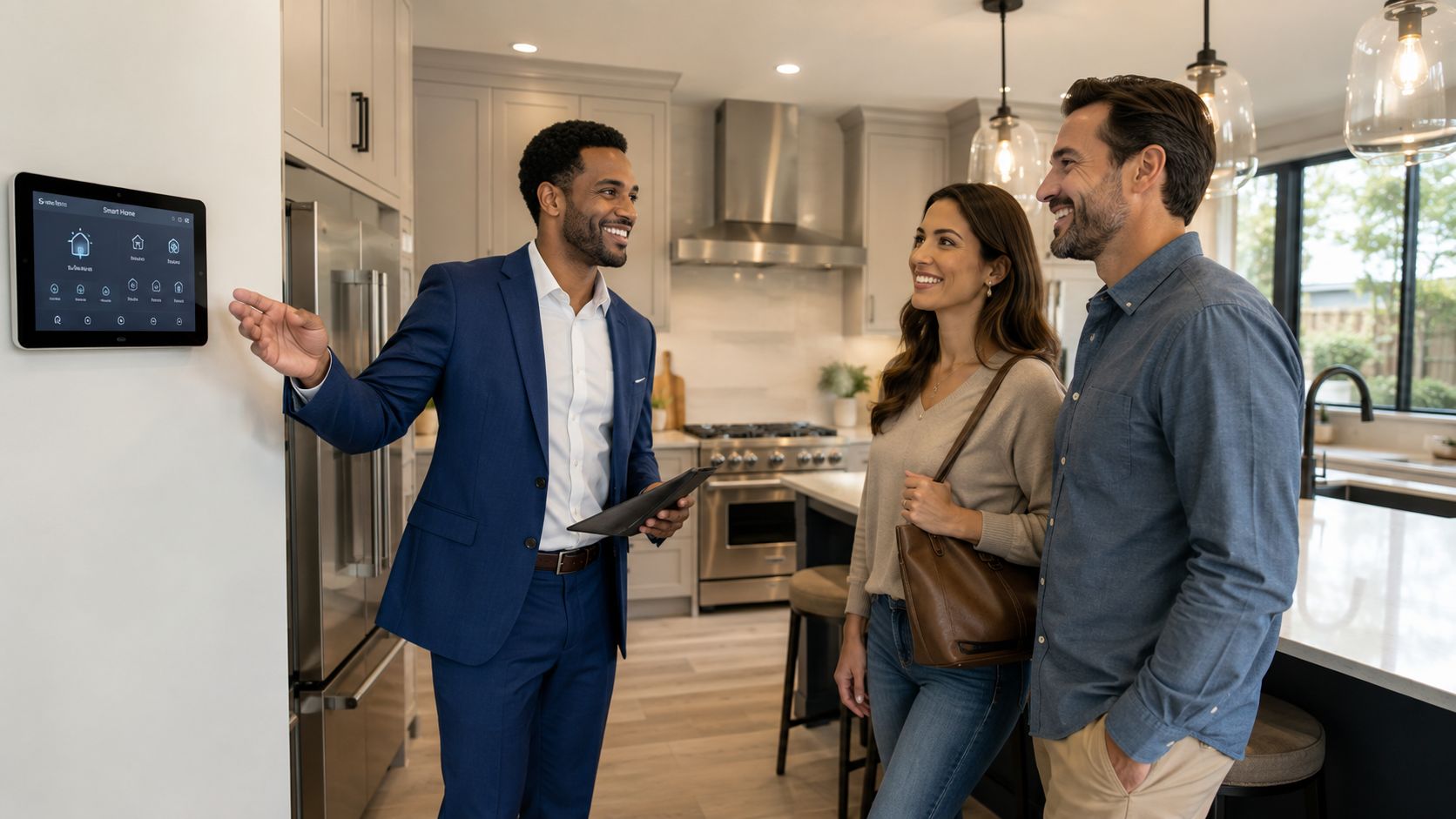
Real estate agents
A buyer loves a listing, but the space doesn't show perfectly online or in person. A staging consult or a property marketing upgrade can be valuable, but only if framed around the sale outcome.
Try this:
“You don't need to do this, but I want to mention it because it often helps a home present better in photos and showings. A staging consult can make the layout easier for buyers to picture. If you'd rather skip it, that's completely fine.”
That last sentence matters. Emerging 2024 to 2025 data from CustomerSuccess Collective shows that accounts given explicit permission to decline upsells experience 22% higher retention and 18% lower churn, as discussed by Lead The Way Marketing. The lesson is practical. When customers hear a real exit ramp, trust goes up.
Restaurants and hospitality
Servers often get trained to “upsell” in a way that sounds robotic. Customers can hear it instantly. The better approach is pairing and context.
A weak version: “Do you want to add wine?”
A better version: “The salmon pairs well with the Sauvignon Blanc if you want something lighter. If not, the dish stands on its own.”
That works because it gives guidance, not pressure. It also respects the customer's original choice.
Auto repair and service shops
Auto shops often have legitimate opportunities to recommend upgrades, but they can drift into fear-based language. That's where customers shut down.
A better script for premium synthetic oil: “You can stick with the standard option. The synthetic tends to make more sense for drivers who keep the car longer or put more stress on the engine with stop-and-go driving.”
Notice what's missing. No scare tactics. No guilt. No “you'd be crazy not to.” Just a clean match between use case and recommendation.
Retail and local e-commerce
In retail, the classic mistake is overloading the buyer with too many extras. A focused pairing works better.
Examples that feel natural:
Apparel: “If you're buying the blazer for events, this shirt usually completes the look better than a second jacket.”
Electronics: “If this is for travel, the carrying case is usually the one add-on people end up needing.”
Beauty: “If you want the treatment to last longer, this aftercare product is the useful one.”
The explicit no protocol
One habit separates ethical sellers from needy ones. They make “no” easy.
Use lines like these:
“If you want to keep it simple, the base option is still a solid choice.”
“This only makes sense if that problem matters to you.”
“Happy to leave it out if you'd rather start smaller.”
Those lines lower defensiveness because they return control to the customer. Ironically, that often makes the offer easier to accept.
Use Advertising to Prime Customers for Upsells
Upsells get easier when the customer already sees your business as credible. If they've never heard of you, every add-on looks like a revenue move. If they already trust your brand, the same recommendation can feel like expert guidance.
That's where brand-building channels matter. A customer who has seen your business in a polished environment tends to assign more authority to your recommendations later.
Why CTV changes the equation for SMBs
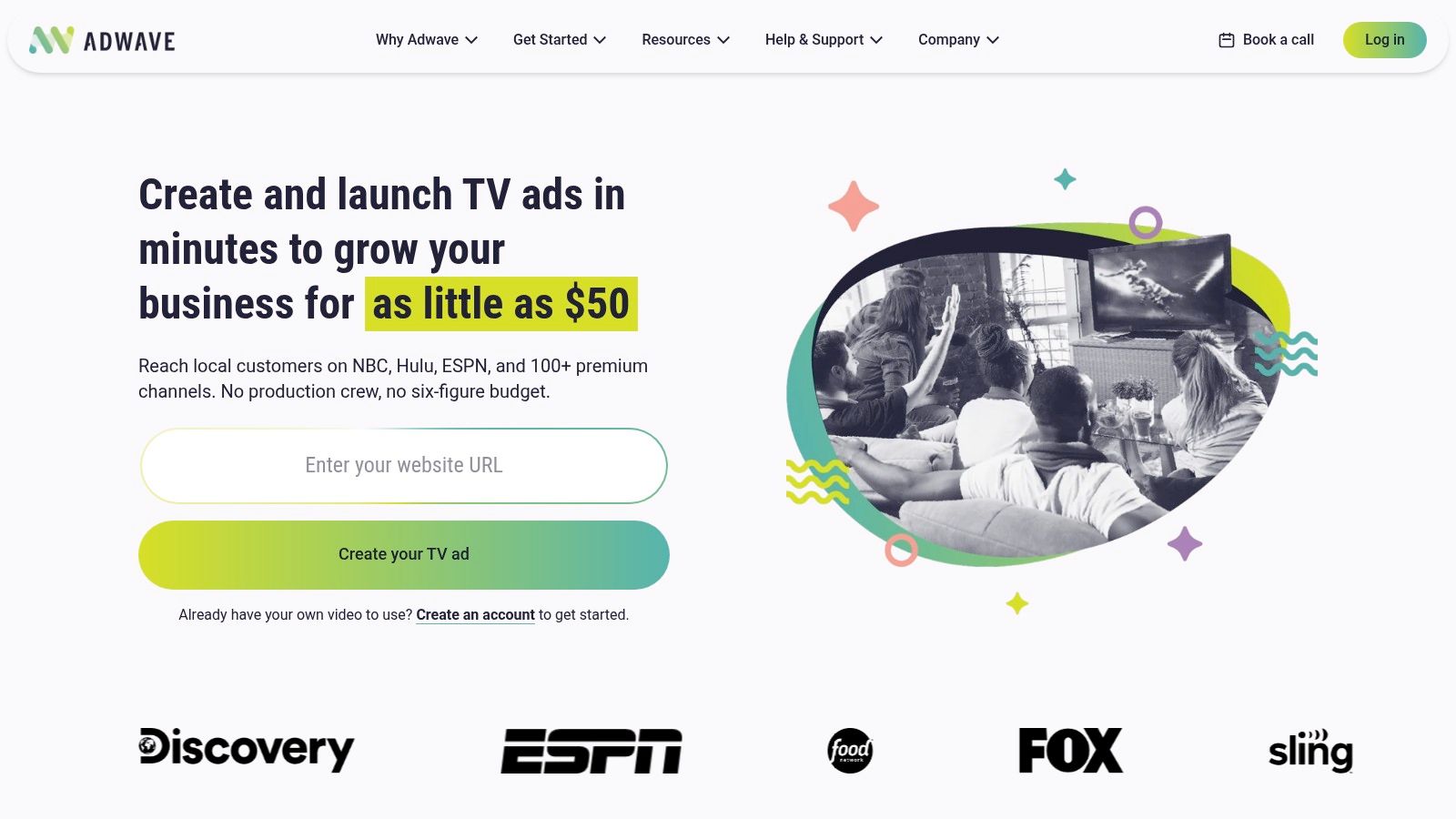
Connected TV used to feel out of reach for local businesses. That's changed. CTV ad spending reached $33 billion in 2025, representing a 27% increase from $26 billion in 2024, according to Adwave's SMB TV advertising report.
For service-based SMBs, that matters because trust is often built before the sales conversation starts. When a homeowner sees your HVAC company, dental practice, brokerage, or legal office on premium streaming inventory, your later recommendations don't arrive cold. They arrive with familiarity.
How trust supports higher-value offers
Customers usually resist add-ons for one of two reasons. They don't understand the value, or they don't trust the seller's motive. Advertising can't solve the first problem by itself, but it can soften the second.
That's why platforms like Adwave fit this topic well. Adwave gives small businesses a practical path to TV advertising without the old agency overhead. Its AI-powered workflow helps local brands create broadcast-ready ads quickly, distribute them on premium channels, and show up like established players. For SMB owners trying to sell outcomes, not just transactions, that trust halo helps later upsells feel earned.
A premium offer lands better when the customer already believes your business belongs in the premium category.
This is especially useful in real estate, health and wellness, home services, automotive, and professional services. In those categories, a stronger brand often raises acceptance of recommendations because customers assume your business has a process, not just a pitch.
Measure Success Without Annoying Customers
A lot of upsell programs look successful at first because revenue goes up. That isn't enough. If customers start returning products, declining renewals, or disengaging, the “win” was expensive.
The cleaner way to judge performance is to look at the offer and the relationship at the same time.
The metrics that matter
To keep the strategy customer-friendly, track conversion rate on offers, attach rate, AOV lift, and cohort Customer Lifetime Value over 90+ days, as outlined by Stacked Marketer's review of upsell and cross-sell effectiveness. If margin lift stays positive after returns and churn are factored in, the revenue is incremental.
That framework forces discipline. It stops you from celebrating a high take-rate on an offer that damages retention later.
What healthy performance looks like
Use this checklist regularly:
Offer conversion rate: Are people accepting because the offer fits, or because they feel boxed in?
Attach rate: Is the add-on becoming a natural companion to the main service?
AOV lift: Are order values rising without creating buyer's remorse?
CLV over time: Do customers who accept the add-on stay longer, buy again, and remain satisfied?
You should also watch softer signals. Complaints, cancellations, refund requests, awkward phone calls, and lower referral quality often show up before hard churn numbers do.
A practical complement to this is regular feedback collection. If you need a lightweight process, this guide on how to measure customer satisfaction without expensive tools is a useful place to start.
If customers accept the offer and feel better about the purchase afterward, you're upselling well. If they accept it and feel a little worse, you're borrowing revenue from the future.
If you want to build the trust that makes ethical upselling easier, Adwave is a smart choice. It helps small businesses create and launch polished TV ads without the usual production complexity, so you can strengthen brand credibility before the sales conversation even starts. When customers already know your name and associate it with a professional presence, your recommendations feel less like pressure and more like guidance.


